
IT Services & Managed Service Providers marketing
MSP marketing agency that wins contracts beyond referrals
IT services and MSP marketing that wins contracts from outside the owner’s network, in the week something breaks or a support contract comes up for renewal.

What people search
What people type, like “emergency it support [city]”
Something is broken right now
Small volume, fast conversion, and usually the quickest route to a first job.
- emergency it support [city]
- server down who to call
- ransomware recovery company
- locked out of microsoft 365 tenant
- it support same day [city]
Looking for a provider or switching
The core commercial searches. Low volume, high value, and mostly won in the map results.
- managed it services [city]
- it support for small business [city]
- outsourced it support cost per user
- how to switch it support providers
- managed service provider near me
Compliance and security driven
Set off by an insurer, an auditor or a customer. Almost nobody in the sector competes here.
- soc 2 readiness consultant
- iso 27001 help for small business
- cyber essentials certification support
- security assessment for cyber insurance renewal
- virtual ciso services
Sector and stack specific
Where generalist competitors can’t follow. Often the most valuable contracts you’ll win.
- it support for law firms [city]
- hipaa compliant it provider
- it support for manufacturing
- azure migration partner [city]
- it support for accountancy practices
These are example searches from keyword research and public search data. Before we suggest anything, we check how often people search for them in your area.
Common problems
Paying for IT services marketing that doesn't work?
IT services isn’t a volume business. Don’t market it like one. In most regions, the realistic market is a few thousand companies, and only a few hundred are the right size and sector to be worth winning.
Demand from that list shows up in two ways. Something breaks, or a contract comes up for renewal. Good IT services marketing makes sure you’re visible and credible in both moments.
- Your website says the same four things as every competitor.
- Proactive support, 24/7 monitoring, a trusted partner, taking IT off your plate. When four local providers describe themselves the same way, the buyer can only choose on price or a friend’s recommendation. You control neither. Stand out with specifics: the company sizes you serve, the sectors you know, the tools you standardise on, and the work you turn down.
- The pipeline is the owner, and the owner is busy.
- Referrals and relationships work, and that is what makes them risky. They grow only as fast as one person’s calendar. They stop when that person moves into delivery, falls ill or wants to sell. Keep the referrals and add a second source that runs without the founder. Give referrers a credible page to point people to, and more of their introductions will turn into contracts.
- Marketing is chasing anyone who owns a computer.
- A five-person consultancy and a two-hundred-seat manufacturer are very different customers with very different economics. A campaign aimed at businesses in general reaches the smaller ones, because there are more of them. Without a stated seat range, sector focus and area, your ads and your website copy drift to the least profitable part of the market.
- Security questionnaires are treated as sales admin.
- Insurers, large customers and auditors now push security requirements down to small businesses. They arrive as questionnaires that stall deals for weeks. Publish your own security posture, list the frameworks you work to and explain what a readiness project involves. That answers procurement early, and it wins searches nobody else in the sector is chasing.
- Enquiries want a price for something they can’t describe.
- A business with no IT staff often doesn’t know its seat count, its licences or what it pays today. If your site offers only a contact form, that confusion lands in a sales call and eats an hour. Explain how you price, what a typical agreement includes and what you need to quote. Most of the qualifying is then done before anyone picks up the phone.
How they choose
Why they pick one business over another
Know how they choose and you know where to show up.
- The search starts with a trigger: an outage, a security incident, a failed audit, an insurance requirement, the IT person resigning, or a renewal date. Whoever looks visible and credible that week makes the shortlist.
- They ask someone they know first. Then they use your website to check you look like a proper company. Named engineers, a real address and current accreditations back up the recommendation. A slick site with no people on it undermines a referral.
- Vendor accreditations and partner tiers work as shortlisting filters, even when the buyer doesn’t know what they mean. Buyers read them as independent proof, which reassures anyone who can’t judge technical skill themselves.
- Knowing the sector beats general skill. A firm in a regulated sector wants a provider who has handled its compliance rules before. It will often choose that provider over a stronger generalist.
- Contract terms get more scrutiny than the technology. Term length, notice period, what happens when they leave, whether hardware and licences are included, and how extra work is billed are where deals are won or lost.
- They want someone who can turn up in person. Even when nearly all support is remote, many buyers expect an engineer on site within a few hours. That is why national providers lose regional deals.
Where the enquiry came from
Four triggers, and only one of them is predictable
Nobody wakes up wanting IT support. Something happens first. What happened decides how fast the deal moves and how much of it you can plan for.
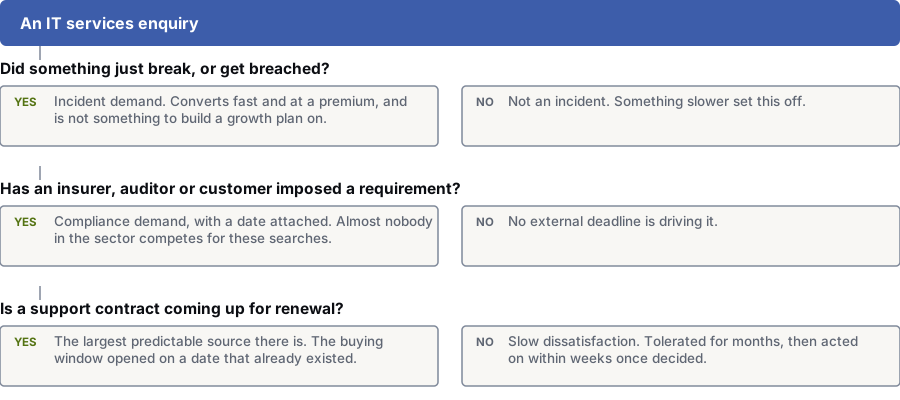
Did something just break, or get breached?
Yes: Incident demand. It converts fast and at a premium. Don’t build a growth plan on it.
No: Not an incident. Something slower set this off.
Has an insurer, auditor or customer imposed a requirement?
Yes: Compliance demand, with a deadline. Almost nobody in the sector competes for these searches.
No: No outside deadline is driving it.
Is a support contract coming up for renewal?
Yes: The biggest predictable source. The buying window opens on a date that already exists.
No: Slow frustration. Put up with for months, then acted on within weeks.
Where to spend
Why local SEO comes before B2B search
In the order we'd put them. Start at the top.
Visibility across the area you can serve
Map results decide a large share of provider searches, and you can win them in a way you can’t win national rankings. That takes a well-built Google Business Profile, consistent details everywhere, a steady flow of new reviews, and a page for each area that is about that place.
Pages built around the reason people start looking
Nobody wants managed services for their own sake. They want a security questionnaire answered, an audit passed, a migration done or an incident fixed. Pages built around those triggers, and around the sectors you serve, reach buyers earlier. They face little competition and give referrers something specific to share.
A site that shows you’re an established company
Show named engineers with photos, a real address, current accreditations and response times in plain words. Explain your contract terms and how you price. This buyer is checking whether you’re big and stable enough to run their whole IT setup. Most provider websites answer none of those questions.
Reviews and references, because this is still a referral market
A buyer who got a recommendation looks for confirmation, and finds your reviews. We help you ask for reviews after every successful project and organise references by sector and company size.
Measuring results
How you'll know it's working
These numbers show if your marketing brings in customers. Website visits alone don't.
- Qualified discovery calls with companies inside your seat range and service area
- Contracts signed and monthly recurring revenue added, kept separate from project work
- Pipeline split by trigger: incident, renewal, compliance requirement or referral
- Average seats per contract and revenue per seat, tracked over time
- Where referrals come from, so that pipeline is visible and not assumed
- Time from first contact to signed agreement, by deal type
- Win rate against the competitors you meet in deals
- How often a security questionnaire delays a deal, and by how long
Your website
Is your website losing you work?
- A clear statement of who you serve: seat range, area and the sectors you know well
- A security and compliance page listing the frameworks you work to, certifications held and your own insurance
- Response and fix times described in words a non-technical owner can check
- Contract terms explained: length, notice period, what onboarding involves and what happens if they leave
- Named engineers and leaders with photos, plus a real address that shows up on a map
- How your pricing works, even if you don’t publish the numbers, including what falls outside the agreement
- A visible emergency contact for the buyer whose systems are down while they read
- Sector pages for the industries you want, covering the rules those businesses must follow
The rules
Claims to avoid
Accreditation and certification claims must be exactly right. Holding a certification, working to a framework without one, and having an audit in progress are three different things. Buyers in this sector increasingly check. Vendor partner programmes also have their own rules on badges and logos, including which tier you may show and for how long.
Support contracts often stop you naming clients. Many agreements forbid disclosing the relationship, and security-minded clients may prefer nobody knows who runs their systems. Get written permission before you publish a name. Often the better option is to describe the client by sector and size.
Procurement documents come with their own obligations. Questionnaire answers, penetration test summaries and architecture documents are usually shared in confidence. Reusing them in marketing without permission is a breach, even when nothing sensitive is named.
If you advertise regulated or safety-related work, or handle personal data for clients in the EU, the UK, Canada or the UAE, your website claims interact with your contracts and data protection duties. We flag anything that looks overstated. You still confirm what you’re allowed to claim.
Sources
Primary sources for these rules
Each rule above, linked to the body that publishes it. Which ones apply depends on where you work. Rules change, so check the latest version.
- A processor handling personal data for a client must work under a contract with prescribed terms.
- GDPR Article 28
- Source: EU — Regulation (EU) 2016/679, Art. 28 (EUR-Lex)
- An organisation stays responsible for personal data it passes to a third party for processing.
- PIPEDA Principle 4.1.3
- Source: Canada — PIPEDA, Schedule 1, clause 4.1.3
Questions
IT services marketing questions
Our market is a few towns. Is there enough search volume to bother?
Not enough to build a pipeline on search alone, and that is the right starting assumption. In a mid-sized region, provider searches often add up to a few hundred a month across everything.
It is still worth it, because one contract can bring years of recurring revenue. A realistic plan combines that small, high-intent search demand with steady coverage of a target list. Compliance and sector pages then reach buyers before they search at all.
How do we look different when every MSP offers the same services?
Be specific about who you’re for. State a seat range, two or three sectors you know, the tools you standardise on and the work you decline. That sets you apart more than any branding exercise.
It can feel like turning business away, and it is. In return, a buyer in your chosen segment recognises themselves straight away. That is worth far more than being a possible option for everyone.
Should we publish our pricing?
Publish how you price, even if you don’t publish the numbers. Explain that you charge per user per month, what the agreement includes, what falls outside it, and what you need to give a quote.
That alone filters out businesses too small to be profitable, and it saves your team many wasted calls. Some providers go further and publish a starting price. That works well when your target customers are similar enough for a range to mean something.
Can marketing help with security questionnaires and audits?
Yes. It can turn them from an obstacle into a source of leads. Publish your own security posture, the frameworks you work to and a clear explanation of what a readiness project involves. That answers much of procurement before it starts.
It also reaches buyers who search for the requirement by name and not for IT support at all. They search under deadline pressure. In most regions few providers compete for those searches, and they tend to bring in better clients than a generic support search.
We get all our work from referrals. Why change anything?
Keep the referrals. They’re the best pipeline in this sector and we wouldn’t try to replace them. The trouble is that they’re limited by one person’s network and stop when that person is unavailable.
The practical goal is a second source that runs without the founder, plus a website that helps referrals convert. A recommendation followed by a site that shows a solid, established company closes more often than one followed by a page of adjectives.
See how your site stacks up
Start with the free checkup. It shows what to fix first on your website, with no sign-up. Want the full plan for your IT services business? Book a call, and we'll look at your market, your competitors and the searches that bring in customers.
Prefer to talk it over? Book a free call
Your BOOSTD score improves within 90 days, or your next month is free. After 6 months, more traffic or leads, or we keep working free (up to 6 free months in any 12 months). Read our guarantee
References
Sources for MSP marketing agency
The official documents and research this page is based on. Platform rules change, so check the source before you act on a detail.
Related
More on IT services marketing
Guides for IT services
Other technology businesses
Industries close to IT services
Last updated · Published by Zubair Afzal, responsible editor