
Freight & Logistics marketing
Freight company marketing that fills the lanes you already run
Freight company marketing for carriers, brokers and forwarders that fills your strongest lanes, with shippers who compare reliability as well as rate.

Common problems
What's holding your freight and logistics marketing back?
A freight company doesn't just sell transport. It sells moving one specific thing between two specific places, on a date, again and again, without the shipper having to think about it.
So your product is a set of lanes, not a list of services. Freight company marketing puts the routes, equipment and commodities you are strongest on in front of the people who ship them, and makes you easy to reach in the hour someone has a problem.
- Capacity is perishable and the marketing plan is annual.
- A truck coming back empty is lost margin no future quarter can recover, and a backhaul gap on a weekly route repeats. You need marketing you can aim quickly: paid search on one lane, a landing page for one equipment type, an outreach list of shippers moving freight in the direction you already go.
- The website lists every service and therefore wins none of them.
- Truckload, LTL, refrigerated, flatbed, drayage, air, ocean and warehousing on one page tells a shipper with a specific problem nothing. A planner searching for a reefer out of a particular region finds no match, because the site never names a region, commodity or equipment type. Listing everything looks like no depth, and depth is what they buy.
- The urgent enquiries arrive by phone and nobody counts them.
- Spot freight is a phone business: a load, a problem, a deadline, and three numbers called until one answers. Untracked, your fastest revenue is invisible in every report and budget drifts to whatever produced a form fill. Track calls, record the outcome and note the lane.
- Tenders are treated as a paperwork exercise.
- By the time an RFP arrives, the shipper usually knows who they hope will win. They have looked you up, checked public safety and licensing data, read your reviews and judged whether you are serious. A two-week tender reply can't undo six months of being invisible.
- Rate is the only thing anybody is arguing about.
- Usually because nothing else was shown. If a shipper can't see your on-time record, tender acceptance, claims history, equipment availability or how fast you answer at four in the morning, price is all that's left to compare. Publish service evidence you will stand behind; it moves the conversation off rate and filters out cheapest-only shippers.
How they choose
How the shortlist gets made
Know how they choose and you know where to show up.
- Lane coverage and density come first. A shipper wants to know if you can cover this origin and destination repeatedly, with equipment free in the week they need it, not whether your map has their state coloured in.
- Evidence of reliability beats promises. Transport buyers want on-time delivery, tender acceptance, claims ratio and dwell times, and where a market publishes carrier safety or licensing data, procurement looks it up.
- Equipment and accreditations must match the freight exactly. Temperature range, food-grade certification, hazardous goods approval, oversize permits, bonded status and tail-lifts are yes-or-no filters.
- Shipment visibility is expected. Tracking, proof-of-delivery photos and EDI or API connection to the shipper's system are the baseline for larger accounts.
- Liability terms get read more carefully than the marketing. Experienced shippers focus on cargo liability limits, insurance cover, the conventions for each mode, and what happens when a claim is filed.
- Someone has to answer the phone and fix the problem. Taking calls out of hours sets you apart, because most enquiries arrive at awkward times.
Two streams, two clocks
How contract and spot freight get awarded, months ahead or same day
Contract and spot freight are both freight, but winning them has nothing in common. Judge both on one cost per load and you can't see which one is filling your lanes.
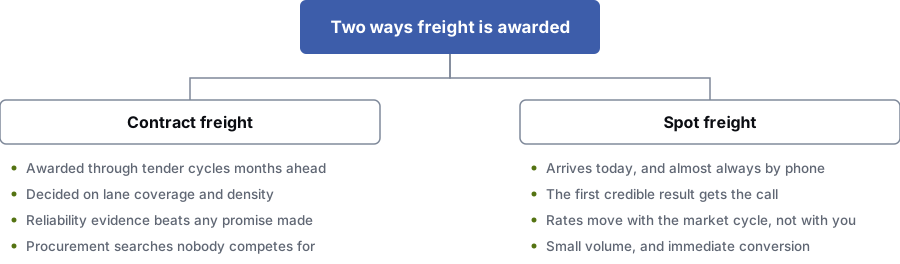
Contract freight
- Awarded through tenders months ahead
- Decided on lane coverage and density
- Proven reliability beats any promise
- Procurement searches nobody competes for
Spot freight
- Arrives today, almost always by phone
- The first credible result gets the call
- Rates move with the market, not with you
- Small volume, and it books at once
Where to spend
Start with B2B search, then local SEO
In the order we'd put them. Start at the top.
Pages for each lane, equipment type and commodity
Build pages around the routes you run, the equipment you own and the commodities you handle. They match how transport planners search, face far less competition than broad terms, and give sales something specific to share when a shipper asks what you are strong on.
Show up around the terminals and ports you work from
Drayage, cross-dock, warehousing and same-day work are searched with a place name, and map results take much of that demand. A proper profile for each terminal, with accurate hours, gate details and photos, wins enquiries that never reach a national result.
A site built for a phone call and a tracking number
A phone number with stated hours, including out-of-hours dispatch. A quote form asking for pickup, delivery, commodity, weight, dimensions and date. Shipment tracking without emailing anyone. Published licensing and insurance details. Most freight websites are brochures for a business that runs on urgency.
A track record that holds up when buyers search your name
A transport buyer looks you up before a tender and finds reviews from drivers and shippers, public safety and licensing records where published, and forum threads. Keep that footprint current and reply properly to complaints; it decides shortlists you never knew you were on.
What people search
Searches like “freight broker for ltl”
Urgent and spot enquiries
Small volume, books at once, almost always by phone. The searcher has a problem today and will call the first credible result.
- freight broker for ltl
- hot shot trucking near me
- same day freight toronto to montreal
- who can move an oversize load in texas
- expedited refrigerated load coverage
Shippers looking for a carrier or partner
The core commercial searches. Combinations of lane, equipment and commodity, searched by transport planners and logistics managers.
- ltl carrier from chicago to atlanta
- flatbed carrier serving western canada
- temperature controlled trucking company uk
- drayage company for port of felixstowe
- customs broker and freight forwarder vancouver
Procurement and evaluation
Made during a tender or supplier review. Educational, and carriers hardly ever compete for them.
- freight rfp template for shippers
- how to compare freight carriers on service
- cargo insurance versus carrier liability limits
- tms integration with carrier api
Compliance and operational requirements
A hard-filter search. The shipper has a requirement and will only look at operators who meet it.
- hazmat certified carrier ontario
- bonded warehouse near heathrow
- food grade trucking requirements
- gdp compliant pharmaceutical transport
These are example searches from keyword research and public search data. Before we suggest anything, we check how often people search for them in your area.
Your website
Your website checklist
- Lane and coverage pages naming real origins, destinations, terminals and frequencies
- An equipment list with capacities, dimensions, temperature ranges and special permits held
- Operating authority, licence and registration numbers published, with insurance and liability limits stated
- Tracking and proof of delivery available without phoning or emailing an account manager
- A clear phone number with stated hours, including how out-of-hours dispatch works
- A quote form asking for pickup, delivery, commodity, weight, dimensions, equipment and date
- Integration details: which EDI standards, which APIs, and which transport management systems you already connect to
- A clear statement on every relevant page of whether you move the freight yourself or arrange it
Measuring results
The figures worth watching
These numbers show if your marketing brings in customers. Website visits alone don't.
- Quote requests by lane, equipment type and commodity
- Quote to booking rate, and how long it takes to send a rate
- Lane use and empty miles on the routes your marketing targeted
- Tracked calls answered, calls missed by hour, and the freight value behind them
- Tenders you are invited to and your win rate, tracked apart from spot business
- Revenue per loaded mile from customers won in the period
- New shippers who book a second load, the true sign of a won account
- Claims ratio on new business, because unprofitable freight can look like growth for two quarters
The rules
Claims to avoid
Claims about operating authority and licences can be checked, and will be. Carrier and broker registration numbers, forwarder licences, customs broker status and international operator permits sit on public registers in many markets, and claiming authorisation outside your current registration is both a marketing and a regulatory problem. Requirements vary a lot between jurisdictions.
Cargo liability is not insurance, and advertising them as the same thing misleads shippers. Liability is usually limited by weight or unit, and the conventions for road, air and sea differ by mode and route. A shipper who reads "fully insured" and finds a limit after a loss has a fair complaint. State the cover, the limits and what extra protection is available.
Several markets require you to say whether you are a carrier moving freight on your own authority or a broker arranging it with someone else. Presenting brokered capacity as your own fleet is a misrepresentation with contract and regulatory consequences, and shippers increasingly ask directly in tenders.
Performance and safety data is public in some jurisdictions, and quoting it selectively invites correction. If you publish on-time, claims or safety figures, use your own measured numbers, state the period and method, and keep them current.
Specialist claims (hazardous goods, temperature-controlled pharmaceuticals, food-grade, bonded movement, oversize permits) each depend on specific certifications, training records and equipment approvals. Every one on your website should match something current you can prove, and requirements differ by country.
Sources
The official wording
Each rule above, linked to the body that publishes it. Which ones apply depends on where you work. Rules change, so check the latest version.
- Sets how US motor carriers, brokers and freight forwarders apply to FMCSA for operating authority.
- 49 CFR Part 365
- Source: US: Federal Motor Carrier Safety Administration, 49 CFR Part 365 (eCFR)
- Bars US brokers from presenting their operations as a carrier’s; advertising must show they are brokers.
- 49 CFR 371.7
- Source: US: Federal Motor Carrier Safety Administration, 49 CFR 371.7 (eCFR)
- Limits an international road carrier’s liability for lost or damaged goods by gross weight.
- CMR Convention art. 23
- Source: UK: Carriage of Goods by Road Act 1965, Schedule (CMR Convention)
Questions
Freight and logistics marketing questions and answers
Should a freight company publish rates on its website?
Rarely the rate itself. Rates move with fuel, capacity and season, and an out-of-date number damages trust more than none. Publish the structure: how you price, what extra charges exist, what triggers them and what you need to quote.
That cuts wasted enquiries, because shippers can see if they fit before anyone spends time. Some operators give a guide range on their strongest lanes, which works when the route is steady enough for the range to mean something.
Most of our enquiries come by phone. How is any of this measured?
With call tracking, which is standard and cheap, plus recording outcomes. Use separate numbers by channel and campaign, note the lane and equipment discussed, and log each result. You get the same reporting a form-based business gets.
It matters more here because your fastest, most valuable freight nearly always comes by phone. Uncounted, your reports end up recommending you cut the channel bringing your best business.
We can move freight anywhere. Why would we build pages about lanes?
Because "anywhere" competes with every operator in the country and matches nothing a shipper searches for. A transport planner searches a specific origin, destination, commodity and equipment.
Lane pages are also accurate positioning. You are better on routes you run every week, where the equipment is there, drivers know the road and the backhaul exists. Saying so wins freight that fits.
Our business is won on tenders. What does marketing change?
It changes who gets invited and what the shipper believes before your bid arrives. Procurement teams research the market months before an RFP, and the operators they find, recognise and can check get invited.
It also improves the bid. With service evidence, coverage details, integration capability and compliance documents already published, a two-week scramble becomes a simple assembly job.
We broker some freight and haul some. How should the site say that?
Clearly, and in both places. Shippers ask in tenders, and several markets require disclosure. Say which services run on your own authority and equipment, and which you arrange with partner carriers.
It is also better for business. A shipper who wants your own trucks on a critical lane and brokered flexibility elsewhere is looking for exactly that mix.
Want to know what you could win?
Start with the free checkup. It shows what to fix first on your website, with no sign-up. Want the full plan for your freight and logistics business? Book a call, and we'll look at your market, your competitors and the searches that bring in customers.
Prefer to talk it over? Book a free call
Your BOOSTD score improves within 90 days, or your next month is free. After 6 months, more traffic or leads, or we keep working free (up to 6 free months in any 12 months). Read our guarantee
References
Sources for freight company marketing
The official documents and research this page is based on. Platform rules change, so check the source before you act on a detail.
Related
More on freight and logistics marketing
- trucking company website designsQuote requests and driver applications built in.
- wholesale and distribution businesses
- waste and environmental servicesFleet routing economics, but the load is a compliance liability.
Guides for freight and logistics
Other logistics businesses
Last updated · Published by Zubair Afzal, responsible editor