
Moving & Storage marketing
Moving company marketing that wins bookings with quotes people trust
Moving company marketing that wins bookings in the short window before moving day, with clear quotes and recent reviews people can check.

Common problems
Where moving and storage marketing budgets leak
Moving company marketing reaches people at a stressful moment. A household books a mover once every few years, in a hurry, for a date someone else chose, while also dealing with a solicitor, a landlord, a school and a van hire quote.
They reach your website expecting trouble, because the industry has taught them to. Everything after that is about being the company whose numbers they can check.
- The industry's reputation is selling for you, badly.
- Bait quotes, prices that double once the van is loaded, vanishing deposits and belongings held over a disputed bill are common enough that most people have heard a story, so they arrive suspicious. The website's first job is reassurance they can check: how you quote, what changes a price, what happens if something breaks, and who is legally responsible.
- You are losing to a number that was never the final price.
- A low phone estimate wins the booking and gets "corrected" on moving day, when the customer has no other option. Cutting your quote just means the same job for less. Show how the price is built instead: what a survey tells you, what is included, what costs extra, and why a quote without seeing the property is a guess.
- The booking window is ten days and the marketing runs monthly.
- Nobody researches movers three months ahead. The search starts when a completion date or lease end is confirmed, and the booking follows within a fortnight, often a week. Be visible on the day they search, reply within minutes, and survey and quote within forty-eight hours.
- Reviews are old, thin, or arrived in one suspicious cluster.
- For a purchase this rare and hard to undo, recent reviews count for more than the total. A latest review fourteen months old looks like a business that stopped caring; identical five-star reviews in one week look fake. Ask after every completed move, and reply thoughtfully in public when one goes wrong.
- Nobody answers, because everybody is on a job.
- Customers call three companies in a row, and the first to pick up wins a big share of the shortlist. A voicemail during working hours is a lost booking. Whether you use a coordinator, a shared rota or an answering service, answer speed decides bookings.
- Every enquiry is treated as the same enquiry.
- A one-bed flat across town, a four-bed house two hundred miles away, an office move and an overseas container have very different costs, crews and margins. Marketing that treats them the same pays as much for the smallest jobs as the profitable ones, and the average makes the whole channel look mediocre.
What people search
“Movers near me quote” and similar searches
Ready to book
A confirmed date and a short list. These book within days, decided by availability, reviews and how fast someone answers.
- movers near me quote
- removals company glasgow prices
- man and van available saturday
- moving company with availability this weekend
Long distance and interstate
Higher value and more research, because the customer can't just hire a van instead.
- moving company from toronto to calgary
- interstate removalists cost estimate
- international movers shipping container to australia
- cross country movers reviews and complaints
Specialist and add-on services
Often the most profitable work. It is searched for separately, yet rarely marketed separately.
- piano movers birmingham
- packing service for house move
- storage while moving between houses
- office relocation company weekend
- single item furniture removal
Checking, worrying and comparing
Searched before the shortlist forms. A trustworthy mover can win here by being the one who explains the trap.
- how much do movers cost per hour
- are moving companies insured for damage
- how to avoid moving company scams
- binding versus non binding estimate
- do i have to pay a deposit to a mover
These are example searches from keyword research and public search data. Before we suggest anything, we check how often people search for them in your area.
How they choose
How customers decide who to hire
Know how they choose and you know where to show up.
- The shortlist comes from a map result, a recommendation and a review profile. Most households contact three companies and stop, so the competition is settled in a tiny group before anyone speaks.
- Being free on the date is a hard filter. The date is set by a completion, lease end or closing, and a company that can't do that Friday is out, whatever its price or reputation.
- The survey is where trust is won. In the home or by video, it is where the customer decides whether the price is real. Quoting a big move unseen looks inexperienced or like a price that will change later.
- The type of estimate matters hugely, and few customers understand it. Most disputes start in the gap between a binding quote, a not-to-exceed price and an hourly estimate, so explaining it clearly is an edge.
- People check insurance and liability carefully, because they are handing over everything they own. Standard cover, limits and the cost of extra cover all come up on the call.
- Speed of reply decides a lot. If three companies look the same, people go with whoever answered first and sounded organised, so the first ten minutes of contact are part of your marketing.
A two-week window
How a household picks a mover in the fortnight before moving day
Most households contact three companies and stop. Being fourth is the same as not being there, however good your quote would have been.
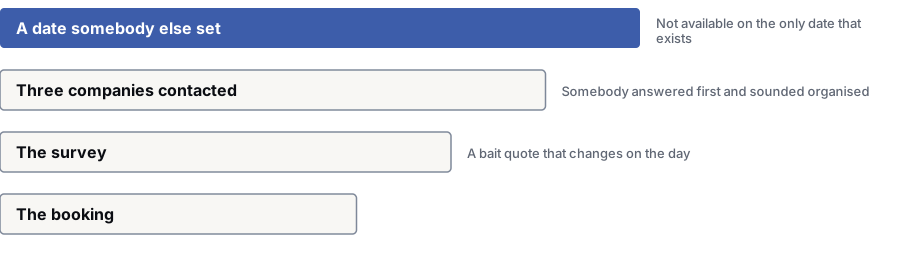
- 1A date someone else set — A completion, lease end or closing is confirmed, and the search starts that week. The window is about a fortnight and won't move.Not free on the only date that matters
- 2Three companies contacted — Most households contact three and stop. Being fourth is the same as not being there, however good the quote.Someone else answered first and sounded organised
- 3The survey — In the home or by video, this is where the customer decides if the price is real. Quote without one and you invite a losing comparison.A bait quote that changes on the day
- 4The booking — The type of estimate matters more than the number: binding, not-to-exceed or hourly. Few customers know the difference until it costs them.
Where to spend
Spend on local SEO first, then reviews
In the order we'd put them. Start at the top.
Show up on the map where your crews work
Most moving searches show a map result first, decided by distance, profile quality and reviews. You need a well-kept business profile, fresh photos of your own vans and crews, service areas that match where you work, and a steady flow of recent reviews.
Keep reviews recent, because people judge movers by them
Ask for a review after every completed move so the profile stays current. Reply thoughtfully in public to moves that went wrong: people read the complaints first, then your reply, which is some of the most valuable copy you publish.
A quote form a nervous customer will finish
Make the room-by-room inventory quick on a phone, offer video survey booking, show the phone number at every step, and explain what the estimate covers before any figure appears. Most moving quote forms ask for commitment before earning any trust.
Answer the cost and worry questions before people shortlist
What a move costs, how estimates differ, what movers won't carry, how insurance works and how to spot a bad mover are searched a lot, and lead-generation sites do most of the answering. Answer them clearly and you reach customers before the shortlist forms, as the company that explained the trap.
Your website
What visitors need to see
- Your pricing explained: how you charge, what is included and exactly what adds cost on the day
- Estimate types described in simple words, so customers understand what they are agreeing to
- Video survey booking as a proper option, with a slot this week visible
- Licence, registration and insurance details published with numbers, plus extra cover options explained
- Reviews shown with dates and sources, including the platforms customers check for themselves
- Route and area pages for the moves you do, not a page for every postcode in the country
- Deposit, cancellation and rescheduling terms that customers can find before booking
- Real photos of your named crews, your own vans and your depot, because being anonymous looks like a broker
The rules
What the rules allow
In several markets, estimate accuracy and estimate types are regulated directly, especially for household moves across a state, provincial or national border. Rules on binding and non-binding estimates, required documents, the most that can be collected on delivery and what a mover may do with goods in a payment dispute vary by jurisdiction. Any price you advertise has to be one you can honour.
Licensing, registration, bonding and insurance claims must be current and match the official register. Operating authority numbers, removal registrations and trade association memberships can all be checked, and "fully insured" without stating cover and limits is the kind of claim consumer regulators treat as misleading.
Asking for reviews is governed by platform rules and, increasingly, consumer law. Rewarding positive reviews, only asking happy customers, writing reviews in-house or hiding negative feedback creates legal risk in several markets, and can get your profile removed.
Deposits, cancellation terms and cooling-off rights differ by jurisdiction and by whether the contract was agreed remotely or in the customer's home. Storage and lien terms are legally sensitive and should never appear in marketing as leverage; describe them neutrally and keep the detail in the contract.
This page describes where care is needed. It is not legal advice. Which rules apply depends on where you work, the moves you do and how your contracts are formed, so take those questions to your own adviser or the relevant regulator.
Sources
Rules and where to read them
Each rule above, linked to the body that publishes it. Which ones apply depends on where you work. Rules change, so check the latest version.
- US rules for interstate household goods movers, covering estimates, required documents and payment due at delivery.
- 49 CFR Part 375
- Source: FMCSA, 49 CFR Part 375 (US)
- Bars fake reviews and incentives conditioned on a review expressing a particular sentiment.
- FTC 16 CFR Part 465
- Source: FTC, Rule on Consumer Reviews and Testimonials, 16 CFR Part 465 (US)
- Bans commissioning fake reviews or concealed incentivised reviews, and publishing reviews misleadingly.
- DMCC Act 2024, Sch. 20
- Source: Digital Markets, Competition and Consumers Act 2024, Schedule 20 (UK)
Measuring results
What good looks like
These numbers show if your marketing brings in customers. Website visits alone don't.
- Cost per booked move, reported separately for local, long-distance and specialist work
- Quote to booking rate by lead source and move size
- Calls answered within the first few rings, and calls missed by hour and day
- Survey completion rate, split between in-home and video
- Average revenue per move, and the gap between estimate and final invoice
- Number and recency of reviews each month, not a lifetime average
- Bookings kept versus cancelled, with the reasons for cancellations recorded
- Enquiries by move date, so you can see the real shape of the booking window
Questions
Moving and storage marketing FAQs
Every move is different. Can a mover publish anything useful on price?
Yes: the method, even if not the number. How you charge, what a survey tells you, what is included, what costs extra and what could change the price on the day is exactly what a nervous customer is trying to work out.
Some movers also give a typical range by property size and distance, marked as a guide subject to survey. It filters out customers never in your range and makes the final quote feel like a confirmation.
Competitors quote low and add charges later. How do we compete with that?
Don't match their number. You would do the same work for less and still not win the price-only shoppers. Change what is being compared instead.
Explain why a quote without a survey is a guess, what usually gets added on the day, and what your estimate does and doesn't allow to change. Customers who understand that stop treating two figures as the same.
How should we split budget between paid search and everything else?
Paid search usually earns a big share, because demand is urgent and date-bound, and you can turn it up in peak weeks and down in quiet ones. It is the fastest way into a booking window only days wide.
Your map listing and reviews make that spend efficient. Start with paid search for immediate coverage while building local visibility and reviews, then rebalance once the profile does some of the work.
We get a few bad reviews every year. What is the right response?
Reply publicly, promptly and without arguing. A calm, specific reply that admits what happened and says what you did about it does more good than the review does harm.
Keep reviews coming too. A steady flow of recent reviews stops one bad month sitting at the top of your profile, where people read only the first few.
Is there any point marketing in the quiet months?
Yes, for different work and with less spend. Outside summer and month-end, demand shifts towards rental moves, downsizing, office moves, storage and single items, with less competition.
The quiet months are also when the slower work must happen: reviews, local visibility, cost content and fixing the quote form. Reach May with all that undone and you pay full price for every booking in the busiest quarter.
Do we need a page for every suburb we cover?
No, and it usually harms the site. Dozens of near-identical pages with the place name swapped signal low-quality content and compete with each other, not your rivals.
Build pages where you have depth: a depot, crews there every week, real jobs and real reviews. Let a well-built business profile cover the rest.
See what to fix first
Start with the free checkup. It shows what to fix first on your website, with no sign-up. Want the full plan for your moving and storage business? Book a call, and we'll look at your market, your competitors and the searches that bring in customers.
Prefer to talk it over? Book a free call
Your BOOSTD score improves within 90 days, or your next month is free. After 6 months, more traffic or leads, or we keep working free (up to 6 free months in any 12 months). Read our guarantee
References
Sources for moving company marketing
The official documents and research this page is based on. Platform rules change, so check the source before you act on a detail.
Related
More on moving and storage marketing
Guides for moving and storage
Other logistics businesses
Last updated · Published by Zubair Afzal, responsible editor