
Cleaning Services marketing
Cleaning company marketing: winning clients is easy, keeping them is the business
Residential cleaning is sold on trust in the home; commercial cleaning is sold on reliability, insurance and cover. Both are recurring, which makes churn — not acquisition — the number that decides whether the company grows.
Prefer to talk it through? Book a strategy call
Search behaviour
Cleaning services searches, grouped by intent
Residential, recurring
Triggered by a life event. The buyer is deciding about a stranger in their house.
- house cleaning services near me
- weekly cleaner cost
- cleaner for a 3 bedroom house price
- fortnightly domestic cleaning [area]
- cleaning service that brings its own supplies
Residential, one-off
Deadline-driven and rarely retained unless somebody asks.
- deep clean before moving out
- end of tenancy cleaning [area]
- post construction cleaning
- airbnb turnover cleaning service
Commercial and contract
A facilities manager, a landlord or an office manager. Different vocabulary entirely.
- office cleaning companies near me
- commercial cleaning contract quote
- janitorial services [city]
- medical office cleaning requirements
- cleaning company insurance and bonding
The trust questions
Asked before booking and almost never answered on a cleaning website.
- are house cleaners background checked
- do i need to be home for a cleaner
- what does a deep clean include
- what happens if a cleaner breaks something
These are examples of how customers in this market search, drawn from keyword research and public search data. They are illustrative, not a volume claim: we size the demand in your area before recommending anything.
What usually goes wrong
Where cleaning services marketing tends to fail
Cleaning is one of the few local businesses where winning the client is the easy part. Enquiries are plentiful, quotes are quick, and a company can add customers all year and finish it exactly the size it started.
What decides whether it grows is the rate at which those clients leave, and that is set by staffing, consistency and how a complaint gets handled rather than by anything in an advertising account.
- New clients arrive at the same rate old ones leave.
- This is the defining condition of the category. Recurring revenue means every departure has to be replaced before growth begins, so a business losing a few per cent of its book each month can run hard for a year and finish the same size. Until churn is measured properly — by cohort, by cause, by cleaner — every pound spent on acquisition is filling a container nobody has looked underneath.
- Two completely different buyers share one page.
- A householder deciding whether to hand over a key and a facilities manager comparing three tenders want opposite things. One needs reassurance about vetting, breakages and who will attend; the other needs insurance certificates, references from comparable buildings, a supervision model and a plan for absence cover. A single page addressed to both persuades neither.
- The commercial bid competes on price because nothing else is written down.
- Where quality, supervision, cover arrangements and complaint response are undocumented, the only comparable figure on the table is the price, and the cheapest operator wins by definition. Publishing how the work is audited, how quickly an issue is resolved and what happens when a cleaner is off sick moves the comparison onto ground where a well-run company can win.
- Staff turnover is treated as an operations issue.
- Residential clients accept a great deal and will not accept a different stranger every visit. When cleaner turnover is high, client churn follows a few weeks behind, and no advertising corrects it. Recruitment and retention of cleaners is therefore part of the growth plan rather than a separate department, and in many companies it is the highest-return marketing work available.
- Getting a price requires a phone call nobody answers.
- A large share of residential enquiries are made in the evening and want a number now. A quote tool that produces a real figure for a standard home — with the assumptions stated and the awkward cases routed to a call — captures people who would otherwise have carried on down the results, and it stops the office spending its mornings quoting jobs that were never viable.
Buying behaviour
How cleaning services customers decide
Strategy follows this, not the other way round. Everything on this page is downstream of how the decision gets made.
- Residential buyers decide on who is coming into the house. Whether staff are background checked, whether it is the same person each visit, whether the company is insured, and what happens if something is broken or a key is lost.
- They compare price, but as a per-visit figure with a clear scope rather than an hourly rate, and a company that lists what is included and excluded wins against one that says every home is different.
- Convenience decides the rest: booking without a phone call, being able to change a date, and not having to be present.
- Commercial buyers begin with compliance. Current insurance certificates, employment status of the staff, health and safety documentation and references from comparable premises are threshold requirements before price is discussed.
- Then they buy reliability. Who supervises, how quality is audited, what happens when a cleaner is off sick, and how quickly somebody answers when a bin has not been emptied on the day the regional director visits.
- Regulated premises add their own criteria — food, healthcare, education and laboratories each carry standards and vetting requirements that eliminate most bidders before the meeting.
- Renewal is decided almost entirely on incident history. A contract with no complaints renews on autopilot; one with three unresolved issues goes to tender regardless of price.
Two businesses, one company
One is decided about a stranger. One is decided about paperwork
Residential and commercial cleaning are bought by people with almost no shared vocabulary. Both are recurring, which makes churn rather than acquisition the variable that compounds.
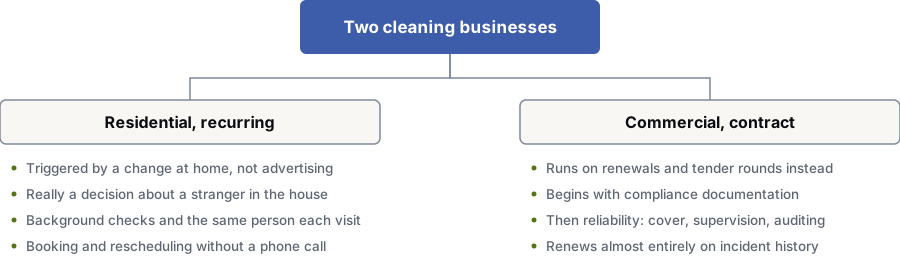
Residential, recurring
- Triggered by a change at home, not advertising
- Really a decision about a stranger in the house
- Background checks and the same person each visit
- Booking and rescheduling without a phone call
Commercial, contract
- Runs on renewals and tender rounds instead
- Begins with compliance documentation
- Then reliability: cover, supervision, auditing
- Renews almost entirely on incident history
Where the money goes
The cleaning services marketing channels that earn their place
In priority order for this business, not a menu. Anything not on this list is something we would need a specific reason to recommend.
Map visibility for the residential side
Domestic cleaning is searched locally and decided from the map results, so the profile, the service list, the service area and a steady arrival of recent reviews carry most of the new client volume. It is also where the trust questions first get answered, through photographs and review replies rather than copy.
Paid acquisition costed against retention
Paid works here only if it is judged on twelve-month value rather than cost per enquiry, because a recurring client is worth many times a one-off deep clean and costs more to acquire. Campaigns need separating by service type, or the automation will fill the pipeline with end-of-tenancy jobs that never recur.
Search for the commercial buyer
Facilities managers, office managers and landlords search in a different vocabulary and read different pages — specification, compliance, cover arrangements, sector experience. Building that content properly reaches contracts that never appear in a domestic-focused campaign, and it supports the tender before anyone meets you.
A quote that produces a number
The largest single conversion improvement available in residential cleaning is giving people a real price for a standard home without a phone call. Alongside it, separate paths for residential and commercial so each buyer reaches material written for them rather than a compromise addressed to nobody.
Churn, cohorts and the reason people leave
Measuring retention by cohort, recording why each client left, and connecting cleaner turnover to client turnover is routine work that changes the shape of the business. In a recurring model it is worth more than any increase in enquiries, and almost nobody in this category does it.
Measurement
Cleaning services numbers we report on, and what we ignore
Sessions are not on this list. These are the numbers that tell you whether the marketing is producing customers.
- Client churn rate, monthly and annualised
- Average client lifetime in months and the revenue attached to it
- Recurring contracts won versus one-off jobs, reported separately
- Cost per acquired recurring client against twelve-month value
- Cleaner retention rate, tracked alongside client retention
- Quote-to-contract rate, split residential and commercial
- Complaint rate per hundred visits and time to resolution
- Revenue per cleaning hour
The website
What a cleaning services website has to do
- An online quote that returns a real figure for a standard home, with assumptions stated
- What is included and what is excluded, listed per service type
- Vetting described exactly: which checks are carried out, by whom, and how often
- Whether the same cleaner attends each visit, answered plainly rather than avoided
- A separate commercial path with insurance, supervision model and comparable references
- Key handling, access arrangements and what happens if something is damaged
- A stated response time and remedy if the work is not right
- Service area and minimum visit length, so unsuitable enquiries stop early
- Recruitment information, because cleaner supply is the constraint on growth
Constraints
Cleaning services advertising rules: what is allowed, and what is not
Statements about vetting, insurance and bonding are the most sensitive claims this category makes, because clients rely on them to allow access to a home or premises. Whatever is advertised has to be currently held, evidenced, and accurate about scope — a check on some staff is not a check on all staff, and lapsed cover described as current is a serious matter with an insurer.
How cleaners are engaged has legal consequences that reach into marketing. Describing self-employed contractors as employees, or the reverse, misstates who carries liability, supervision and tax obligations, and worker classification rules differ substantially between markets and are actively enforced in several.
Environmental and safety claims about products need substantiation. Terms such as non-toxic, chemical-free, hypoallergenic and eco-friendly are regulated advertising claims in most jurisdictions, and safety data sheet obligations apply regardless of what the marketing says.
Regulated premises carry their own standards — healthcare, food preparation, education and childcare settings each impose vetting, training and documentation requirements. We draft to the constraints we understand apply, and expect the company to confirm its vetting, employment and product claims with its own advisers and insurer. Nothing here is legal advice.
Primary sources
The cleaning services rules above, at source
The rules this page refers to, linked to the regulator or rule-maker that publishes them. Which apply depends on where you operate, and they change, so check the current version.
- Treats ‘non-toxic’ claims for a product or service as needing substantiation and qualification.
Green Guides § 260.10
Treats ‘non-toxic’ claims for a product or service as needing substantiation and qualification.
- CMA guidance on making environmental claims that comply with UK consumer protection law.
CMA Green Claims Code
CMA guidance on making environmental claims that comply with UK consumer protection law.
Source: CMA, Green Claims Code (UK)
- Requires employers to keep safety data sheets for hazardous chemicals and make them available to workers.
OSHA 29 CFR 1910.1200
Requires employers to keep safety data sheets for hazardous chemicals and make them available to workers.
Source: OSHA Hazard Communication Standard, 29 CFR 1910.1200 (US)
Questions
Cleaning services marketing questions, answered
Our churn is high. Should we stop advertising until it is fixed?
Not stop, but change what the money is doing. Acquisition into a leaking book buys the same client twice, and in a recurring business the retention figure sets the ceiling on everything else.
The practical sequence is to measure churn by cohort and cause first, fix the two or three things that explain most of it — usually cleaner turnover, inconsistent attendance and unresolved complaints — and keep acquisition running at a level the operation can serve well while that happens.
Should we chase residential or commercial work?
They are different businesses and it is worth being deliberate rather than opportunistic. Residential is faster to win, smaller per client, and highly sensitive to who turns up. Commercial takes months, involves tendering and compliance, and produces larger contracts that renew quietly.
Most companies can run both, but not with one website, one sales process or one set of reports. Where resources are tight, choosing one and doing it properly beats being the second-best option in each.
Every commercial tender comes down to price. How do we escape that?
By putting something else on the table before the price is discussed. Facilities managers are buying the absence of problems, so what differentiates a bid is the supervision model, the audit process, the absence cover arrangement and the complaint response time.
Documenting those publicly, and referencing comparable buildings you already clean, moves the comparison away from a rate per square metre — which is the only ground on which the cheapest operator is guaranteed to win.
Should we publish prices for domestic cleaning?
Publish a real figure for a standard home along with the assumptions behind it, rather than a rate that means nothing without a survey.
People searching in the evening want a number, and a company that offers one captures enquiries that would otherwise keep scrolling. It also filters out the jobs that were never going to be viable, which saves your office more time than it costs.
Is recruitment really a marketing problem?
In this category it usually is the marketing problem. Growth is capped by the number of reliable cleaners you can retain, and client churn follows staff churn within a few weeks.
Treating recruitment with the same seriousness as client acquisition — a proper careers page, honest pay information, a fast application — is frequently the highest-return work available, and it is usually the last thing a cleaning business thinks of as marketing.
Find out what is winnable for your cleaning services business
Start with the free Growth Scan: an indicative read of your website and the few things to fix first, with no sign-up. BOOSTD is in early access, so the fuller picture for your cleaning services business — your area, your competitors and the searches that matter — is worked through with our team on a strategy call. If we do not think we can move it, we will tell you.
Prefer to talk it through? Book a strategy call
If we don't deliver the work we agreed to deliver for reasons within our control, you don't pay for the undelivered work. Read our guarantee
References
Sources
The primary documents and published research this page relies on. Platform rules change, so check the source before acting on a detail.
More to explore
Guides that answer the same questions
More in consumer services
Last updated · Published by Zubair Afzal (responsible editor), on owner authorisation