
Funeral Homes & Services marketing
Funeral home marketing that gives families clear, simple information
Funeral home marketing that helps a family find your prices and what to do first, within hours of a death. Planning-ahead readers get calm information of their own.

What people search
“Funeral home costs” and similar searches
Cost
The most searched question in this area, and the one families find hardest to ask in person.
- funeral home costs
- how much does a funeral cost
- direct cremation price
- cheapest funeral options
- burial plot cost [area]
What to do first
Practical and step by step, and often searched by someone acting for another person.
- what to do when someone dies
- registering a death
- how long after a death is the funeral
- do i need a funeral director
- who to call when someone dies at home
Finding a funeral director
Local and immediate, and often searched by a relative in another city.
- funeral directors near me
- funeral home [town]
- muslim funeral services near me
- jewish funeral director
- green burial near me
Planning ahead
A very different reader: unhurried, private, and comparing over months.
- prepaid funeral plan
- how do funeral plans work
- writing down my funeral wishes
- is a funeral plan worth it
These are example searches from keyword research and public search data. Before we suggest anything, we check how often people search for them in your area.
Timing
How demand moves through the year
There are two audiences with almost nothing in common: a family arranging a funeral within hours of a death, and someone thinking about their own arrangements over months or years. The first needs speed and clarity; the second needs time, privacy and detail.
Searches for an immediate funeral happen at any hour, often by a relative who doesn’t live nearby and doesn’t know the local crematoria, customs or who was already involved. Content that assumes local knowledge lets that person down.
Families usually decide within a day, often from the first few results and after one phone call. The tone of that call decides a lot.
Planning ahead is prompted by an illness, a death elsewhere in the family, or getting older. It is slow and careful, and it should never come with any pressure.
The number of funerals in an area is set by the local death rate, and advertising can’t increase it. What changes is which provider a family contacts, so this is about being easy to find and understand, not creating demand.
Two readers
Families arranging a funeral now, and people planning years ahead
These two readers arrive at the same website in very different states, and content written for one can upset the other. Advertising can’t increase the number of funerals in an area.
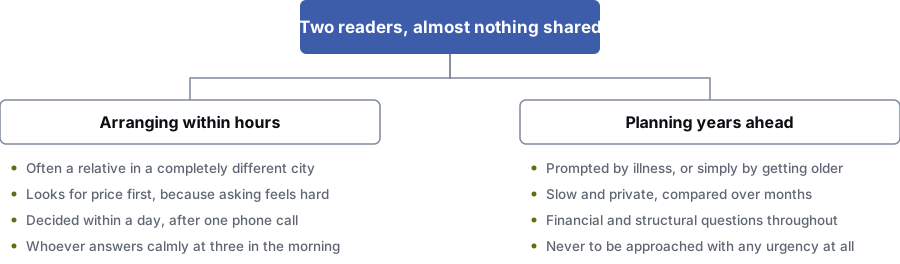
Arranging within hours
- Often a relative living in another city
- Looks for price first, because asking feels hard
- Decided within a day, after one phone call
- Whoever answers calmly at three in the morning
Planning years ahead
- Prompted by illness, or by getting older
- Slow and private, compared over months
- Questions about money and plan terms throughout
- Never to be approached with any urgency
How they choose
What customers check before they choose
Know how they choose and you know where to show up.
- Price is the first thing families look for. They look online because asking someone feels uncomfortable so soon after a death.
- Distance from where the death happened, where the family lives, or where the burial or cremation will take place narrows the list quickly.
- For many families it matters whether the home has cared for people of their faith or culture, or carried out their rites, before. That should be visible on the site, not something they have to ask.
- Recommendations carry a lot of weight. They often come from a hospital, hospice, care home, celebrant, place of worship or another family who used the home recently.
- The first phone call matters more than anything on the website. Whether the person answering is calm, unhurried and able to explain what happens next often settles it.
- Availability is a practical filter. Does someone answer at three in the morning? How soon can the person who has died be brought into your care? How quickly can you hold an arrangement meeting?
- For pre-arranged plans, the questions are about money and structure. Where is the money held? What is guaranteed and what isn’t? Can the plan be transferred? What happens if the provider stops trading?
Common problems
What's holding your funeral services marketing back?
Someone has died. A family member is on the phone, often at an hour when nothing else is open, trying to find out what happens next and what it will cost. Your website has to serve that moment, and almost none of the usual marketing habits fit it.
What works here is keeping everything simple: clear prices, short sentences, the practical steps in order, and nothing that asks a grieving person to be persuaded of anything.
- Families can find your prices everywhere except on your website.
- Families search for funeral costs more than anything else. If your site doesn’t answer, the figures they find come from comparison sites and other providers. A complete, itemised price list, including the lowest-cost options, is what they want, and in a number of markets it’s required by law.
- The site is written as if the reader is browsing.
- Long paragraphs, a rotating banner, a menu of eight items, copy about heritage and values: someone who learned of a death two hours ago won’t read any of it. Put the phone number, what to do first and what things cost at the top, in short sentences.
- Planning ahead and immediate need share the same pages.
- These are two readers in very different states. One has hours and needs the practical steps; the other has months and wants detail on how a plan is held and what it guarantees. Mixing them makes pages too slow for the first, too thin for the second, and risks showing planning material to someone just bereaved.
- Nobody has written down what to do first.
- Who do you call when someone dies at home, at night or in hospital? What is a medical certificate, and who issues it? How does registration work? People search for these constantly, and most homes don’t have the pages.
- Your faith and cultural services can’t be seen.
- A family looking for a home that has held services in their own tradition can’t tell from a general page whether you have. If you have that experience, set it out: the facilities, the timescales, your arrangements with particular places of worship or burial grounds.
Where to spend
Spend on search content first, then local SEO
In the order we'd put them. Start at the top.
Clear answers to the practical questions
What to do when someone dies, how registration works, what the options are and what each costs are the most searched questions in this area. The useful page simply answers the question and asks nothing of the reader.
Easy to find and reach at any hour
Families search locally, often at night. You need an accurate profile with working 24-hour contact details, the correct address, and directions that work. If you serve several communities, the profile should reflect where each one is.
A website people can use at a hard time
Short pages, large text, strong contrast, an always-visible phone number and a price list one tap away. It must load on a weak connection, because many of these visits happen on a phone in a hospital corridor.
Simple language on every page
Most funeral home copy is either formal or sentimental, and neither helps someone working out what happens next. Short sentences, concrete words, no euphemisms that hide the meaning and no attempt to persuade. Our specialists write and check this part line by line.
Replying to reviews with care
Families write about their experience, and other families read it. Replies must acknowledge the review without confirming a particular person was in your care or describing the arrangements. Agree your approach in advance.
Your website
What your website must have
- A complete, itemised price list one click from the home page
- The lowest-cost options, including direct cremation, shown as clearly as every other option
- What to do first, as a short numbered list for the hours after a death
- A phone number that reaches a member of staff at any hour, and what happens when you call
- Separate, clearly signposted information for people planning ahead
- Faith, cultural and specific rites named where the home has provided them
- No countdown timers, no limited availability, no offers and no time pressure anywhere
- Short sentences, large text and strong contrast, on pages that load on any connection
- Directions, parking and step-free access for each location
The rules
Advertising rules to know
In several markets, showing prices is a legal duty, not a choice. Requirements often cover a standard price list, where it appears on the website, giving prices over the phone, and rules against bundling that hides the cost of individual items. The detail differs by country and by state or province, and it has changed in a number of markets in recent years.
Prepaid funeral plans are often regulated as financial products, not as funeral services. The rules cover how money is held, what must be disclosed, how plans may be sold and what happens if a provider fails. Some markets ban certain sales practices for these plans outright, including cold contact.
Conduct rules in this sector often restrict pressure selling and unsolicited approaches to bereaved families, and may ban using a death notice or registration record to find contacts. Some markets restrict referral arrangements with hospitals, hospices and care homes, and seeking business through coroner or police contracts.
A funeral home holds sensitive information about people who have died and their families, so review replies, obituaries and remembrance pages all raise confidentiality questions. We write to the rules we understand apply, and expect the home to confirm price presentation, plan wording and conduct with its own regulator, trade association or lawyer. Nothing here is legal advice.
Sources
Read the rules yourself
Each rule above, linked to the body that publishes it. Which ones apply depends on where you work. Rules change, so check the latest version.
- Requires US funeral providers to give itemised price lists and to give price information by telephone.
- FTC Funeral Rule
- Source: FTC Funeral Rule, 16 CFR Part 453 (US)
- Requires a Standardised Price List on the website; restricts referral arrangements and coroner soliciting.
- CMA Funerals Order 2021
- Source: CMA, Funerals Market Investigation Order 2021 (UK)
- FCA rules for pre-paid funeral plans from 29 July 2022, including a ban on cold calling.
- FCA funeral plan rules
- Source: FCA, Protecting new funeral plan customers (UK)
Questions
Your funeral services marketing questions, answered
Should we publish our prices?
Yes. In several markets you’re required to, in a set format and position. Even where it isn’t required, it’s the question families search for most and find hardest to ask out loud.
A complete, itemised list, including the lowest-cost options, means families find accurate information, not a guess from a comparison site. The conversations that follow are generally calmer, because the hard subject has already been covered.
Will marketing increase the number of funerals we conduct?
No. The number of deaths in an area is what it is, and no advertising changes it. Any agency that says otherwise has misunderstood the business.
What marketing can change is whether a family who needs a funeral director can find you, understand what you offer and reach you at three in the morning. That’s the whole opportunity, and a valuable one.
Is it appropriate to market a funeral home at all?
Yes, in the sense of being easy to find and understand, which is most of what we’d do. A family searching at night for what to do next wants information, and providing it well is a service, not a sales activity.
Anything that applies pressure isn’t appropriate, and we won’t do it. That rules out urgency, scarcity, time-limited prices, and contacting a bereaved family who hasn’t approached you.
How should we handle pre-arrangement enquiries?
Treat them as a completely separate audience, with their own pages, pace and follow-up. Someone planning ahead is unhurried and compares carefully, and wants full detail on how a plan is held and what it guarantees.
Keep it away from the pages for families arranging a funeral now. A family who has just been bereaved shouldn’t see planning-ahead information while they’re trying to find out what to do first.
Should we approach families we’ve served about planning ahead?
Not soon after a funeral, and in some markets not at all in the way it’s often suggested. Rules on approaching bereaved families and selling prepaid plans are strict in a number of jurisdictions, and apart from the rules it’s a poor thing to do.
If you want to offer planning information, make it easy to find and ask for. Don’t contact anyone who hasn’t shown an interest.
How do we respond to reviews without breaching confidentiality?
Carefully, using wording agreed in advance, not written in the moment. A reply should never confirm that a particular person was in your care, describe any arrangement, or discuss anything a family told you.
A short acknowledgement, a word of sympathy and an offer to talk privately is almost always the right reply, especially when the review is critical.
Find your quickest wins
Start with the free checkup. It shows what to fix first on your website, with no sign-up. Want the full plan for your funeral services business? Book a call, and we'll look at your market, your competitors and the searches that bring in customers.
Prefer to talk it over? Book a free call
Your BOOSTD score improves within 90 days, or your next month is free. After 6 months, more traffic or leads, or we keep working free (up to 6 free months in any 12 months). Read our guarantee
References
Sources for funeral home marketing
The official documents and research this page is based on. Platform rules change, so check the source before you act on a detail.
Related
More on funeral services marketing
Guides for funeral services
Other consumer services businesses
Last updated · Published by Zubair Afzal, responsible editor