
Salons & Spas marketing
Salon marketing agency that keeps clients rebooking
Salon marketing built around rebooking: fill quiet hours from your own client list, and keep clients with the salon when a stylist leaves.

Timing
When people start looking
Demand runs on repeating intervals: colour every six to eight weeks, cuts every four to six, brows every three or four, facials monthly. That makes a salon more like a subscription than a shop.
Busy periods are easy to predict: December, wedding season, school formals, the days before a public holiday. Those weeks sell out without marketing, so spend there is mostly wasted.
Your biggest stock problem is the quiet hour. An unsold Tuesday morning slot is gone for good. A busy Saturday won’t make up for it.
In most established salons, new clients are a small stream next to existing ones. Growth comes from clients visiting more often and rebooking reliably.
Spas have an extra layer: gift vouchers. Bought in one season, used in another — more like a booking made in advance than a sale.
Where the growth is
A quiet Tuesday costs more than a missing new client
Almost every salon markets for new clients and measures itself on them. In an established business, growth comes from more frequent visits and rebooking. The stock that goes to waste is a quiet hour.
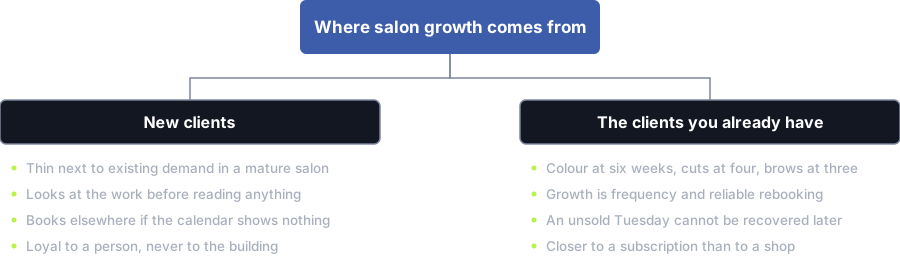
New clients
- A small stream next to existing clients
- Look at the work before reading anything
- Book elsewhere if the calendar shows nothing
- Loyal to a stylist, not the building
The clients you already have
- Colour at six weeks, cuts at four, brows at three
- Growth comes from more visits and rebooking
- An unsold Tuesday can’t be made up later
- More like a subscription than a shop
Common problems
Paying for salon and spa marketing that doesn't work?
A salon looks like a shop but works like a subscription. Your diary is a set of repeat appointments, and the business is worth what those repeats are worth.
The catch: the appointment belongs to the stylist, not the building. So a big share of your revenue sits with whoever holds the scissors.
- A stylist leaves and takes part of the diary with them.
- It’s the most predictable revenue shock in this business, and the least planned for. If contact details, booking history and messages live on one phone, you can’t reach clients before they hear about a new chair. Own the booking system, review profile and client messaging before anyone resigns.
- You count bookings, not rebookings.
- Nearly every salon tracks appointments taken. Few track, per stylist, how many clients leave with their next visit booked. That number predicts revenue further ahead than any other, and a script and a prompt improve it more than a campaign.
- Your booking page shows nothing free for six days.
- Someone deciding at eleven at night books whoever can see them. Nothing free within a week loses every browsing client, and no advertising fixes that. Check how far ahead you open the diary and how services are timed.
- You market to strangers and ignore the empty Tuesday.
- New-client discounts fill the chair with people who came for the deal and don’t return. The regular who’d happily move from Saturday to Wednesday is never asked. Filling quiet hours from your own client list costs less and protects your prices.
- With chair rental, nobody agrees whose client it is.
- If a renting stylist takes the booking, holds the phone number and gets the review, the salon is a landlord with a sign outside, not a brand with its own clients. That can be a fair model, but make it a decision and write down who owns the data, deposits and messages.
Where to spend
The website first, then local SEO
In the order we'd put them. Start at the top.
Put booking first
Show live availability and let people book on a phone in under a minute. List prices by service and stylist level, with your deposit policy up front. A photo gallery with a phone number loses bookings made after closing time.
Getting found for the right services
Showing up on the map brings new clients. Get your service list, hours, photos and reviews right. It matters most for a new salon, new location, or new specialism.
Reviews from every client
Clients choose a salon by its reviews. Send every client the same review link after the visit to open on their own phone, never ask them to name a stylist, reply without revealing client details and keep reviews on the salon’s profile.
What people search
What people type, like “hair salon near me”
Looking for a salon
Driven by the map and specialism. General searches are crowded, specific ones aren’t.
- hair salon near me
- balayage specialist [city]
- curly hair salon near me
- best colourist near me
- salon open sunday
Price and service
Compared before anyone calls. No prices shown means lost bookings.
- how much is a full head of highlights
- keratin treatment cost
- facial near me price
- gel manicure price near me
Spa days and gifts
Bought in one season, used in another — often by someone else.
- spa day for two
- spa gift voucher
- couples massage near me
- spa packages [city]
Events and one-off occasions
Booked well ahead and high value. These clients rarely return unless you make the effort.
- bridal hair and makeup near me
- prom hair appointment
- wedding hair trial cost
These are example searches from keyword research and public search data. Before we suggest anything, we check how often people search for them in your area.
Measuring results
How you'll know it's working
These numbers show if your marketing brings in customers. Website visits alone don't.
- Rebooking rate at the chair, reported per stylist
- Client retention at six and twelve months
- How often clients visit, and the gap between appointments
- How full the diary is, by day and by hour
- Average spend per visit, and how often clients buy retail products
- Share of new clients who come back a second time
- Gift voucher sales, and how many get used
- Share of appointments booked online versus by phone
Your website
What your website needs
- Live availability, with booking under a minute on a phone
- Prices by service and stylist level, and what changes the price
- A page for each stylist, with their own portfolio and booking link
- Photos of work done in your own chairs, with client consent
- Your deposit and cancellation policy shown before booking
- Gift vouchers people can buy online, with terms and expiry stated
- Patch test and consultation requirements flagged at booking
- Parking and how to find the door — many salons are hard to spot
The rules
Stay inside the ad rules
Claims about hair and beauty results are advertising claims. Words like “permanent”, “damage-free”, “anti-ageing” or “clinically proven” draw scrutiny in most markets. Before-and-after photos generally need documented consent and comparable conditions — flattering lighting isn’t a fair comparison.
Colour services come with allergy testing duties and manufacturer instructions, increasingly treated as a safety matter. Promoting same-day colour without mentioning patch tests can put you on the wrong side of your insurer, the manufacturer’s instructions and, in some markets, your licensing body.
Some treatments sit outside beauty regulation altogether. In many jurisdictions, injectables, laser, microneedling and similar procedures are limited to certain practitioners and regulated as medical or delegated medical acts. Advertising them from a salon page can be an offence, even where carrying them out is allowed.
Gift vouchers are consumer contracts. Rules on expiry dates, refunds and what happens if a business closes vary a lot. We write to the rules we understand apply — confirm treatment, testing and voucher wording with your insurer and your own regulator. This isn’t legal advice.
Sources
Check the rules at the source
Each rule above, linked to the body that publishes it. Which ones apply depends on where you work. Rules change, so check the latest version.
- Bars publishing an advert likely to lead to the use of a prescription-only medicine, such as Botox.
- HMRs 2012, reg. 284
- Source: Human Medicines Regulations 2012, reg. 284 (UK)
- The UK advertising code: claims need objective evidence, with specific rules for beauty and health claims.
- CAP Code
- Source: ASA / CAP, UK Code of Non-broadcast Advertising (UK)
Questions
What people ask about salon and spa marketing
A stylist is leaving. What can we do about it now?
Less than you could have done a year ago. If contact details, booking history and messages sit on their personal phone, you have little way to reach clients first.
Contact those clients yourself now: who’ll look after them, when and at what price. Then fix the set-up so the next resignation is a staffing problem, not a revenue problem.
We’re fully booked on Saturdays. Do we need marketing at all?
Probably not for Saturday. The real questions are what Tuesday morning looks like, and whether clients come seven times a year or five.
If weekends are busy and midweek quiet, focus on rebooking and moving flexible clients into quiet hours. Adding new clients to a full peak mostly creates disappointed people.
Should we discount to attract new clients?
Rarely, and never as a permanent offer. Introductory discounts attract price shoppers, and few of them come back.
To fill a specific gap, send a targeted offer to existing clients for that quiet hour instead. Same result, without cheapening your price list.
How do we handle marketing when stylists rent their chairs?
Choose the model on purpose and write it down. Decide who takes the booking, holds contact details, receives the deposit, and gets the review — and what happens if the renter leaves.
Both models can work. What fails is marketing yourself as a brand while every relationship you rely on belongs to someone else.
Our online booking shows nothing free for a week. Is that a good problem?
No, it’s a scheduling problem. Everyone browsing at night sees a closed door and books elsewhere without contacting you.
Look at how far ahead you open the diary, how service times are set, and whether you run a waitlist. Fix that before spending anything on visibility.
Show me what to fix
Start with the free checkup. It shows what to fix first on your website, with no sign-up. Want the full plan for your salon and spa business? Book a call, and we'll look at your market, your competitors and the searches that bring in customers.
Prefer to talk it over? Book a free call
Your BOOSTD score improves within 90 days, or your next month is free. After 6 months, more traffic or leads, or we keep working free (up to 6 free months in any 12 months). Read our guarantee
References
Sources for salon marketing agency
The official documents and research this page is based on. Platform rules change, so check the source before you act on a detail.
Related
More on salon and spa marketing
- barbershop website designs
- day spa website designsTreatment menus, packages and gift cards.
- hair salon website designsBooking by stylist, deposits and a consented portfolio.
- marketing for pet groomers and kennels
- marketing for medical aesthetics clinics
Guides for salon and spa
Other consumer services businesses
Last updated · Published by Zubair Afzal, responsible editor