
Med Spas & Cosmetic Clinics marketing
Med spa marketing that beats non-medical injectors on trust
Med spa marketing for aesthetic clinics that makes your medical oversight visible, advertises within the rules, and brings clients back on schedule.

The rules
What you can say in your ads
Before-and-after images are the most tightly controlled asset in this field. Where allowed, you need documented, specific consent; images must not be retouched or relit; angle and lighting must match; results shown must be representative, not exceptional cases. Several regulators ban them outright for prescription-only treatments.
Advertising prescription-only treatments to the public is restricted or banned in a number of markets, and the ban is wider than clinics expect — brand names, casual names, abbreviations and hashtags all covered, extending to social posts and paid creator content. Some markets also restrict promotional pricing on these treatments. Where this applies, a site built around product names has to be rebuilt around concerns and consultations.
Outcome and safety wording has its own rules. Claims that a result is “permanent”, “guaranteed”, “risk-free” or “suitable for everyone” are restricted in every market we cover, as are superlatives about being the “leading” clinic. Medical benefit claims for energy devices must meet their own evidence requirements too.
Who may prescribe, perform and supervise is a regulatory question, and your marketing must not misrepresent it. Copy or images suggesting a doctor performs a treatment delivered by someone else are a serious problem, even when everyone’s properly qualified.
Patient finance is usually a regulated credit activity with its own disclosure duties, separate from the health rules. All of this differs by regulator and market and changes regularly. We work to the rules we understand apply and flag what needs professional judgement. Confirm your position with your own regulator and credit adviser — we give no clinical or legal advice.
Sources
Rules and where to read them
Each rule above, linked to the body that publishes it. Which ones apply depends on where you work. Rules change, so check the latest version.
- Botox is prescription-only and may not be advertised to the public; hashtags on social media can count as ads.
- CAP rule 12.12 (Botox)
- Source: ASA and CAP (UK), Advice: Botulinum toxin (Botox) products
- No one may publish an advertisement likely to lead to the use of a prescription-only medicine, subject to exceptions.
- HMR 2012 reg. 284
- Source: Human Medicines Regulations 2012 (UK), regulation 284
- Guidance on marketing cosmetic procedures, including exaggerated claims made through before-and-after images.
- CAP cosmetic guidance
- Source: ASA and CAP (UK), Marketing of surgical and non-surgical cosmetic procedures
Common problems
Where med spa businesses lose customers
Med spa marketing has three odd problems. You sell something nobody needs, to people paying out of their own pocket. The clinic next door may have no medical oversight and charge half as much. And in a number of jurisdictions, you may not name the treatment your customers are typing into Google.
More traffic fixes none of these. What helps is showing who’s accountable, getting found without naming a product, and building the business on the fourth visit, not the first.
- You can’t name the treatment everyone is searching for.
- Where a treatment is a prescription-only medicine, several markets ban advertising it to the public by any means, brand names, nicknames, abbreviations and hashtags included. Clinics tend to ignore the rule or publish nothing. The third option is organising the site around concerns and consultations, so the pages that rank are pages you may publish.
- A salon two doors down charges half as much.
- Your competitors include beauty salons and mobile injectors, many with no medical oversight and no prescriber, and a client comparing prices sees no difference because nobody explained one. Say who prescribes, who supervises, and what happens if something goes wrong. Nervous clients search for this, and almost no clinic answers it.
- The discount promotion filled the diary with people who never came back.
- Deep-discount first visits give you a full week and a worse year, because price shoppers move to the next offer and you pay to win them again for one low-margin visit. In several markets, promotional pricing of a prescription-only treatment is restricted too.
- The injector has ten times the following the clinic has.
- Clients follow practitioners, and a personal account usually beats a clinic account. That’s fine while the practitioner stays, and a serious risk when they leave with a following and a client list. Support personal accounts, make the clinic visible behind every treatment, and spread new enquiries across the team.
- Nobody can say what a client is worth over a year.
- This business is built on repeat visits: maintenance every few months, device courses of several sessions. The number that counts is revenue per client over twelve months against the cost to win them. Cost per enquiry overrates discount campaigns and underrates everything that brings a second visit.
How they choose
How customers decide who to hire
Know how they choose and you know where to show up.
- They want to know who’s holding the needle, checking the practitioner’s profession and registration first. An anonymous team loses that comparison straight away.
- They check price early and in detail: per unit, per area, per session. Publish nothing and they assume you’re expensive and drop you before a consultation.
- They look at the practitioner’s own social account before the clinic’s, and recent posts more than a portfolio page, exactly where the image rules bite hardest.
- Safety questions decide it for nervous clients: who prescribes, whether a doctor is available, what happens if there’s a complication.
- Convenience shapes the repeat visit more than the first: whether it fits around the working day and rebooking takes thirty seconds.
- Self-paying clients who know they’ll be back do the maths on memberships, so the terms need to be easy to read, with no sales gloss.
Who else is on the search
Salons and mobile injectors show up in the same searches as you
Many non-medical providers appear on the same searches as you. Your medical oversight only wins the comparison if a nervous reader can find it.
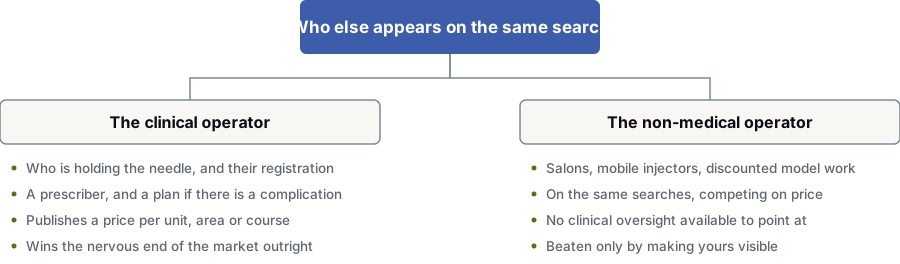
The medical clinic
- Who holds the needle, and their registration
- A prescriber, and a plan if there is a complication
- Publishes a price per unit, area or course
- Wins over nervous clients outright
The non-medical provider
- Salons, mobile injectors, cheap model treatments
- On the same searches, competing on price
- No medical oversight to point to
- Beaten only when you make yours visible
What people search
“Botox near me cost” and similar searches
Price first
The biggest group, and worthless unless your site gives a figure. People who cannot find a price assume the worst and go elsewhere.
- botox near me cost
- how much is a unit of botox
- lip filler price [city]
- laser hair removal cost full body
- med spa membership cost
Safety and who does the treatment
The searches that decide between a clinic and a non-medical provider. This is where your medical oversight is worth marketing.
- is it safe to get botox at a salon
- who is allowed to inject filler
- nurse injector vs doctor
- can filler be dissolved
- what to do if filler goes wrong
How it works and how long it lasts
Research done months before booking. Most clinics leave these answers to manufacturers and forums.
- how long does botox last
- difference between botox and filler
- how many laser sessions for hair removal
- does microneedling work for acne scars
- what age should you start preventative treatment
Ready to book locally
Few searches, strong intent. The choice rests on availability and distance as much as on the clinic itself.
- med spa near me
- aesthetic clinic [city] consultation
- walk in appointment injectables
- skin clinic open saturday near me
Corrections and complications
Urgent, anxious searches from people treated somewhere else. A clinic that can manage complications should show up here.
- filler migration what to do
- eyelid droop after treatment how long
- burn after laser hair removal
- how to remove lip filler
- lumps after dermal filler
These are example searches from keyword research and public search data. Before we suggest anything, we check how often people search for them in your area.
Where to spend
Spend on search content first, then local SEO
In the order we'd put them. Start at the top.
Rank for the treatment you may not name
Build the site around concerns, questions and consultations: what causes the thing the client dislikes, the options, how long results last, how complications are handled. It gets found for what people search, and can be published where naming the product is banned.
Show up in the area clients return to every few months
Maintenance visits keep clients close to home. Map listings, accurate hours and a profile listing the treatments you may legally name win a large share of repeat bookings.
Measure the whole year of a client’s visits
Second and third visit rates, membership retention and yearly revenue per client sit in your clinic system, not your ad account. Matching the two often moves the budget, exposing discount campaigns that look great on cost per booking but lose money over a year.
Your website
What to fix on your website
- Pages organised by concern and consultation, so they stay publishable without product names
- The named practitioner for each treatment, with profession and registration
- A clear statement of who prescribes, who supervises, and what happens if there’s a complication
- Prices per unit, area, session or course, and full membership terms with no small print
- Booking that presents the consultation as a medical assessment, with no sales pitch
- Frank aftercare advice, downtime, and how many sessions a typical course needs
- Images used strictly within your regulator’s conditions, with consent recorded
- Finance examples that meet the credit disclosure rules in your market
- A rebooking link in the appointment confirmation — the calendar is what you sell
Measuring results
What good looks like
These numbers show if your marketing brings in customers. Website visits alone don't.
- Treatment plans started, counted in place of enquiries
- Rebooking rate at the right clinical interval for each treatment
- Second and third visit rate within twelve months of a first appointment
- Membership sign-ups, and month-to-month retention
- Revenue per client over twelve months, against cost to win them
- Course completion rate for device treatments booked as a series
- Consultations that turn into treatment, by practitioner
- Share of revenue from discounted first visits, and how many came back
Questions
Short answers on med spa marketing
We’re not allowed to name the treatment people search for. What do we do?
Rebuild your site around the concern and the consultation: what causes the thing a client dislikes, the realistic options, and how complications are handled. Those pages attract the same readers and stay publishable.
It also changes how you compete. A clinic that can only push a product name competes on price; one that explains its assessment and who’s accountable competes on something a non-medical provider can’t match. Confirm what your regulator allows before publishing.
How do we justify our price against a salon charging half as much?
Make the difference visible rather than assuming clients understand it. Name the practitioner and their profession, say who prescribes and supervises, and what happens if there’s a complication.
Clients already search for these answers. Answer them clearly, without criticising anyone, and the comparison moves away from price alone.
Should we run a discounted introductory offer?
Rarely. In some markets you may not be allowed to on prescription-only treatments, since promotional pricing is separately restricted.
It also attracts the wrong clients, because deep-discount shoppers move to the next offer. Compare the return rate of discounted first visits with full-price ones before running another.
Our best injector has a bigger following than the clinic. Is that a risk?
Yes, an asset and a risk to manage. Clients follow practitioners, and a personal account usually beats a clinic account whatever you post.
Support the account, make the clinic visible behind every treatment, and spread new enquiries across the team, so if someone leaves you lose a practitioner, not an audience and a client list.
Do memberships work, or do people just cancel?
They work when the value is easy to add up. Spell out the terms: what the monthly fee buys, whether credits roll over, how to leave.
Early cancellations usually mean the membership was sold on a discount. Offer it once the treatment interval has been explained and the second appointment is being booked, and retention looks very different.
Can we post client videos and work with creators?
Check before agreeing to anything. In several jurisdictions, a client’s account of a treatment by a regulated practitioner counts as a testimonial and may be restricted, and paid creator content is usually treated the same way.
Where the treatment is a prescription-only medicine, a further ban may stop the creator naming it at all. Confirm your position with your own regulator before any deal.
Find out where you stand
Start with the free checkup. It shows what to fix first on your website, with no sign-up. Want the full plan for your med spa business? Book a call, and we'll look at your market, your competitors and the searches that bring in customers.
Prefer to talk it over? Book a free call
Your BOOSTD score improves within 90 days, or your next month is free. After 6 months, more traffic or leads, or we keep working free (up to 6 free months in any 12 months). Read our guarantee
References
Sources for med spa marketing
The official documents and research this page is based on. Platform rules change, so check the source before you act on a detail.
Related
More on med spa marketing
- med spa website designsTreatment pages within drug-advertising and before-and-after rules.
- turning a consultation into a treatment plan
- marketing for therapy and counselling practices
Guides for med spa
Other healthcare businesses
Last updated · Published by Zubair Afzal, responsible editor · We check this page every three months. Next check: .