
Mental Health Practices marketing
Therapy practice marketing that gets more first sessions attended
Marketing for therapists, counsellors and psychologists that matches each enquiry to a clinician with space, with clear fees, so more first sessions get attended.

How they choose
How buyers choose between you and a rival
Know how they choose and you know where to show up.
- They choose a face and a paragraph. A photo and a short first-person note on how a clinician works counts for more than any page about the practice.
- Practical filters come first: fee per session, whether a benefit plan covers it, and whether the clinician is taking new clients.
- Identity fit often decides it. People search directly for gender, language and cultural background, which practices rarely state clearly.
- Therapy approach matters to a minority. Most people describe a feeling, not a named modality, and your site has to serve both.
- They want to know what the first session is like before booking. Describe it clearly and you remove the main reason people put off booking for months.
- Reviews count for less here than anywhere else in health. Many clients never write one, and in several markets a testimonial about a registered practitioner isn’t allowed at all.
Before anyone is sure
People read for months before they send a first message
Most people here are not yet sure their situation counts. Of those who are ready, many are caught by a directory before they reach your website.
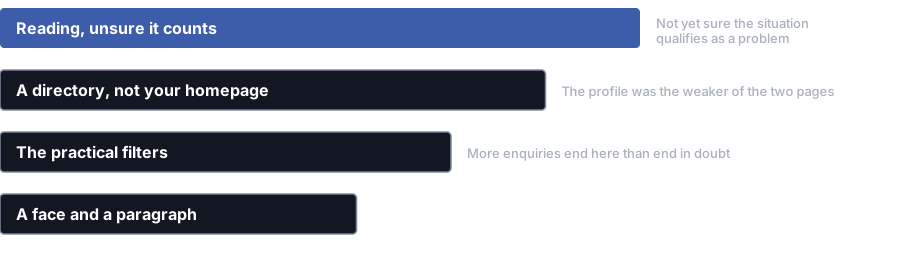
- 1Reading, unsure it counts — Weeks or months of reading, often late at night. They come back to the same page several times before they contact anyone.Not yet sure their situation is a problem
- 2A directory profile first — Directories catch a large share of demand before anyone reaches a practice site. For many practices the profile is the main front door.The directory profile was the weaker page
- 3The practical checks — Fee per session, whether a plan or scheme covers it, and whether the clinician is taking anyone at all. All this before they read a word about approach.More enquiries end here than end in doubt
- 4A face and a paragraph — A photo and a short first-person note on how a clinician works decide more than any page about the practice.
Timing
Busy months and quiet months
The gap between what prompts someone to seek help and their first enquiry is long. People read for weeks or months, often late at night, returning to the same page before contacting anyone, so last-click reporting tells you almost nothing.
There are seasonal patterns too. Enquiries rise in January and early autumn as routines restart, and around exam periods, and drop off in summer.
Therapist directories catch a large share of demand before anyone reaches a practice website, and for many practices the directory profile is the main front door.
Online sessions widen the catchment to wherever a clinician is registered to practise, and no further, so registration, not office location, sets your marketing area.
Capacity changes in jumps. A clinician leaving or cutting hours changes what the practice can take on within a week, so marketing needs to turn up and down easily.
Common problems
What's holding your mental health marketing back?
Therapy practice marketing has a different job from other health marketing. Most practices don’t need more enquiries; they need the ones they get to reach a clinician with room this week, before the client’s resolve wears off.
That’s why most marketing advice fails here. Pushing more demand into a full practice just lengthens the waitlist, gives struggling people a worse experience, and brings the practice nothing.
- Two clinicians are full and three have gaps.
- Availability inside a practice is rarely even. One or two clinicians are booked months ahead while colleagues with openings get nothing, usually because people ask for a name they read about. The fix is routing: know who has space this week, publish each clinician’s focus areas, and ask enough at first contact to match well.
- An enquiry sat for four days because everyone was in session.
- Clinicians see clients all day and can’t answer a message at eleven o’clock, and the person who wrote it after months of deciding won’t chase you. Make one team member responsible for replies, set a target in hours, and send an instant acknowledgement that says something useful.
- The site never says what a session costs.
- Cost, insurance cover and sliding-scale fees are among the first things these readers want to know, and silence reads as expensive. Publish your fee, which benefit plans clients often claim under, and whether reduced-fee places exist. Money worries end more enquiries than doubts about therapy do.
- The copy tries to persuade someone who’s not sure they want help.
- Urgent wording and sales-style buttons land badly with a reader still deciding if their situation is serious enough. Practical detail helps: how long a session is, what the first one covers, what happens if they want a different clinician. Reassurance helps people book; pressure puts them off.
- There’s nothing for someone in crisis, and someone in crisis will arrive.
- People in acute distress will find a practice website, whoever it was written for — some at three in the morning when nobody can answer. A marketing page must never present itself as crisis support, and must never put emergency information behind a form. Clear signposting to crisis services is a duty, sitting outside any booking path.
Where to spend
Start with search content, then local SEO
In the order we'd put them. Start at the top.
Write for the months before anyone contacts you
These readers take a long time to act. What earns the enquiry is practical information: what the first session involves, how confidentiality works, what happens if someone wants to stop. People return to pages like these again and again.
Say clearly that you’re accepting new clients
Whether a practice has openings is the most searched detail here, and almost nobody publishes it. Keep listings current, show availability per clinician, and list online sessions across each clinician’s registered region.
Clinician profiles that help someone choose a therapist
These are the most valuable pages on your site. Each needs a photo, a first-person note on how that clinician works, focus areas, availability and fee. Write each individually; a house template makes everyone look the same and stops people choosing.
Handle reviews without confirming anyone is a client
Testimonials about registered practitioners are restricted in a number of markets, and replying to a review can confirm a therapy relationship even when it says nothing about it. Use a written policy: a standard reply that reveals nothing, and a private route for anything that needs one.
What people search
Searches like “how do i know if i need therapy”
Unsure, before any decision
The biggest group by volume. Often months before contact, from people not yet sure their situation counts.
- how do i know if i need therapy
- is what i am feeling normal
- should i see a therapist or just talk to friends
- difference between a psychologist and a counsellor
- does therapy actually work
Availability and access
Strong intent, and often left unanswered. The whole question is whether a practice is taking new clients.
- therapist accepting new clients
- counsellor near me evening appointments
- online therapy in [region]
- how long is the waitlist for therapy
- psychologist taking new patients [city]
Fees, benefits and schemes
The practical blocker. More enquiries stop here than stop because of doubts about therapy itself.
- how much does therapy cost per session
- does insurance cover a psychologist
- sliding scale therapist near me
- is counselling covered by employee benefits
- low cost counselling [city]
A specific concern or approach
Two readers in one group. Some describe a feeling. Others have had therapy before and know what they want.
- therapist for anxiety near me
- emdr therapist [city]
- couples counselling near me
- adult adhd assessment
- grief counselling after a bereavement
What happens in a session
Searched just before booking and just after. A clear answer does more for attendance than anything else on the site.
- what happens in the first therapy session
- what do you talk about in therapy
- can i change therapists
- is what i say in therapy confidential
- how many sessions of therapy do people usually have
These are example searches from keyword research and public search data. Before we suggest anything, we check how often people search for them in your area.
Your website
Your website checklist
- Crisis signposting that nobody can miss, outside any form or booking step
- A profile for each clinician with a photo, a first-person description and current availability
- The fee per session, what the first session costs, and how benefit plans are usually claimed
- Whether reduced-fee or sliding-scale places exist, and how someone asks for one
- A clear description of what the first session involves
- Clear notes on confidentiality and its limits, in plain words
- A way to enquire without phoning, and a stated reply time in hours
- Which clinicians are taking new clients, kept up to date
- Analytics and ad tags set up so pages suggesting a mental health concern send nothing identifiable
The rules
Stay inside the ad rules
Titles are protected in this field more than most of healthcare. Titles like “clinical psychologist” are restricted by statute or a registering college. In some markets “psychotherapist” is protected too, while “counsellor” isn’t regulated in the same markets. Using a protected title for an unregistered practitioner is a registration issue before it’s an advertising one — check it practitioner by practitioner.
Testimonials about regulated health professionals are restricted or banned in several markets, extending to republished reviews and content from anyone paid to promote it. Where reviews appear, the reply is the danger — acknowledging one can confirm that a named person is a client, a confidentiality breach before it’s an advertising one.
A marketing page must never present itself as crisis support. This is the most important rule in this field. People in acute distress will reach a practice website at hours when nobody can answer. Crisis information must be prominent and accurate, and must never sit behind a form or booking step. Content about self-harm or suicide should follow recognised safe-messaging guidance and be reviewed by a registered clinician before publishing.
Outcome language is restricted in every market we cover. Claims of recovery, cure or success rates draw regulator attention, as do superlatives about being the “leading” practice. Any claim that an approach treats a specific condition must fit both the evidence and what the registering body allows.
Analytics, ad pixels and session recording on pages suggesting a mental health concern can send out information about an identifiable person, which health privacy law covers. Plan for this before anything is installed. These rules differ by regulator and market and change regularly. We write to the rules we understand apply and flag what needs professional judgement. Confirm your position with your own regulator — we give no clinical or legal advice.
Sources
The rules in full
Each rule above, linked to the body that publishes it. Which ones apply depends on where you work. Rules change, so check the latest version.
- Titles such as clinical psychologist and counselling psychologist may be used only by HCPC registrants.
- HCPC protected titles
- Source: Health and Care Professions Council (UK), The professions we regulate
- Advertising a regulated health service, psychology included, must not use testimonials or be misleading.
- National Law s133
- Source: Ahpra and National Boards (Australia), Guidelines for advertising a regulated health service
- FTC action over mental health data shared with advertising platforms; the order bans sharing it for advertising.
- FTC v. BetterHelp
- Source: Federal Trade Commission (US), BetterHelp case, 2023
Questions
Questions about mental health SEO and ads
We already have a waitlist. What would marketing do for us?
Send the enquiries you already get to the clinicians who have room, and cut the number that never reach a first session. In a typical group practice, enquiries all land in the same two diaries.
It can also shape the client mix, attracting more of the concerns and session types you want, and being clear enough about the waitlist that people still turn up when a space opens.
Should we publish our fees?
Yes, and the case is stronger here than in most of healthcare. Cost and cover are among the first things these readers check, and silence looks expensive to exactly the people a sliding scale is meant for.
Publish your standard fee, what a first session costs, and whether reduced-fee places exist. Saying there are three such places and they’re full right now is more useful, and more trusted, than silence.
Can we ask clients for reviews?
Check with your registering body first. In several markets, testimonials about regulated practitioners are restricted whether or not the client offered one, one of the strictest areas in health advertising.
Where reviews appear, the bigger risk is your reply. Practices need a standard reply that reveals nothing, and a proper private route for anything raising a clinical or safety concern.
What should be on the site for someone in crisis?
Crisis lines and emergency guidance for every market the site serves, visible without scrolling and never behind a form or chat widget.
The practice website is not crisis support and must not read as if it is. People in acute distress will arrive anyway, often when nobody can answer, so the only responsible design sends them somewhere that can help right away.
People book a first session and then don’t come. Why?
Usually mixed feelings more than practical problems. Someone booked in a moment of resolve after months of hesitation, and by the appointment that feeling has faded, a normal part of therapy.
What helps is what you send between booking and appointment: describe the first session, say they can stop at any point, and offer an appointment soon, not three weeks out.
Most of our new enquiries come from therapy directories. Is that a problem?
No, but it’s a dependency worth understanding. For many practices the directory profile is the main front door and deserves as much care as your website.
Build your own visibility alongside it for control. A directory can change its ranking rules or layout, and a practice with nothing else can’t respond.
Check your site before you spend more
Start with the free checkup. It shows what to fix first on your website, with no sign-up. Want the full plan for your mental health business? Book a call, and we'll look at your market, your competitors and the searches that bring in customers.
Prefer to talk it over? Book a free call
Your BOOSTD score improves within 90 days, or your next month is free. After 6 months, more traffic or leads, or we keep working free (up to 6 free months in any 12 months). Read our guarantee
References
Sources for therapy practice marketing
The official documents and research this page is based on. Platform rules change, so check the source before you act on a detail.
Related
More on mental health marketing
- therapist and counsellor website designsPrivate intake, therapist matching and a crisis line on every page.
- marketing for med spas and elective clinics
Guides for mental health
Other healthcare businesses
Industries close to mental health
Last updated · Published by Zubair Afzal, responsible editor · We check this page every three months. Next check: .