
Veterinary Clinics marketing
Veterinary marketing for clinics whose client is the owner, not the patient
A veterinary practice runs two businesses at once: a plannable preventative one and an unplannable emergency one. Corporate groups have taken the easy end of both, cost is the question owners ask most and practices answer least, and the ceiling is usually an empty rota slot rather than a shortage of demand.
Prefer to talk it through? Book a strategy call
Demand shape
When veterinary demand arrives, and how
Preventative demand is the plannable half of the practice: vaccinations, boosters, parasite treatment, dental checks, neutering and annual examinations. It runs on a calendar the practice already owns, which makes it the most reliable revenue in the building and the most commonly neglected in the marketing.
Emergency demand arrives without warning, is searched in a state of panic, and is decided from a map result in under two minutes. It carries the highest value per visit in the category and it is won on being open, close and answering the telephone rather than on anything persuasive.
New puppy and kitten registrations are the single most valuable acquisition moment available, because each one begins a relationship measured in a decade. Practices that grew fastest during a surge in pet ownership are also the ones now facing the largest churn as those animals age or their owners move.
Most practices are capacity-limited rather than demand-limited. Unfilled surgeon and nurse posts cap how many consultations exist to be sold, which means the useful question is usually about mix and pricing rather than about generating more enquiries.
Seasonality is real and specific. Parasite treatment peaks in warm months, fireworks and thunderstorms produce a predictable anxiety spike, holiday periods concentrate emergency demand on whoever stays open, and the turn of the year brings a wave of pet insurance renewals and policy switching.
Two halves of the practice
One half is on a calendar you already hold
Preventative and emergency work arrive in completely different states of mind, and only one of them can be planned for. The plannable half is also the one most practices market least.
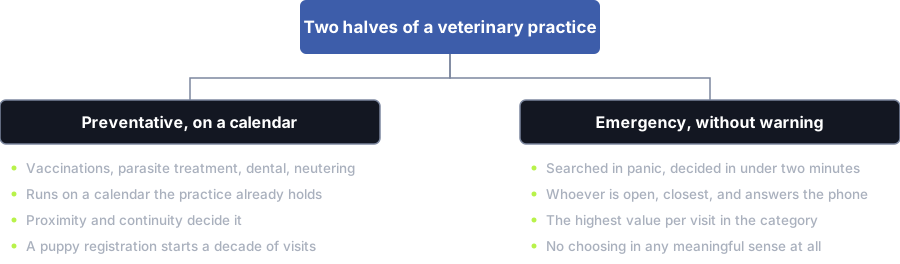
Preventative, on a calendar
- Vaccinations, parasite treatment, dental, neutering
- Runs on a calendar the practice already holds
- Proximity and continuity decide it
- A puppy registration starts a decade of visits
Emergency, without warning
- Searched in panic, decided in under two minutes
- Whoever is open, closest, and answers the phone
- The highest value per visit in the category
- No choosing in any meaningful sense at all
What usually goes wrong
Where veterinary marketing tends to fail
Veterinary marketing is not human healthcare with animals in the photographs. The person deciding is the owner, the person paying is the owner, and the patient has no view at all — but the emotional weight sitting on the decision is closer to family medicine than to any other service business.
Underneath that sit two different businesses. Preventative care is recurring, plannable and defensible. Emergency care is unpredictable, high value and decided in minutes. Marketing that treats them as one thing usually underserves both.
- Cost is the most searched question in the category and the least answered.
- Owners search what a consultation costs, what a dental costs, what imaging costs and what an out-of-hours visit costs. Most practice websites publish none of it, so the gap is filled by forums, comparison content and other owners recollections. A practice that publishes its consultation fee, ranges for common procedures and a plain explanation of what drives an estimate upward is answering demand that already exists, and it removes the conversation that damages trust most — the one that happens at the till.
- The practice markets to strangers and neglects the animals already registered.
- A registered animal represents a decade of predictable revenue. Missed boosters, unclaimed dental checks, lapsed parasite treatment and health plan members who quietly stopped attending are worth more to recover than a new client is to win, and each of them already exists in the practice management system with a contact record and a due date attached. Most practices run this as one automated reminder and nothing else, then spend the budget advertising to people who have never heard of them.
- You are being compared to a corporate group and you sound exactly like one.
- Consolidation has changed the competitive shape of the category. Group-owned practices have larger budgets, standardised sites and structured health plans, and independents frequently respond by imitating them. That is the losing move. What a group cannot easily replicate is continuity of clinician, named vets who have known the same animal for years, ownership that is local and accountable, and pricing explained by the person who set it. If an owner cannot tell from the website who owns the practice, the main advantage has already been surrendered.
- Emergency provision is real and impossible to find on the site.
- Out-of-hours arrangements are the most urgently searched information a practice publishes and are typically buried in a footer or described in professional language nobody in a panic will parse. What an owner needs at eleven at night is whether you are open, where to go instead if you are not, roughly what it will cost, and a telephone number large enough to press one-handed. Getting that single page right is worth more than a year of social posting.
- The vacancy is a nurse, not a client.
- A practice that cannot fill a clinical rota has a hard ceiling on consultations, and no amount of client acquisition raises it. Where staffing is the constraint, the highest-value marketing asset is a careers section written for a veterinary surgeon or registered nurse: rota and out-of-hours expectations, case mix, equipment, clinical freedom, support ratios, mentoring and who owns the practice. Most careers pages say the team is friendly and hard working, which describes every practice in the country.
Where the money goes
The veterinary marketing channels that earn their place
In priority order for this business, not a menu. Anything not on this list is something we would need a specific reason to recommend.
The map result an emergency is decided from
Almost all urgent veterinary demand and most routine registration begins in the map results. Accurate opening hours including the out-of-hours arrangement, species listed properly, a telephone number that reaches a person, and recent reviews are what decide it. For a group the work has to be done branch by branch, because one shared listing sends an emergency to the wrong building.
Paid cover for the hours nobody else is open
Emergency queries are the one place in veterinary where paid search reliably pays for itself, because case value is high and the decision window is minutes. Run it tightly: emergency and out-of-hours terms only, the hours you staff, a landing page carrying the address and the fee, and call tracking that shows which clicks became telephone calls rather than which became clicks.
Publish the prices and the out-of-hours plan
Two pages carry most of the commercial weight on a veterinary site: what things cost, and what to do at three in the morning. Consultation fees, ranges for common procedures, what moves an estimate, health plan terms in plain language, and an emergency page that works one-handed on a phone in the dark. Everything else is secondary to those two.
Reminders that recover an animal you already have
Boosters, parasite treatment, dental checks and annual examinations fall due on dates the practice already holds. Recovering an animal that quietly stopped attending is cheaper than winning a new client and worth more, because the record and the trust both already exist. Done properly this is segmented by species, age and health plan status rather than one reminder that goes out and is ignored.
Say who owns the practice and why that matters
The advantage an independent holds is continuity, accountability and a named owner, and none of it is visible on a website that reads like every other one. Owner-authored content, the clinical team with their actual interests, involvement in local rescue and community work, and coverage that treats the practice as a local institution rather than a retailer, is the part a group cannot copy quickly.
Search behaviour
Veterinary searches, grouped by intent
Emergency and out of hours
Decided in under two minutes from a map result, at any hour, usually one-handed and in distress.
- emergency vet open now
- vet open sunday near me
- 24 hour vet near me
- my dog ate chocolate what do i do
- out of hours vet cost
Cost and estimates
High volume and growing, currently answered on forums because practices will not answer it.
- how much does a vet consultation cost
- dog dental cleaning cost
- cat neutering price near me
- is pet insurance worth it
- how much is an x ray for a dog
Registering and routine care
The acquisition moment that begins a ten-year relationship with an animal and its owner.
- vets near me taking new clients
- puppy first vaccination near me
- register puppy with vet
- cat vaccination near me
- pet health plan worth it
Species and special interest
Lower volume, far less competition, and frequently the most profitable clients a practice can attract.
- rabbit savvy vet near me
- exotic pet vet [city]
- equine vet near me
- reptile vet near me
- vet that does home visits
These are examples of how customers in this market search, drawn from keyword research and public search data. They are illustrative, not a volume claim: we size the demand in your area before recommending anything.
Measurement
Veterinary numbers we report on, and what we ignore
Sessions are not on this list. These are the numbers that tell you whether the marketing is producing customers.
- New animal registrations, separated from enquiries and from telephone calls
- Consultations attended per available clinician hour, since capacity is usually the limit
- Preventative compliance: boosters, parasite treatment and dentals completed against due
- Health plan sign-ups, and monthly retention on those plans
- Emergency and out-of-hours cases attributable to paid and map visibility
- Average transaction value by visit type, and the mix of preventative against treatment
- Lapsed animals brought back per month, and the visits that produced
- Applications per open clinical vacancy, and time to fill
- Acquisition cost per registered animal set against expected lifetime value
The website
What a veterinary website has to do
- Consultation fees and typical ranges for common procedures, stated in figures
- An out-of-hours page that works one-handed on a phone in the dark
- Which species the practice sees, including exotics, equine and farm where relevant
- Named veterinary surgeons and nurses with their clinical interests and real photographs
- Health plan terms explained plainly, including what is not covered
- How insurance claims are handled, and whether the practice claims directly
- Registration that can be completed online without a telephone call
- An end-of-life page written with care, because owners read it before they need it
- A careers section written for a veterinary surgeon or registered nurse
Constraints
Veterinary advertising rules: what is allowed, and what is not
Veterinary advertising sits under the standards of the body that registers the practice and its surgeons — a royal college, board or association depending on the market. The recurring constraints are restrictions on claiming specialist or advanced status where that is a protected designation, on comparative and superlative claims, and on anything implying an outcome for an animal that cannot be assured.
Advertising veterinary medicines to the public is restricted in most markets, and prescription-only veterinary products commonly may not be promoted to pet owners or the general public at all. Content about parasite treatment, sedation, anaesthesia and pain relief has to be written by somebody who knows which category a product falls into in your market, and any paid campaign naming a product needs checking before it runs.
Client confidentiality applies to review responses and case examples exactly as it does in human healthcare. Confirming that a named person brought an animal in, or referring to what was done, is a disclosure. Case photographs and stories need documented owner consent, and consent obtained on the day of a distressing case deserves to be reconfirmed before anything is published.
Price and service statements have to be accurate and complete. Where a fee is advertised, what it includes and excludes must be clear, and out-of-hours claims must reflect the provision in place — describing a service as around the clock when cases are referred elsewhere after ten in the evening is a consumer protection problem as well as a reputational one. Competition and consumer authorities in several markets have taken an active interest in pricing transparency in this sector.
Requirements differ by regulator and by market and are revised periodically. We draft to the constraints we understand apply to you and flag anything needing professional judgement, but the practice must confirm final wording with its own regulator. Nothing we produce is legal or veterinary advice, and any content describing a condition or a treatment should be reviewed by a registered veterinary surgeon before publication.
Primary sources
The veterinary rules above, at source
The rules this page refers to, linked to the regulator or rule-maker that publishes them. Which apply depends on where you operate, and they change, so check the current version.
- Only vets on the RCVS Specialist List may use the title specialist; advertising must be accurate and truthful.
RCVS Code ch. 23
Only vets on the RCVS Specialist List may use the title specialist; advertising must be accurate and truthful.
Source: Royal College of Veterinary Surgeons (UK), Supporting guidance 23: Protection of title, advertising
- Prescription-only veterinary medicines may be advertised only to vets, vet nurses, pharmacists and professional keepers.
VMR 2013 reg. 11
Prescription-only veterinary medicines may be advertised only to vets, vet nurses, pharmacists and professional keepers.
Source: Veterinary Medicines Regulations 2013 (UK), regulation 11
- Vet businesses must publish standard price lists and say who provides their out-of-hours care.
CMA vets remedies
Vet businesses must publish standard price lists and say who provides their out-of-hours care.
Source: Competition and Markets Authority (UK), What veterinary businesses need to do
Questions
Veterinary marketing questions, answered
Clients keep asking what things cost. Do we put fees on the site?
Yes, and more of them than feels comfortable. Cost is the highest-volume question in the category and the one practices answer least, which means the answer is currently supplied by forums, comparison content and other people recollections.
Publish the consultation fee as a figure, ranges for common procedures, and a plain account of what makes an estimate move — anaesthesia, imaging, length of stay, complications. It removes the conversation nobody wants to have at the till and it wins owners who have already priced two other practices.
How do we compete with a corporate group that opened nearby?
Not on price and not on facilities. Compete on the things ownership makes possible: continuity of clinician, a named owner who is accountable, and decisions made in the building rather than in a regional office.
That has to be visible. Put the owner name and face on the site, publish the clinical team with their real interests, and explain how the practice handles the things owners care about most — estimates, second opinions, end of life. A group site cannot say any of that credibly.
We cannot recruit a vet. Is that even a marketing problem?
It is the marketing problem, if consultations are capped by an empty rota slot. Winning clients you have no capacity to see costs money and generates complaints.
A careers section that answers what a clinician wants to know — rota and out-of-hours expectations, case mix, equipment, support ratios, mentoring, and who owns the practice — outperforms a broad campaign, because the audience is small and reads carefully. Treat it as a landing page, not a line on the contact form.
Is paid search worth running for a veterinary practice?
For emergency and out-of-hours terms, usually yes, because case value is high and the decision takes minutes. For routine registration it competes with map visibility you can earn without paying for it.
The discipline is knowing when to stop. If the diary is full and the constraint is clinical hours, paid emergency cover still makes sense and paid routine acquisition does not. We would rather switch it off than run it out of habit.
Can we post about a case on social media?
With documented owner consent, and with more care than most practices take. Case content performs extremely well here, which is exactly why it needs a process rather than a phone in somebody pocket.
Get consent in writing, reconfirm it before publishing anything emotionally significant, avoid detail that could identify the client rather than the animal, and keep clinical claims out of the caption. The rules on advertising veterinary medicines apply to a social post exactly as they apply to a page.
Find out what is winnable for your veterinary business
Start with the free Growth Scan: an indicative read of your website and the few things to fix first, with no sign-up. BOOSTD is in early access, so the fuller picture for your veterinary business — your area, your competitors and the searches that matter — is worked through with our team on a strategy call. If we do not think we can move it, we will tell you.
Prefer to talk it through? Book a strategy call
If we don't deliver the work we agreed to deliver for reasons within our control, you don't pay for the undelivered work. Read our guarantee
References
Sources
The primary documents and published research this page relies on. Platform rules change, so check the source before acting on a detail.
More to explore
Guides that answer the same questions
More in healthcare
Last updated · Published by Zubair Afzal (responsible editor), on owner authorisation · Reviewed quarterly — next review: