
Cosmetic Dentistry marketing
Cosmetic dentistry marketing that turns research into consultations
Cosmetic dentistry marketing for veneers, whitening, bonding and smile makeovers that wins self-paying patients through months of research, then turns consultations into cases.

Common problems
Why your cosmetic dentistry marketing isn't bringing in work
Cosmetic dentistry sells something nobody needs and many people want: veneers, whitening, bonding and smile makeovers. The patient pays, often a lot, for something they’ve wanted for years and thought about for months.
So it works more like a big retail purchase than healthcare, with one catch: the rules for registered clinicians still apply, and your most persuasive material is the most restricted. Aligners have their own page under orthodontics, and implants have theirs.
- You market veneers the way you market check-ups.
- General dentistry is won on distance and availability; cosmetic work on the clinician, proof of their work, the price and the risk. Use the same ads, pages and form for both and you get “how much?” messages that go nowhere.
- No price anywhere, so every enquiry is a price question.
- A self-paying patient won’t book an hour-long consultation to learn it costs three times their budget. Without a starting price and a finance option, your coordinator spends the week qualifying by phone, and the consultations booked are the most likely to be missed.
- You treat the consultation as a booking. It’s the sale.
- This is where the money is made and lost. A cosmetic consultation takes clinical time, sometimes imaging, and a coordinator. When a third don’t turn up and the rest get no follow-up plan, you pay full price for an unmeasured result. Deposits, useful confirmations, a set follow-up plan and a tracked conversion rate change the numbers faster than any campaign.
- Your best photos are the ones you can’t use freely.
- Patients want to see the work of the dentist who’ll treat them, and patient images are exactly what regulators restrict: consent, editing, lighting, typical results and sometimes whether they can be shown at all. Some practices avoid them and lose their best proof; others risk their registration. Plan for the rules from the start.
- A clinic abroad quotes a quarter of your fee.
- Dental tourism targets exactly the treatments that matter most here, and matching the price isn’t a plan. Answer what patients already search: who’s accountable if something fails, what happens at reviews, what fixing it costs and the ten-year cost.
What people search
Searches such as “how much are veneers”, grouped by intent
Cost-led research
The biggest group by far. Searched months before any enquiry, and rarely answered on practice sites.
- how much are veneers
- veneers cost monthly payment
- composite bonding price uk
- teeth whitening cost
- is teeth whitening worth the money
Comparing options
Weighing up treatments before practices. Whoever explains them best usually gets the call.
- veneers vs composite bonding
- teeth whitening vs veneers
- crown or veneer which is better
- how long do veneers last
- do veneers ruin your natural teeth
Risk and regret
Lots of searches and lots of worry. Answer clearly and you win patients who were about to book abroad.
- veneers gone wrong
- cosmetic dentistry abroad risks
- what happens when veneers fail
- turkey teeth problems
- can veneers be reversed
Ready to consult
Small volume, high value. The only group most practices target.
- smile makeover consultation near me
- best cosmetic dentist [city]
- composite bonding [city]
- teeth whitening near me
- cosmetic dentist free consultation
These are example searches from keyword research and public search data. Before we suggest anything, we check how often people search for them in your area.
How they choose
Why they pick one business over another
Know how they choose and you know where to show up.
- They choose a dentist more than a practice: the clinician’s training, experience and own cases matter more than the name above the door.
- They want to see similar work on similar teeth, and can spot a stock image. Showing no work at all is a big handicap where showing it is allowed.
- They check affordability before they pick up the phone. A starting price and a monthly figure decide whether they enquire at all.
- Patients are wary, and getting more so, after stories of treatment gone wrong. They want to know about reversibility, how long results last, aftercare and who fixes problems.
- The consultation itself is part of the choice. Did they feel listened to, were options explained without a hard sell, did they leave with a written plan? That decides between two practices that looked equally good online.
- Timing is often personal: a wedding, a big birthday or a new job. The practice that replies while they’re thinking about it usually gets the case.
Months of research
The reading starts in March. The consultation is in September
Almost none of this research shows up in your reports. So last-click numbers mean little here, and your cost page is the most valuable page on the site.
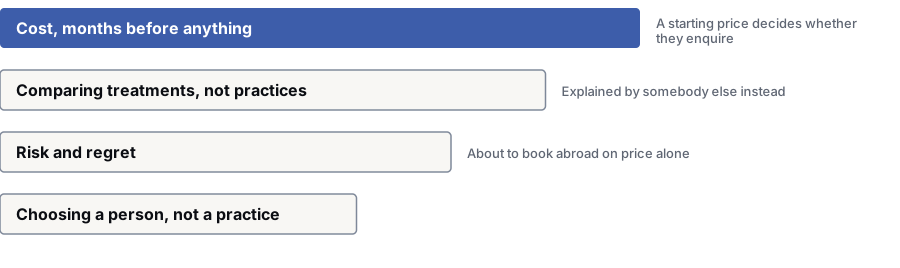
- 1Cost, months before anything — The largest group by far. Searched months before any enquiry, and rarely answered by practice websites.A starting price decides whether they enquire
- 2Comparing the treatments — Choosing between the options first. Whoever explains them best usually gets the call.Someone else explained it first
- 3Risk and regret — Many have seen stories of treatment gone wrong. They read about reversibility, how long results last and aftercare.About to book abroad on price alone
- 4Choosing the clinician — The dentist who will treat them, their training and their own cases. Patients spot a stock image at once.
Where to spend
Why organic search comes before the website
In the order we'd put them. Start at the top.
Answer the cost and risk questions in full
Cost comparisons, treatment comparisons and “what goes wrong” searches have huge volume months before anyone enquires, and most practices dodge all three. Answer them well and you become the practice they’ve been reading, with a defence against a cheaper quote from abroad.
A site with prices, proof and a booking button
Show a starting price per treatment, a monthly finance example, the treating dentist up front, their own work where the rules allow, and a consultation booking that takes a deposit. Together these lift attendance and conversion more than extra traffic.
Consultation attendance, follow-up and case tracking
Attendance, consultations that lead to treatment, finance take-up and average case value decide if this pays. Those numbers live in your practice system, away from the ad platform, and connecting the two is often the most useful step.
Your website
What a good site does
- A starting price for each treatment, with a monthly finance example next to it
- The treating dentist at the centre of the page, with training, experience and their own cases
- Your own work, where images are allowed, shown within the rules
- Clear content on how long results last, upkeep, reversibility and what happens if something fails
- A comparison of the realistic options, including doing nothing
- Consultation booking that takes a deposit and explains exactly what happens
- A calm answer to the overseas price question that criticises nobody
- Content people will come back to over months, beyond a single booking page
The rules
Before you publish an ad
Before-and-after images are the most tightly controlled asset in this field. Where allowed, the usual conditions are written patient consent, no retouching or filters, similar lighting and angle, and typical results, not the best case. Some regulators restrict them further for certain treatments or ban them outright.
Several jurisdictions restrict or ban testimonials and endorsements for registered health professionals, often further than practices expect: social media comments on content you control, reviews republished on your site and content a paid creator makes for you.
Several markets restrict advertising treatments that use prescription-only products directly to the public. If you offer anything like that alongside dental treatment, treat it as restricted until confirmed otherwise, and keep it separate on the site if needed.
Patient finance is usually a regulated credit activity with its own disclosure rules. Representative figures, comparison examples and wording about interest-free periods all have their own rules, which getting the dental side right doesn’t cover.
All of this differs by regulator and market, and it changes. We design to the rules we understand apply to you and flag anything that needs professional judgement; the practice must confirm its position with its own regulator. We don’t give legal or clinical advice and can’t certify anything as compliant.
Sources
See each rule in full
Each rule above, linked to the body that publishes it. Which ones apply depends on where you work. Rules change, so check the latest version.
- Advertising a regulated health service, dentistry included, must not use testimonials or be misleading.
- National Law s133
- Source: Ahpra and National Boards (Australia), Guidelines for advertising a regulated health service
- Prescription-only medicines and prescription-only medical treatments may not be advertised to the public.
- CAP Code rule 12.12
- Source: ASA and CAP (UK), CAP Code section 12: Medicines, medical devices and health
- Credit promotions must be clear, fair and not misleading, with a representative example where triggered.
- FCA CONC 3
- Source: Financial Conduct Authority (UK), Handbook CONC 3: Financial promotions
Measuring results
How we measure success
These numbers show if your marketing brings in customers. Website visits alone don't.
- Consultation requests, and how many attend
- Consultations that lead to treatment, by treatment type
- Cost per treatment start, alongside cost per enquiry
- Average case value and total case value started each month
- Finance applications started and approved
- Time from first contact to treatment start
- Bookings with a deposit versus free bookings, and the attendance gap between them
Questions
Things to know about cosmetic dentistry marketing
Should we publish a price for veneers?
Yes. Publish a “from” price and a monthly finance example. An exact quote before an exam would be a guess, but a starting point is fair, and stops enquiries from people who were never in range.
Practices that do this usually get fewer enquiries and more treatment starts. Attendance improves, because patients arrive knowing roughly what they’re committing to.
A third of our consultations do not attend. What fixes that?
A deposit, most reliably: small, and put towards treatment. It turns a casual booking into a commitment, and the ones you lose were rarely going ahead.
Beyond that, book sooner, send a confirmation with useful details, and have someone call within a day if a patient misses it.
How do we compete with clinics abroad quoting far less?
Compete on accountability and total cost over time, not price, and don’t criticise them; that reads as defensive, and in some markets breaks the advertising rules.
Patients already search for what happens when treatment done abroad fails: who reviews it, who fixes it and what it costs. Answer calmly and factually; almost nobody does.
Is social media appropriate for a clinical practice?
For cosmetic work, yes. Much of the demand starts there, because results are visible and people look for them before they look for a dentist.
How you do it matters. Clinical explanations, what treatment is like, aftercare and each option’s limits do well within the rules. Transformation reels set to music, reaction videos and anything that reads as a testimonial are where practices get into trouble.
Can we work with an influencer if we treat them for free?
Be very careful. In several jurisdictions this counts as a testimonial or endorsement of a registered health professional, and may be restricted however the deal is described or disclosed.
Ad disclosure rules apply on top. They don’t replace the health advertising rules. Check your position with your regulator before you agree anything.
How long before we see cases from this?
Longer than in general dentistry, because the decision itself is long. Enquiries and consultation bookings move first; treatment starts follow as people finish a decision they may have weighed for a year.
So we report on the whole pipeline. Judging cosmetic marketing on thirty days of treatment starts misleads both ways.
Get a free website check
Start with the free checkup. It shows what to fix first on your website, with no sign-up. Want the full plan for your cosmetic dentistry business? Book a call, and we'll look at your market, your competitors and the searches that bring in customers.
Prefer to talk it over? Book a free call
Your BOOSTD score improves within 90 days, or your next month is free. After 6 months, more traffic or leads, or we keep working free (up to 6 free months in any 12 months). Read our guarantee
References
Sources for cosmetic dentistry marketing
The official documents and research this page is based on. Platform rules change, so check the source before you act on a detail.
Related
More on cosmetic dentistry marketing
- cosmetic and general dental website designsBefore-and-after galleries built around consent and title rules.
- general practice growth
- dental implant marketing, covered separately
- orthodontic practice marketing
- improving consultation conversion
- marketing to UK patients
Guides for cosmetic dentistry
Other healthcare businesses
Industries close to cosmetic dentistry
Last updated · Published by Zubair Afzal, responsible editor · We check this page every three months. Next check: .