
Dental Practices marketing
Dental marketing agency that fills your diary with returning patients
Dental marketing that fills the diary with nearby patients who turn up and come back, and grows the treatments that carry your margin.

Your website
What your website must have
- Online booking that works without a phone call, including out of hours
- Fee ranges for common treatments, with a note on what changes them
- Which plans, insurers and payment options you accept, stated clearly
- A page for nervous patients that doesn’t read like an advert
- Named clinicians with registration numbers, their own photos and background
- A same-day emergency route that’s obvious on a phone
- Treatment pages that explain what it involves, what it costs and how long it lasts
- Directions, parking and accessibility, because convenience decides here
- Fast loading on mobile, since almost all this traffic is on a phone
Common problems
Common dental marketing mistakes
Your practice runs on two kinds of income. Hygiene and check-ups are frequent, steady and low in value. Treatment is rarer, harder to predict and carries most of the margin.
Most dental marketing treats the practice as one business and chases the cheaper side. That’s why you can be busy, spend on new patients and still feel no difference.
- New patient numbers look good, but the diary has gaps.
- Usually you’re counting bookings, not attendance. A good share of new patients booked from ads never turn up, and those who do are mostly booked for the lowest-value slot. Count attended appointments by type and the picture changes; the fix often sits at reception.
- You’re paying to win patients you already have.
- Every practice has a list of people treated once who never came back. They’re registered, they trust you and they cost almost nothing to contact, so bringing back even a few often fills more slots than a new patient campaign. It rarely happens, because the list lives in the practice software.
- Your ads cover a bigger area than your patients live in.
- People choose routine dental care on convenience: near home, work or school. Practices often advertise across a whole city, paying for clicks from people who’d never drive forty minutes for a scale and polish. Shrink the area to where patients come from and you usually get more attended appointments for less.
- Your site sells check-ups and says little about treatment.
- Implants, crowns, bridges, orthodontics and full rebuilds are where you make your money and what patients research hardest. One thin page per treatment, with nothing on cost, options, lifespan or process, gives a keen patient no reason to choose you.
- Nobody answers “what does it cost?” or “will it hurt?”
- Ask any receptionist what people ask on the phone: cost and pain. Most practice websites answer neither. Publish fee ranges, explain what plans and insurance cover and talk to people who’ve avoided the dentist for years; it removes the two biggest hesitations and filters out price shoppers.
How they choose
How the shortlist gets made
Know how they choose and you know where to show up.
- For routine care, convenience wins. Distance, parking and evening appointments beat a better dentist twenty minutes further away.
- Whether you take their plan or insurance is often the first filter. If your site doesn’t say so clearly, they drop you without you knowing.
- Patients read reviews for gentleness, fairness and whether anyone felt pushed into treatment. They assume you’re skilled; what they fear is being judged or upsold.
- A friend’s recommendation still starts most decisions, and the search that follows checks it. That’s why your profile and reviews matter so much.
- Availability seals it. Being seen this week, booking online at eleven at night and seeing a photo of their dentist turns a comparison into an appointment.
- For nervous patients, a large minority, the deciding factor is whether you say anything about nerves at all. Saying nothing reads as not caring.
Two businesses, one practice
The diary is filled by two very different patients
Routine registrations and emergencies come from different searches, on different timescales, decided on different things. Most practice websites only serve the first.
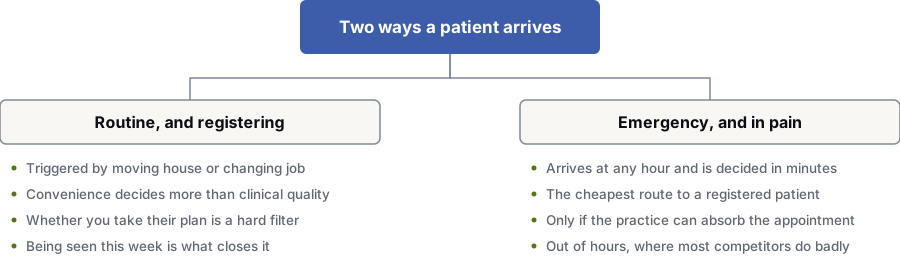
Routine, and registering
- Triggered by moving house or changing job
- Convenience matters more than clinical quality
- Whether you take their plan is a hard filter
- Being seen this week is what seals it
Emergency, and in pain
- Comes at any hour and is decided in minutes
- The cheapest way to gain a registered patient
- Only if the practice can fit the appointment in
- Out of hours, where most competitors do badly
What people search
Searches like “dentist near me”
Looking for a practice
Led by convenience and Google Maps. Whoever looks trustworthy and close usually wins.
- dentist near me
- dentist accepting new patients
- family dentist [city]
- dentist open saturday near me
- nhs dentist taking new patients
Emergency and pain
Urgent, often out of hours, decided in minutes. The cheapest new patients you can win.
- emergency dentist open now
- toothache cant sleep what to do
- broken tooth emergency dentist near me
- dentist open sunday
- knocked out tooth what to do
Cost and coverage
The most searched topic, and the least answered on dental websites.
- how much does a dental crown cost
- is a root canal covered by insurance
- dentist payment plan monthly
- how much is a filling
- private dental plan worth it
Anxiety and specific treatment
Often someone who’s avoided the dentist for years and needs more work than average.
- dentist for nervous patients
- sedation dentist near me
- does a root canal hurt
- wisdom tooth removal near me
- dental implants how long do they last
These are example searches from keyword research and public search data. Before we suggest anything, we check how often people search for them in your area.
Where to spend
Start with local SEO, then the website
In the order we'd put them. Start at the top.
Win the few streets your patients come from
Google Maps decides most routine dental demand. You win it with a complete profile, signs you have appointments free and steady recent reviews. For a general practice with a small area, it’s the best return for the money.
A site that books, shows prices and reassures
Online booking that works at eleven at night, easy-to-find fee ranges, plan and insurance details where people look, and a page for nervous patients. Each saves a phone call and removes a reason to hesitate.
Recall, reactivation and clear reporting
A lapsed patient who comes back is the cheapest slot you can fill, and that work happens in your practice software. Matching spend to attended appointments by type shows many practices what a new patient costs for the first time.
Treatment and cost pages that win the consultation
Patients researching a crown, an implant or orthodontics read for weeks before booking. Pages explaining what it involves, costs and lasts, and the options, win that appointment; almost no practice site has them.
Measuring results
The figures worth watching
These numbers show if your marketing brings in customers. Website visits alone don't.
- New patients who attended, by appointment type
- No-show and late cancellation rate for new patients
- Cost per attended new patient, against what a patient is worth over two years
- Hygiene rebooking rate when the patient leaves the chair
- Lapsed patients brought back each month, and what they booked
- Treatment consultations booked, and how many go ahead
- Calls answered and missed, by hour of the day
- Where new patients live, compared with the area you assumed
The rules
The rules that apply to you
Dental advertising follows the standards of the body that registers the practice, whether a board, council or college. The same limits come up everywhere: restrictions on testimonials and endorsements, rules on before-and-after images, limits on claiming specialist status, and a ban on anything that could mislead patients about results.
Replying to reviews is a privacy matter first. Confirming that a reviewer is a patient, or mentioning their treatment, can breach confidentiality even if the patient posted the review, so every reply must reveal nothing about anyone.
Words like best, painless, leading and most experienced cause the most trouble. Time-limited offers, free consultation offers and discounts on clinical treatment are also restricted in several markets.
The rules differ by regulator and market, and they change. We write to the rules we understand apply to you and flag anything that needs clinical or professional judgement; the practice confirms final wording with its regulator. Nothing we produce is legal or clinical advice, and the duty stays with the registered professional.
Sources
The official wording
Each rule above, linked to the body that publishes it. Which ones apply depends on where you work. Rules change, so check the latest version.
- Only dentists on a GDC specialist list may call themselves specialists; no claims creating unjustified expectations.
- GDC advertising
- Source: General Dental Council (UK), Guidance on advertising
- Advertising a regulated health service, dentistry included, must not use testimonials or be misleading.
- National Law s133
- Source: Ahpra and National Boards (Australia), Guidelines for advertising a regulated health service
Questions
What to ask before you pay for dental marketing
Should we publish our prices?
Publish ranges. An exact price is rarely accurate before an exam, but silence is worse: cost is almost every patient’s first question, and silence reads as expensive.
A range for common treatments, a note on what changes it and clear plan and payment details win more appointments than they lose, pick up the cost searches competitors ignore and filter out people who’d never accept the fee.
How far away will patients travel to us?
For routine care, not far. People choose check-ups and hygiene on convenience. They rarely drive past several other practices to reach one.
Treatment is different. Someone choosing an implant surgeon or orthodontist will travel much further, because they’re choosing the clinician, so routine care and treatment need different target areas.
Our new patients book and then do not turn up. Is that a marketing problem?
Partly, and it’s usually the most valuable thing to fix. Patients from ads miss appointments more often than referred patients, because they’re less committed.
Three things help: a small deposit or card on file, a confirmation with useful details and an appointment within days, not three weeks. This often does more than any change to the ads.
Is it worth marketing when we are already busy?
It depends what you’re busy with. A diary full of check-ups isn’t the same as a profitable diary. Most busy practices have gaps exactly where the margin is.
So the work is changing the mix: more treatment consultations, fewer wasted slots and better recall. If more patients would have nowhere to go, we’ll recommend holding off.
Can we use patient before-and-after photographs?
Sometimes. The rules vary a lot by regulator and market. Where it’s allowed, you usually need written patient consent, unedited images taken in similar conditions, and typical results, not the best case.
Some regulators go further for certain treatments, so check your position before building a page around it. A breach is worse than a slow month.
Can you guarantee a number of new patients each month?
No. Patient numbers depend on your area, competitors, fees, availability and how the phone is answered, and we control very little of that.
We commit to doing the agreed work and reporting on attended appointments and cost per patient, including when the numbers say to stop spending.
Show me what to fix
Start with the free checkup. It shows what to fix first on your website, with no sign-up. Want the full plan for your dental business? Book a call, and we'll look at your market, your competitors and the searches that bring in customers.
Prefer to talk it over? Book a free call
Your BOOSTD score improves within 90 days, or your next month is free. After 6 months, more traffic or leads, or we keep working free (up to 6 free months in any 12 months). Read our guarantee
References
Sources for dental marketing agency
The official documents and research this page is based on. Platform rules change, so check the source before you act on a detail.
Related
More on dental marketing
Last updated · Published by Zubair Afzal, responsible editor · We check this page every three months. Next check: .