
Personal & Consumer Services
Marketing for the local services people book in minutes
Somebody finds you, glances at the reviews and books, usually inside ten minutes. The constraint in this sector is the diary rather than the demand, and the money sits with the customers who keep coming back rather than the ones who arrive once.
Prefer to talk it through? Book a strategy call
The category
Personal & Consumer Services: what the businesses have in common
This is the part of the economy people use most and think about least: the garage, the groomer, the cleaner, the salon, the pest controller, the funeral director. The businesses are small, the decisions are fast, and the marketing that works is routine and relentlessly local.
The most common mistake is treating demand as the constraint. When the product is an hour of a skilled person’s time, the interesting questions are which hours sit empty, which customers come back, and which jobs are worth taking at all.
Diaries, not warehouses
What changes here is how often the same person comes back
A salon sees the same customer forty times across a decade. A funeral director meets most families once. From outside the businesses look alike, and underneath they need opposite plans.
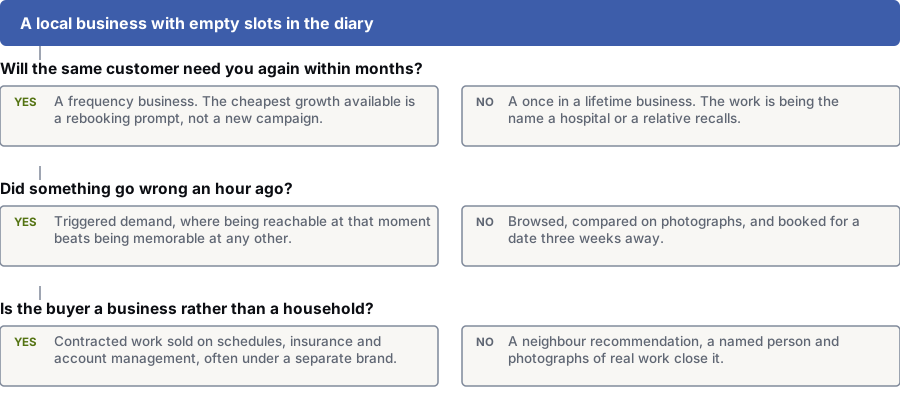
Will the same customer need you again within months?
Yes: A frequency business. The cheapest growth available is a rebooking prompt, not a new campaign.
No: A once in a lifetime business. The work is being the name a hospital or a relative recalls.
Did something go wrong an hour ago?
Yes: Triggered demand, where being reachable at that moment beats being memorable at any other.
No: Browsed, compared on photographs, and booked for a date three weeks away.
Is the buyer a business rather than a household?
Yes: Contracted work sold on schedules, insurance and account management, often under a separate brand.
No: A neighbour recommendation, a named person and photographs of real work close it.
Where they split
Where one consumer services strategy stops working
These differences are the reason the pages below are written separately rather than as one page with the business type swapped out.
- A frequency business and a once-in-a-lifetime business need opposite plans. A salon markets to the same person forty times across a decade; a funeral director meets most families once, cannot advertise urgency, and depends on being the name a hospice, a hospital or a relative recalls.
- Emergency-triggered and appointment services buy different kinds of attention. Pest control and vehicle recovery are searched under pressure, where answering first beats everything; a spa treatment is browsed, compared on photographs and booked for a date three weeks away.
- Part of this sector is bought by businesses rather than households. Contracted cleaning and commercial pest work are sold on schedules, insurance and account management, and one operator may run a consumer brand and a commercial one that share nothing but a van.
- Regulation ranges from almost none to considerable. Funeral services and animal care carry conduct rules, price transparency duties and licensing that a nail bar does not, and the tone permitted in the advertising varies just as widely.
Questions
Consumer services marketing questions, answered
We are already booked out. Why would we market at all?
Because being booked out and being profitable are not the same thing. A full diary made of low-value appointments at inconvenient times is worse than a slightly emptier one full of the work you want.
The questions worth asking are which hours are consistently empty, which services carry margin, and which customers you would happily see every month. Marketing that answers those is about shaping demand, not adding to it.
How much do reviews actually matter in this sector?
More than anything else the business controls. A customer choosing between three nearby options with no other information uses the rating, the number of reviews and how recent they are, and that comparison takes seconds.
Recency matters more than most owners expect. Forty reviews from two years ago read as a business that used to be good. A steady trickle every month, with owner replies to the difficult ones, reads as a business that is still paying attention.
Should we take online bookings when the owner prefers the phone?
Offer both, and make the online route work. A meaningful share of customers will not ring at all, particularly younger ones and anyone deciding at ten in the evening, and those bookings are simply lost rather than delayed.
The compromise that fails is a form that promises somebody will call back. That is a phone booking with extra steps, and it converts far worse than either a real calendar or a phone number.
All our best customers come from word of mouth. Can marketing help with that?
It can make recommendations easier to act on. A person given your name looks you up, and what they find either confirms the recommendation or quietly undermines it — a dead profile, no recent photographs and a rating from 2021 all cost referrals nobody ever hears about.
It also helps to give people something to pass on. A named practitioner, a specific thing you are known for and visible recent work make a recommendation concrete rather than a vague suggestion to try somewhere.
How do we compete with a national chain that outspends us?
By competing where scale is a disadvantage. Chains struggle with named individuals, real local knowledge, flexibility on unusual requests and reviews that mention a person rather than a brand.
They also cannot maintain a distinct profile for every branch the way an owner can for one location. Photographs of your actual premises and staff, accurate opening hours and replies written by the person who did the work beat a centrally managed listing consistently.
More to explore
Last updated · Published by Zubair Afzal (responsible editor), on owner authorisation