
Financial Services
Marketing for regulated financial businesses
Financial services sits in the highest-stakes category search engines recognise, under advertising rules that differ by country and change without notice. The work is building visibility and trust inside those constraints rather than pretending they are not there.
Prefer to talk it through? Book a strategy call
The category
Financial Services: what the businesses have in common
Financial marketing is constrained in ways that most categories are not, and pretending otherwise is how firms end up with a website their compliance function will not approve and an ad account that keeps getting restricted for reasons nobody has explained.
The constraints are also where the opportunity sits. Once rate claims and outcome promises are off the table, what is left is clarity, eligibility, process, credentials and speed of response, and almost nobody in this sector competes on those. These pages are written per business because a mortgage transaction and an insurance renewal are opposite commercial problems.
Deadlines and renewals
What splits financial services is when the customer has to act
All of it is regulated, high stakes and compared before anyone makes contact. What is not shared is timing, and a closing date and an idle reconsideration cannot be served by the same page.
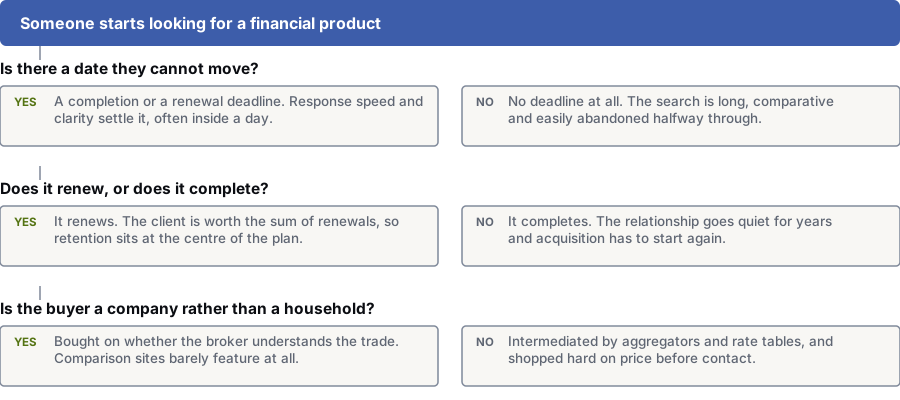
Is there a date they cannot move?
Yes: A completion or a renewal deadline. Response speed and clarity settle it, often inside a day.
No: No deadline at all. The search is long, comparative and easily abandoned halfway through.
Does it renew, or does it complete?
Yes: It renews. The client is worth the sum of renewals, so retention sits at the centre of the plan.
No: It completes. The relationship goes quiet for years and acquisition has to start again.
Is the buyer a company rather than a household?
Yes: Bought on whether the broker understands the trade. Comparison sites barely feature at all.
No: Intermediated by aggregators and rate tables, and shopped hard on price before contact.
Where they split
Where one finance strategy stops working
These differences are the reason the pages below are written separately rather than as one page with the business type swapped out.
- A one-off transaction and a recurring renewal are different businesses. A mortgage completes and the relationship goes quiet for years; a policy renews annually and the value of a client is the sum of renewals, which puts retention marketing at the centre of one and nowhere near the centre of the other.
- Personal and commercial lines behave nothing alike. Personal products are intermediated by comparison sites and shopped on price; commercial cover is bought on whether the broker understands the trade, and comparison sites barely feature.
- Regulatory regimes differ sharply between Canada, the United States, the United Kingdom and the United Arab Emirates, down to who may call themselves an adviser, what must be disclosed and how a rate may be shown. Multi-market firms cannot run one set of marketing claims across all of them.
- Urgency ranges from a hard external deadline to no deadline at all. A borrower with a closing date behaves entirely differently from someone idly reconsidering their cover, and the same page cannot serve both without failing one.
Questions
Finance marketing questions, answered
Who signs off compliance on the work you produce?
You do, and that is not a technicality. You hold the licence, you carry the regulatory obligation, and no agency can accept it on your behalf regardless of what they say in a pitch.
What we do is draft with the constraints in mind, flag anything that needs review, keep a record of what was published and when, and build pages so that a compliance change can be made in minutes rather than requiring a rebuild.
Why do our finance ads keep getting disapproved?
Most often because the advertiser has not completed the platform verification that financial services advertisers are required to hold in several countries, or because the landing page makes a claim about rates, returns or eligibility that the platform policy treats as restricted.
The policies differ by platform and by country and they change. The practical approach is to keep the account verification current, keep restricted claims off the landing pages entirely, and treat a disapproval as a diagnosis rather than an appeal to be argued.
Does search really treat financial content differently?
It treats it as higher stakes. Content that could affect someone’s money, health or safety is held to a stricter standard, which is why anonymous, thin or unreviewed financial pages struggle even with a strong link profile behind them.
The practical consequences are consistent: publish under named people with real credentials, show the regulated entity and its registration, date the content and review it on a schedule, and be explicit about what is general information rather than advice.
We operate in more than one country. Can we reuse the same website copy?
Not for anything that touches regulated territory. Required disclosures, licence categories, what counts as a financial promotion, how rates or premiums may be presented, and whether you may describe yourself as independent all differ between Canada, the United States, the United Kingdom and the United Arab Emirates.
Structure and design travel well. Claims, disclosures and product language do not, and they need separate review by someone qualified in each market before anything is published there.
Our competitors advertise things we are told we cannot say. What do we do?
Assume they are either operating under a different licence, taking a risk, or about to be told to stop. Matching a claim you have been advised against is not a marketing decision you get to make.
The more useful response is to compete where they are weak. Almost nobody in this category explains eligibility clearly, publishes an honest process, states how they are paid, or answers the awkward questions. That ground is open and it is not restricted.
More to explore
Last updated · Published by Zubair Afzal (responsible editor), on owner authorisation