
Business & Equipment Finance marketing
Equipment finance and business lending marketing
Business lending and equipment finance marketing that reaches borrowers the day the need appears, and wins on decision speed, not rate.

The rules
Before you publish an ad
In most markets, commercial lending is regulated differently from consumer lending, and the gap is narrower than lenders assume. In several jurisdictions, sole traders, small partnerships and businesses below certain thresholds get consumer-style protections. That changes what you must disclose, how cost may be presented and what recourse the borrower has. Assuming a business borrower sits outside the consumer rules is one of the more common and costly mistakes in this sector.
Where you advertise a cost of borrowing for credit under a consumer-credit regime, some markets require a representative example with prescribed components and prominence. Several US states now require cost disclosures for commercial finance, and restrict how a headline figure can sit next to it. Appetite and pricing move with funding conditions, so anything like this needs to be dated, qualified and quick to change — never a fixed claim baked into a page template.
Licensing, registration and broker status disclosure duties vary by market and activity. Calling a firm a lender when it introduces, or whole-of-market when it works from a panel, is a misrepresentation, not shorthand. Commission and introducer arrangements must be disclosed separately in several jurisdictions, some of which require disclosure to the borrower directly, not just an internal record.
Requirements differ a great deal between Canada, the US, the UK and the UAE — the regulator that applies, thresholds for small-business protection, rules on security and personal guarantees, and record-keeping duties for marketing communications. Material approved for one market is reviewed again before it’s used in another.
We write with these rules in mind and flag anything that needs judgement, but the licence, the credit policy and the regulatory duty are yours. Your own compliance function, regulator or legal adviser confirms every claim about cost, eligibility, approval, status or suitability before publication. Nothing here is legal, regulatory or financial advice.
Sources
Primary sources for these rules
Each rule above, linked to the body that publishes it. Which ones apply depends on where you work. Rules change, so check the latest version.
- Defines ‘individual’ to include small partnerships and unincorporated bodies, not only consumers.
- CCA 1974, s. 189
- Source: UK — Consumer Credit Act 1974, s. 189
- Promotions of regulated credit that state a rate or cost must include a prominent representative example.
- FCA CONC 3.5
- Source: UK — FCA Handbook, CONC 3.5
- Credit brokers must disclose the existence and nature of commission to the customer before the agreement.
- FCA CONC 4.5
- Source: UK — FCA Handbook, CONC 4.5
Common problems
Why your business lending marketing isn't bringing in work
A business doesn’t want finance. It wants the excavator, the delivery van, the second oven, the stock for a contract it just won, or six weeks between paying a supplier and getting paid by a customer.
Finance is how it gets there, and it turns urgent on one specific day. Borrowers compare you on the spot, and a fast answer beats a good price almost every time.
- Applications arrive that were never fundable.
- A generic enquiry form invites every business in the market, including ones outside every credit policy you have. Underwriters spend hours on files that could’ve been declined from the first line. Set out your appetite in the open: asset classes, trading history, deposit, situations outside policy. Volume drops and approval rate climbs at the same time.
- Nobody can say which introducer sent which deal.
- Dealers, brokers and accountants send deals, and nobody tracks which relationship produced which funded facility, at what margin or with what fall-out rate. So whoever visited last manages the relationship. A dealership that stopped sending deals six months ago gets noticed a year late. Tracking it decides where your business development team spends its week.
- Borrowers compare you on a number you can’t publish.
- Borrowers assume finance is a commodity and shop that way. Advertising rules restrict how a rate can be shown, and usually require a representative example with prescribed detail. Say nothing, and you hand the comparison to others. The open ground is everything the rate leaves out: how long a decision takes, what documents you need, what happens with a second-hand asset, whether a personal guarantee is required, and what the total cost includes.
- The borrower needs an answer today. Your process takes four days.
- A contractor who’s found the machine talks to three funders in one afternoon. Whoever answers first usually wins, even at a worse price. If your process takes days, say so, and explain what happens on each one. A borrower can plan around a known timeline, but not around an unanswered form. If the process could be faster, fixing it pays back more than any campaign.
- The accountant rewrites the deal after the quote.
- Whether a purchase is a lease, a hire purchase agreement or a loan changes the tax treatment, the balance sheet and who owns the asset at the end. The owner usually doesn’t know this. Their accountant does. So a deal you quoted with the owner can get restructured or moved after a call you weren’t on. Write material a professional adviser can check quickly, and you reach the person deciding.
How they choose
What customers check before they choose
Know how they choose and you know where to show up.
- Speed of answer decides more of these deals than price. Whoever comes back with a firm position — not just an acknowledgement — usually takes the deal, even at a slightly higher cost.
- Certainty counts for more than the headline number. A borrower approved and then repriced or declined late won’t come back, and brokers remember it longer than borrowers do. That’s why a stated appetite and consistent decisions build introduced volume over time.
- The introducer often chooses for the borrower. A dealer or broker with a customer in front of them sends the deal to the funder they trust to answer today. The borrower often never compares anything at all.
- The accountant decides the structure, and sometimes the lender. Tax treatment, who owns the asset at term end, and the balance sheet impact are their call. A lender whose material makes that easy to check keeps the deal it quoted.
- Businesses with a complication choose differently. A short trading history, a past arrangement, a used asset or an unusual sector sends them looking for a funder who’s done it before. They’ll pay more to avoid another decline.
- Repeat borrowing is strong and underused. A business that’s financed one asset will finance another within a few years. The current funder wins that by default, unless the last experience was poor.
A window measured in hours
Several funders get the call. The fastest answer usually wins.
The purchase is already decided. Finance is just the obstacle. So the rate is rarely what wins — coming back first with a firm answer usually is.
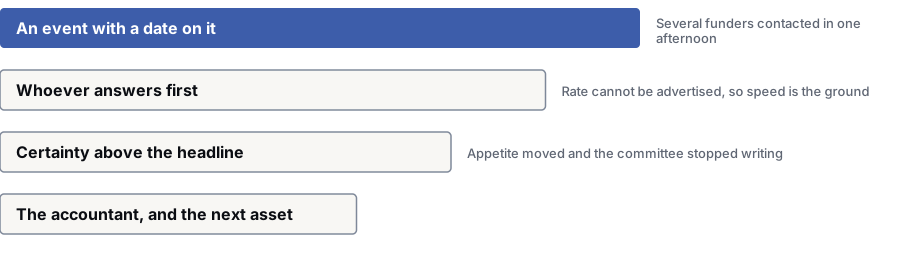
- 1An event with a date on it — A won contract, a broken machine, a stock build, or a gap between paying suppliers and being paid. Short-lived and already urgent.Several funders called in one afternoon
- 2Whoever answers first — Speed of answer decides more of these deals than price, and an introducer with a customer in front of them decides in seconds.Rate can’t be advertised, so speed is where you compete
- 3Certainty over the headline rate — A borrower approved, then repriced or declined late, won’t return. Brokers remember it much longer than the borrower does.Appetite moved and the committee stopped writing
- 4The accountant, and the next asset — Structure, tax treatment and balance sheet impact are the accountant’s call. A business that financed one asset will finance another within a few years.
What people search
What people type, like “equipment finance for contractors”
Financing a specific asset
The purchase is decided, finance is the obstacle. Short fuse, high conversion, and the searches name the machine.
- equipment finance for contractors
- excavator finance for a limited company
- commercial vehicle leasing for a new business
- catering equipment finance uk
- used machinery finance options
Cash flow and working capital
Set off by a gap more than a purchase. Often urgent, and the borrower often doesn’t know which product they need.
- invoice factoring vs invoice discounting
- working capital loan for a seasonal business
- finance to cover a vat bill
- funding for a contract we have just won
- merchant cash advance for a restaurant
Structure and eligibility questions
Asked by the owner, checked by their accountant. This is where a deal gets restructured or moved elsewhere.
- hire purchase vs lease for equipment
- business loan for a company trading under two years
- do i need a personal guarantee for asset finance
- balance sheet treatment of an operating lease
- sale and leaseback of existing machinery
Speed and process
Where you compete when rate can’t be advertised. Almost no lender writes for these searches.
- how long does a business loan take to approve
- same day equipment finance decision
- what documents do i need for asset finance
- fastest business finance for a limited company
- asset finance broker near me
These are example searches from keyword research and public search data. Before we suggest anything, we check how often people search for them in your area.
Where to spend
Why landing pages comes before measurement
In the order we'd put them. Start at the top.
A page for each asset class and each situation
A contractor financing a five-year-old excavator, a restaurant fitting a kitchen and a haulier adding two trucks all ask different things — deposits, terms, residual values, used equipment. One general business finance page answers none of them. Pages built per asset class and trigger convert better, and because they state your appetite clearly, they screen the application before it reaches an underwriter.
Reporting that runs all the way to drawdown
We connect each enquiry source to the application submitted, the credit decision and the money drawn down, split by asset class and introducer. Without that chain, you back the channel with the most applications — usually the one whose applications the credit team declines — and the true cost per funded facility stays hidden.
Rank for the situations owners search in
Owners rarely search “business lending”. They search the situation: cash-flow gaps before a big contract, equipment they need now, a tax bill. Pages for each situation, with eligibility and timelines stated honestly, reach owners at the moment they are choosing a lender, and stay within the rules on how credit can be promoted.
Your website
Is your website losing you work?
- A clear statement of appetite: asset classes funded, minimum trading history, deal size range and situations outside policy
- A page for each major asset class, written in the language of the trade that buys it
- Clear decision timelines, step by step, including what the borrower must supply at each stage
- A document checklist so applications arrive complete and the first underwriting pass gets somewhere
- Simple comparisons of lease, hire purchase and loan structures that an accountant can check quickly
- A separate section for dealers, brokers and accountants, with appetite documents and a named contact
- The licensed or registered entity, its registration and the markets it operates in, shown clearly
- Any rate or cost illustration shown as a compliant representative example, dated and quick to amend, or left out
Measuring results
Results you can check
These numbers show if your marketing brings in customers. Website visits alone don't.
- Applications submitted, and the share that fall inside your stated credit appetite
- Applications approved as a share of applications received, kept apart from enquiry counts
- Approval-to-drawdown rate, with the reason recorded when an approved facility isn’t taken
- Funded volume and number of facilities, split by asset class and product structure
- Cost per funded facility by source, never cost per enquiry
- Time from application to decision, measured in hours and reported weekly
- Introduced volume traced to named dealers, brokers and accountancy firms
- Repeat facility rate from businesses already funded, tracked against the useful life of the first asset
Questions
Short answers on business lending marketing
Most of our volume comes from brokers and dealers. Why market directly at all?
Because introducers choose between funders on the same things a borrower does, and what they find about you in public shapes that choice. A dealer deciding where to send a deal checks whether your appetite covers it and how fast you answer. If it isn’t published, they fall back on habit.
Direct demand is also your cheapest cover against relying on a few sources. A lender with four introducers has four points of failure. Rebuilding origination after losing one takes far longer than keeping a second source going would have.
We can’t advertise a rate. What’s left to compete on?
Decision speed, certainty and appetite. Borrowers and brokers choose on these once they accept that money is broadly a commodity. Few lenders publish how long a decision takes, what they need to make it and what they won’t fund, so that ground is open in most markets.
It also brings better applications. A borrower who’s read what you fund and still applies is a very different prospect from one who filled in a general form, and your approval rate shows it.
How do we stop wasting underwriting time on applications we decline?
Show the credit policy before the application. List asset classes, minimum trading history, deal size and common decline reasons on the page itself. That removes a large share of unfundable applications before anyone opens a file.
Then build the form around what the first credit pass needs. The goal is a form that produces an application you can decide on, whatever its length. Volume falling while approvals rise is the result you want.
Our appetite changes with our funding. How do we keep marketing current?
Store your appetite as content anyone can edit in minutes, kept out of fixed page designs. Asset classes, deal size ranges and policy notes should sit where a credit or product manager can change them without a developer.
Agree who owns the update and when it happens. Most of the damage comes from marketing that keeps advertising the old position for a quarter after appetite changes.
Is this the same as marketing a mortgage brokerage?
No. The borrower is a business, and the security is often the asset being financed, rarely a home. The decision involves an owner, sometimes a finance director, and usually an accountant who cares about tax treatment and balance sheet effect.
Distribution differs too. Residential broking runs on estate agents and consumer referrals. This market runs on equipment dealers, vendor programmes and commercial brokers. The point of sale is often the dealer’s forecourt, well before any search result.
Want to know what you could win?
Start with the free checkup. It shows what to fix first on your website, with no sign-up. Want the full plan for your business lending business? Book a call, and we'll look at your market, your competitors and the searches that bring in customers.
Prefer to talk it over? Book a free call
Your BOOSTD score improves within 90 days, or your next month is free. After 6 months, more traffic or leads, or we keep working free (up to 6 free months in any 12 months). Read our guarantee
References
Sources for equipment finance marketing
The official documents and research this page is based on. Platform rules change, so check the source before you act on a detail.
Related
More on business lending marketing
- application pages that screen borrowers first
- programmes for introducers and repeat borrowers
- building pipeline with a business buying group
- marketing for payments and lending technology
Guides for business lending
Other finance businesses
Last updated · Published by Zubair Afzal, responsible editor · We check this page every three months. Next check: .