
Mortgage Brokers marketing
Mortgage broker marketing for more funded purchase and refinance deals
Mortgage broker marketing that treats purchase and refinance as two markets, so you get more funded deals and fewer wasted enquiries.

Timing
Busy months and quiet months
Demand follows interest rates and housing sales, and the brokerage controls neither. Refinance volume can multiply or vanish within a quarter when rates move. Build a plan that can shift weight between the two products.
Purchase demand is seasonal in most markets. Activity peaks in spring and early summer, with a smaller rise in early autumn. Plan campaigns and content ahead of that calendar, not two months after it.
In markets with fixed terms, you can see renewal dates coming. A good share of any brokerage book reaches renewal on a date already in your system. That makes retention marketing more predictable than any acquisition channel, and much cheaper.
Licensing is set by province or state, so you can only serve borrowers where you’re licensed, even when searches are national. A national content plan for a locally licensed brokerage brings in enquiries you can’t serve.
Purchase decisions are quick and refinance decisions are slow. A pre-approval request is usually acted on within days. A refinance enquiry can sit for months until a penalty calculation or a rate move tips it.
Two files, two clocks
One is decided in days. The other can sit for months
Purchase and refinance are both mortgage enquiries, and they’re won in very different ways. One cost-per-file figure for both hides which one is paying.
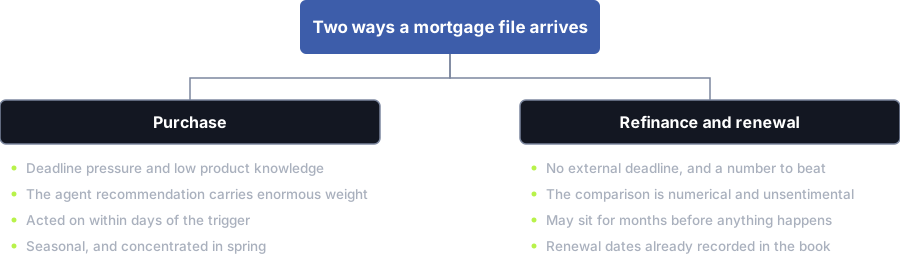
Purchase
- Deadline pressure and little product knowledge
- The agent’s recommendation carries huge weight
- Acted on within days of the trigger
- Seasonal, and busiest in spring
Refinance and renewal
- No outside deadline, and a current rate to beat
- The comparison is all about the numbers
- May sit for months before anything happens
- Renewal dates already in your book
Common problems
Where mortgage broker businesses lose customers
A mortgage brokerage has two demand curves, and they often move in opposite directions. Refinance surges when rates fall and dries up when they rise. Purchase follows listings, confidence and the season.
Most mortgage broker marketing assumes one steady market, so it works for two quarters and stalls for the next two. Know which demand your market has now, and be set up for both.
- Purchase and refinance run through one funnel.
- A buyer with a firm completion date and a homeowner wondering whether to break their term need different pages, response times, questions and follow-up. Mix them and the homepage speaks to neither, and an urgent file gets treated like a maybe. Separating them is often the biggest single improvement a brokerage website can make.
- The enquiry arrives and sits until the afternoon.
- Borrowers contact several brokers in one sitting. The first to reply with a useful answer, and not just an automatic confirmation, usually gets the file. This is where most brokerages lose deals they have already paid for. Measure speed to first contact in minutes; the fixes are usually quick.
- Purchased leads are rate shoppers sold to four brokerages at once.
- Bought leads convert badly in this sector. They’re often resold, the borrower is comparing on price alone, and after two years of buying them a brokerage is back where it started.
- Your best pipeline is agents and builders, and nobody manages it.
- Most brokerages get a large share of purchase business from real estate agents, builders, accountants and lawyers. Few treat that as a channel with a plan, so referrals depend on how recently someone had lunch.
- The ad account keeps getting restricted and nobody knows why.
- Financial services advertisers must complete platform verification in several countries. Ad policies also limit how rates, approvals and savings can be shown. A landing page that shows a rate without its conditions, or copy that implies approval is guaranteed, will trigger disapprovals. Keeping restricted claims off your pages works better than appealing each rejection.
Where to spend
Spend on local SEO first, then conversion fixes
In the order we'd put them. Start at the top.
Visibility in the areas where you can lend
Licensing is local, so aim to lead in a defined area instead of chasing national reach. That means a well-kept Google Business Profile, steady reviews, and area pages that describe each local housing market, not a template with the town name swapped.
Calculators that qualify borrowers
Affordability, payment and penalty calculators are the highest-intent tools on a brokerage site, yet most are treated as decoration. Built well, they catch a borrower mid-calculation and collect what you need to route the file. They also separate a serious purchase enquiry from a browser, with no twenty-field form.
Material your referral partners can use
Agents, builders, accountants and lawyers send business to the broker who makes them look well informed. Co-branded buyer guides, document checklists, first-time buyer sessions and clear notes on programme eligibility give them something to hand over. This channel drives purchase volume, and it almost never gets a budget.
Reporting that follows each lead to a funded deal
We connect each enquiry source to applications started, applications submitted and deals funded, split by product. Without that link, a brokerage chases whichever channel fills the most forms. That is usually the channel full of rate shoppers who never complete.
What people search
Searches like “how much mortgage can i afford”
Purchase and first-time buyers
Deadline pressure and little product knowledge. An agent is usually involved too.
- how much mortgage can i afford
- how much down payment do i need
- mortgage pre approval online
- first time home buyer programs [region]
- mortgage broker near me
- what documents do i need for a mortgage
Refinance and renewal
No outside deadline and a number to beat. These searches rise and fall with rates.
- should i renew or switch my mortgage
- is it worth breaking my mortgage
- mortgage penalty calculator
- refinance to consolidate debt
- home equity loan vs refinance
Difficult qualification
Where specialists win and generalists slowly lose. Higher value and far less competition.
- mortgage for self employed
- mortgage with bad credit
- mortgage for newcomers to canada
- second mortgage for debt consolidation
- mortgage after a consumer proposal
Choosing a broker
The evaluation stage. Most brokerage websites answer these questions badly.
- mortgage broker vs bank
- do mortgage brokers charge a fee
- how do mortgage brokers get paid
- best mortgage broker [city]
- questions to ask a mortgage broker
These are example searches from keyword research and public search data. Before we suggest anything, we check how often people search for them in your area.
Measuring results
The numbers we report
These numbers show if your marketing brings in customers. Website visits alone don't.
- Applications started, and applications submitted to a lender
- Pre-approvals issued, and how many of them go on to fund
- Funded volume and number of deals, split by purchase, refinance and renewal
- Cost per funded deal by source, alongside cost per enquiry
- Speed to first contact, in minutes, reported weekly
- Deals from named referral partners, so that pipeline is visible
- Renewal retention rate against the part of the book due for renewal
- Calculator completions that turn into contact, as an early signal before funding data arrives
Your website
Your website checklist
- Licensing shown clearly: legal entity, brokerage and individual licence numbers, and the areas you cover
- Separate, obvious paths for purchase and for refinance or renewal from the first screen
- Calculators that work and give results a borrower can act on, without a form blocking the answer
- A clear explanation of how the broker is paid, because every borrower wonders and few ask
- A document checklist, so applicants arrive prepared and the first call gets somewhere
- Named brokers with photos and individual licence numbers, in place of a generic team page
- Instant contact options, including click-to-call and booking, since borrowers are contacting competitors at the same time
- Content on the harder cases you want: self-employed, newcomers, damaged credit, rental property
- Any rate shown with a date and its conditions and easy to update, or left off entirely
The rules
What you can say in your ads
Mortgage broking is licensed, and its advertising is regulated in every market we cover. The common rules are: disclose the licensed firm and its registration number, follow the rules on how rates and payments may be advertised, only call the firm independent or whole-of-market where allowed, and keep records of marketing material for a set period.
The rules differ sharply between Canada, the United States, the United Kingdom and the United Arab Emirates. Regulators, licence types, required disclosures, what counts as a financial promotion and how a rate must be qualified all vary. Nothing written for one market can be used in another without its own review.
Ad platforms add their own rules on top of the regulator’s. Financial services advertisers must complete verification in several countries, and ad policies limit how approvals, rates and savings may be shown in ads and on landing pages. Missing that check is a common cause of disapprovals that seem to have no explanation.
Rate tables and best-rate wording carry the most risk and go out of date fastest. If you want to publish rates, we build them dated, with their conditions and quick to update. We usually prefer a range with the qualifying conditions to a single headline number.
We write with these rules in mind and flag anything that needs review. Every claim must still be confirmed by your own regulator, compliance team or legal adviser before it goes live. We don’t give legal, regulatory or financial advice, and compliance sign-off stays with you.
Sources
Read the rules yourself
Each rule above, linked to the body that publishes it. Which ones apply depends on where you work. Rules change, so check the latest version.
- Advertised credit rates must be stated as an APR, and payment or term figures trigger further disclosures.
- Regulation Z §1026.24
- Source: US — CFPB Regulation Z, 12 CFR 1026.24 (eCFR)
- Sets the financial promotion rules for home finance, including mortgages.
- FCA MCOB 3A
- Source: UK — FCA Handbook, MCOB 3A
- An Ontario mortgage brokerage must disclose its authorised name and licence number in its public materials.
- O. Reg. 188/08, s. 6
- Source: Canada (Ontario) — O. Reg. 188/08, Mortgage Brokerages: Standards of Practice
Questions
Mortgage broker marketing questions and answers
Rates just moved and our refinance pipeline vanished. What do we do?
Shift weight to purchase and to renewal retention, and do it early. Don’t wait for a quarter of bad numbers. The two products often move in opposite directions, so a brokerage set up for both can rebalance within weeks.
That is why purchase and refinance need separate paths, campaigns and content. A merged funnel can’t be rebalanced, so a rate move hits the whole business at once.
Should we publish rates on our website?
Only if you can keep them current and correctly qualified, and only after your compliance team approves the format. A stale rate loses enquiries and creates regulatory risk. The rules on how rates must be shown differ by market.
A common middle ground is a range with the conditions that affect it, plus a date. Then put your effort into content on eligibility and process. That content ages slowly and attracts borrowers who aren’t shopping on price alone.
Are purchased mortgage leads worth it?
Occasionally, as overflow. Rarely, as a foundation. Bought leads are often sold to several brokerages at once, which turns each file into a race and squeezes the margin.
They also build nothing. Two years of buying leads leaves you where you started. The same spend on your own visibility and referral relationships keeps working after you stop paying.
How do we market to real estate agents without being a nuisance?
Give them something their clients want. Co-branded buyer guides, document checklists, clear notes on programme eligibility and joint first-time buyer sessions all make the agent look well informed in front of their client.
Referrals follow from being useful. Agents refer to the broker who makes their deal easier and replies fast when they send a client over. So quick replies and partner material work best as one programme.
Can you guarantee a number of funded deals?
No. Funded volume depends on rates, local housing sales, lender policy, your own criteria and how fast your team replies. Most of that is outside anyone’s control, yours included.
We commit to doing the agreed work and reporting on funded deals, not enquiry counts. If market conditions mean a channel won’t pay its way this quarter, our report will show it.
Get your free checkup
Start with the free checkup. It shows what to fix first on your website, with no sign-up. Want the full plan for your mortgage broker business? Book a call, and we'll look at your market, your competitors and the searches that bring in customers.
Prefer to talk it over? Book a free call
Your BOOSTD score improves within 90 days, or your next month is free. After 6 months, more traffic or leads, or we keep working free (up to 6 free months in any 12 months). Read our guarantee
References
Sources for mortgage broker marketing
The official documents and research this page is based on. Platform rules change, so check the source before you act on a detail.
Related
More on mortgage broker marketing
- mortgage broker website designsCalculators, secure applications and licence-ready footers.
- insurance broking marketing
- bringing cost per lead down
- marketing in Canadian markets
Guides for mortgage broker
Other finance businesses
Last updated · Published by Zubair Afzal, responsible editor · We check this page every three months. Next check: .