
Wealth Management & Financial Planning marketing
Wealth management marketing that wins the households you want
Wealth management marketing that brings in more households at your minimum, and wins on a clear philosophy, open fees and who you serve.

How they choose
How customers decide who to hire
Know how they choose and you know where to show up.
- The recommendation comes first. The check comes second. Someone trusted names a firm. The prospect searches the firm, the adviser and their designation before agreeing to meet. What turns up decides if the introduction survives.
- Fees are the first big question, and most firms answer it last. Percentage of assets, flat retainer, hourly, commission — each changes the conversation. Can’t find the answer? Prospects assume it’s bad news.
- Designations are shorthand for competence, since prospects have no other way to judge it. They check which qualifications you hold, which regulator you answer to, and whether they can confirm it themselves.
- The trigger is almost always a life change, rarely unhappiness with a current adviser. Retirement, an inheritance, a business sale, a divorce, losing a spouse — someone choosing an adviser for the first time, under stress.
- Continuity matters more here than almost anywhere else. A household committing for thirty years wants to know who they’ll speak to, whether that adviser will still be around, and what happens when they’re not.
- Prospects want to know who else you serve. Describe your typical household — profession, life stage, complexity — and you’re easier to say yes to than a firm that claims to serve everyone equally well.
Referral, then a background check
What a referred household checks before they say yes
Nearly every household arrives through someone they trust. Next comes a search. Turn up nothing, and the introduction fades.
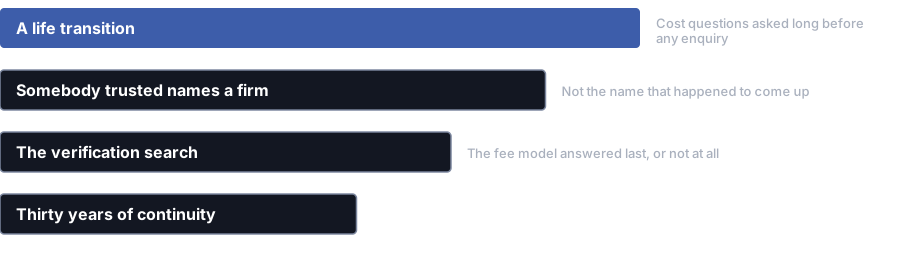
- 1A life change — A business sale, a retirement date, an inheritance or a divorce. Life events drive demand here — seasons and campaigns barely move it.Cost questions asked well before any enquiry
- 2Someone trusted names a firm — Introductions arrive in lumps, because they rest on a few relationships. Four accountants sending three households each never averages out.Your firm wasn’t the name that came up
- 3The background search — The prospect looks up the firm, the adviser, the designations and the registrations. Turn up nothing, and the introduction fades.Fees explained last, or not at all
- 4Thirty years of continuity — Who they’ll speak to, whether that adviser will still be there, and what the firm does when they’re not.
Common problems
Why wealth management ads and SEO fall flat
A family hands you the money they’ll live on for the rest of their life, on trust nobody can check for twenty years. Normal marketing wasn’t built for that.
Most new households come through an introduction. The search comes after. So the real question is what a referred prospect finds when they look you up, and whether it backs up the recommendation.
- The book belongs to the adviser, but the marketing budget belongs to the firm.
- Clients choose a person, not a logo. They follow their adviser to a new firm, look them up by name before the first meeting, and talk about the relationship as personal. Spend everything on the corporate brand and keep advisers off the site, and you build none of the trust clients are buying. Show your advisers under the firm’s roof, and let the firm stand for continuity and scale.
- Nobody can say which accountant sent which household.
- A handful of professional contacts bring in most new clients, and they live in one partner’s memory. Nobody records where a client came from. There’s nothing an accountant or solicitor can hand their own client, and no reason for them to think of you when it matters. When one of those contacts retires, the flow stops — and it can take two years to work out why.
- Your minimum is a secret, so you get enquiries you’ll turn down.
- Households below the threshold enquire, take up time and get declined. Households well above it can’t tell if you’re built for them, so they assume you’re not. State your minimum, with a short reason why advice below it doesn’t make sense.
- Every firm’s website makes the same three claims.
- Independent. Personal. Long-term. Every planning firm says it, so it tells a reader nothing. You can’t talk about returns, so say something a competitor might disagree with: a stated investment philosophy, a defined type of household, a fee schedule in numbers, and the clients you turn away.
- Compliance sees the copy after the design is signed off.
- Promotion rules, limits on describing performance, record-keeping and designations all apply before anyone asks if a page reads well. Leave the review to the end and you get a rebuild, or a page stripped of everything worth reading. Write inside the rules from day one and compliance becomes a quick check.
What people search
What people type, like “financial advisor near me fees”
Cost, fees and whether advice is worth it
The biggest group. Firms hate answering these in public. People search them long before they enquire.
- financial advisor near me fees
- how much does a financial advisor cost
- fee only vs commission financial advisor
- is a 1 percent aum fee worth it
- do i need a financial advisor with 500k
Life changes that start the search
Typed by someone choosing an adviser for the first time, under pressure. Low volume, high value.
- what to do with an inheritance
- financial planning after selling a business
- retirement income planning advice
- financial adviser after divorce
- managing a lump sum from a pension
Checking credentials
The check that follows every referral. Turn up nothing, and the introduction fades.
- how to check if a financial advisor is registered
- cfp vs cfa which qualification
- what does fiduciary mean for an adviser
- questions to ask a financial planner
- how do i know if my adviser is independent
Comparing types of provider
Searched before someone even looks at named firms.
- private bank vs independent wealth manager
- robo advisor vs human adviser
- discretionary vs advisory portfolio management
- wealth manager minimum investment
- do i need a planner or an investment manager
These are example searches from keyword research and public search data. Before we suggest anything, we check how often people search for them in your area.
Where to spend
Why your Google profile comes before search content
In the order we'd put them. Start at the top.
The profile a referred prospect checks before replying
Someone just given your name checks you out on their phone within the hour. A complete, accurate Google profile helps at that fragile moment — current hours, office photos and reviews that sound like real clients. It also picks up local searches from people with no professional network to ask.
Answering the fee question in public
Cost and eligibility questions carry the search volume here, and almost nobody answers them properly. Explain how your charges work, what they cover and where your minimum sits. You attract households that already accept the model, and skip the awkward first ten minutes of every meeting.
A first meeting that’s easy to book and clear on who qualifies
Most planning websites lose people between interest and a first meeting — usually an unattended form asking for a phone call, with no mention of who you serve. State your minimum. Describe the first meeting and name who’ll be in it. Offer a live calendar.
Your website
Make your site easy to buy from
- Your regulated entity, registration number and regulator, named clearly, with the jurisdictions you’re licensed in
- Your household minimum, stated, with a short reason why advice below it doesn’t make sense
- Your fee schedule in numbers — what’s covered, what isn’t, and how third-party costs are charged
- Named advisers with photos, designations and a registration prospects can check themselves
- A written investment philosophy specific enough that another planner could argue with it
- What happens at the first meeting: who attends, how long it takes, what to bring and what it costs
- A clear answer: what happens to the relationship if your adviser retires, leaves or is unavailable
- Any performance, returns or comparison wording dated, qualified and easy to amend, or left out entirely
Measuring results
How you'll know it's working
These numbers show if your marketing brings in customers. Website visits alone don't.
- Qualified enquiries from households at or above your stated minimum
- First meetings held, and the meeting-to-client rate for each adviser
- New client households onboarded, reported apart from enquiry counts
- Assets brought in by new households, and the average relationship size at onboarding
- Introductions traced to named centres of influence, so your largest channel shows up
- Clients lost, and why — retention sets the value of every household you win
- Share of new households arriving through introduction, search and existing-client referral
- Enquiries traced to each adviser, so the people carrying the trust show up in the reports
The rules
The rules on claims
Marketing from an advice firm is a regulated communication everywhere we work. You must identify your licensed entity and registration. There are limits on describing past performance and expected returns. Rules govern whether you can call yourself independent or a fiduciary. Professional designations are controlled. And promotional material has to be kept on record for a set period.
Requirements differ a lot between Canada, the US, the UK and the UAE — who can use the title adviser or planner, what counts as a financial promotion, how fees must be shown, whether testimonials are allowed at all. Several of these rules changed in the last few years. Material approved for one market on one date isn’t automatically valid elsewhere, or forever.
Testimonials and client stories are what firms in this category get wrong most often. Some regulators restrict them heavily or ban them in certain channels. Others allow them with set disclosures about payment and conflicts. Almost all treat a performance claim inside a testimonial as a performance claim. We check anything like this against your own rules before it’s drafted.
Case studies and household examples carry client confidentiality duties, separate from the promotion rules. Figures, professions, locations and family details can identify someone in a small market, even with the name removed. The safer option is usually an illustrative example built from composite or hypothetical facts, labelled as such.
We write inside these rules and flag anything that needs judgement. But you hold the licence and the obligation. Your own compliance function, regulator or legal adviser confirms every claim about performance, fees, independence, designations or regulatory standing before publication. We don’t give financial, legal or regulatory advice, and we don’t give or accept sign-off on it.
Sources
Links to each rule
Each rule above, linked to the body that publishes it. Which ones apply depends on where you work. Rules change, so check the latest version.
- Governs adviser advertising, including performance presentation and testimonials with required disclosures.
- SEC Marketing Rule
- Source: US — SEC Rule 206(4)-1, 17 CFR 275.206(4)-1 (eCFR)
- Sets approval, filing, record-keeping and content standards for broker-dealer communications.
- FINRA Rule 2210
- Source: US — FINRA Rule 2210, Communications with the Public
- Sets conditions on how past and future performance may be shown in financial promotions.
- FCA COBS 4.6
- Source: UK — FCA Handbook, COBS 4.6
Questions
Common questions about wealth management marketing
Should we publish our minimum?
Yes, in almost every case. Hiding it brings enquiries from households you’ll decline, and leaves the ones you want unsure. That’s the opposite of what the secrecy was meant to do.
Publish it with a reason. Planning takes a similar amount of time whatever the portfolio size — below a threshold, the fee stops being fair to the client. Put that way, it reads as fairness, not a velvet rope.
Our growth comes from three accountants. Does marketing matter for us?
Yes, and those three accountants are exactly why. A professional who introduces a client puts their own relationship on the line, and the first thing that client does is look you up. A thin or anonymous website makes their decision harder every time.
Beyond that, treat introductions as a channel you manage. Record where every household came from. Give each professional something their own clients would find useful. And build a fourth and fifth relationship before one of the three retires.
What can we say when we can’t talk about returns?
More than you think. You can explain your investment philosophy and why you chose it, your fees in numbers, and who you serve and turn away. You can cover what planning includes, how you handle conflicts, and who’ll be in the room in year ten. Almost none of your competitors publish this.
That’s where you stand out. Firms that keep trying to compete on restricted claims end up saying nothing, and leave that open ground empty.
Our advisers won’t write or appear on the website. Can this still work?
Partly, and it’ll fall short in a category where clients choose a person. Prospects search your adviser’s name before a meeting. Finding nothing weakens a referral that had almost won them over.
The fix is an hour’s interview with the adviser. Someone else drafts from it, and the adviser approves it before compliance review. The adviser never has to write, and the substance is theirs.
How is this different from marketing a mortgage or insurance brokerage?
Time span is the big difference. A mortgage completes and goes quiet. A policy renews each year. A planning relationship is meant to run for decades and survive your adviser changing firms. That puts continuity, succession and reputation at the centre.
The rules differ too. In broking, rate and premium claims dominate compliance thinking. Here, the restricted ground is performance, returns, suitability and testimonials. The open ground is fees, philosophy and process.
Find your quickest wins
Start with the free checkup. It shows what to fix first on your website, with no sign-up. Want the full plan for your wealth management business? Book a call, and we'll look at your market, your competitors and the searches that bring in customers.
Prefer to talk it over? Book a free call
Your BOOSTD score improves within 90 days, or your next month is free. After 6 months, more traffic or leads, or we keep working free (up to 6 free months in any 12 months). Read our guarantee
References
Sources for wealth management marketing
The official documents and research this page is based on. Platform rules change, so check the source before you act on a detail.
Related
More on wealth management marketing
- articles published under an adviser’s own name
- marketing for business lenders and equipment finance
- our standards for claims about money
Guides for wealth management
Other finance businesses
Industries close to wealth management
Last updated · Published by Zubair Afzal, responsible editor · We check this page every three months. Next check: .