
Charities & Nonprofits marketing
Charity marketing agency for donors and the people you help
Charity marketing that grows regular giving and legacies and helps people find your services, within Ad Grant policy and fundraising rules.

The rules
Stay inside the ad rules
Google Ad Grants comes with rules before it comes with budget. Eligibility depends on registered charitable status, and several types of organisation are excluded outright. The account also has rules commercial advertisers never face: search ads only, no single-word keywords, no keywords below a minimum quality score, required geographic targeting, conversion tracking that records real conversions, and a click-through rate floor that can get an account deactivated. Policies change, so read the current rules in Google's own documentation, not an agency deck, including ours.
In most markets fundraising is regulated separately from charity registration. Depending on the country, and often the state or province, a charity may need to register before asking for donations there, disclose set information when it asks, follow a legal or self-regulatory code of practice, and follow rules on approaching people who may be vulnerable. Involving a professional fundraiser or third-party platform usually has to be disclosed too.
Tax statements are the easiest thing to get wrong on a charity website, because the answer differs for every country a donation might come from. Gift Aid, deductibility and receipting each have their own conditions, and copy promising a donor a tax benefit they don't qualify for is a problem for the charity. Say only what the charity can back up, country by country.
Content about the people you help carries duties fundraising content doesn't. Consent to be photographed or described must be informed, recorded and possible to withdraw; safeguarding limits what may be published about children and people at risk; and data protection rules treat much of what a charity holds about service users as sensitive. Dignity is a sector standard too: several fundraising codes cover how the people a charity helps may be shown.
Campaigning has limits ordinary advertising doesn't. In a number of jurisdictions, rules on political activity by charities, and on regulated periods around elections and referendums, restrict what may be published and spent. This is for the charity and its own advisers; we flag content that looks like it needs that check well before publication.
Sources
Check the rules at the source
Each rule above, linked to the body that publishes it. Which ones apply depends on where you work. Rules change, so check the latest version.
- No single-word keywords, keywords with quality score 1 or 2 paused, and a 5% account click-through rate.
- Ad Grants policy
- Source: Google Ad Grants Policy Compliance Guide
- Standards for charitable fundraising in the UK, including how donors and people in vulnerable circumstances are treated.
- Code of Fundraising
- Source: Fundraising Regulator, Code of Fundraising Practice (UK)
- What campaigning and political activity charities may undertake, and the limits on it.
- CC9
- Source: Charity Commission guidance CC9 (England and Wales)
Common problems
The charity marketing traps to avoid
Charity marketing asks one website to do two jobs that pull against each other: convince a donor a problem is urgent and that money will help, and help someone living with that problem find support without making them feel like a case study.
Most of the difficulty comes from running both through one homepage, one tone and one set of pages, inside rules most marketing advice ignores. A good charity marketing agency starts by pulling those jobs apart.
- One homepage is serving donors, service users, volunteers and funders.
- Each came for a different reason and is put off by messages written for the others. Someone looking for help doesn't want an appeal before the eligibility criteria; a donor doesn't want a service leaflet; a grant funder wants governance and evidence. Give each group its own route from the first click, and keep every fundraising ask off the service route.
- The Ad Grant account was set up once and left.
- The signs are familiar: a handful of old keywords, no conversion tracking that records anything real, ad groups paused for breaking policy, and a click-through rate below the programme requirement. The grant is valuable run as an account with rules, and worthless treated as free money that looks after itself.
- Almost everything raised is a one-off gift.
- A one-off donation is a transaction; a monthly gift keeps paying, and after eighteen months is worth several times a single gift from the same donor. Charities judging appeals on total raised keep choosing many single gifts over fewer regular givers, and the shortfall shows up in a later financial year.
- The people you exist to help cannot find the help.
- Service pages are often written in the language of the funding bid: outcomes, cohorts, interventions. People type something else at eleven at night. Whether they reach out depends on four answers — is it free, am I eligible, is it confidential, what happens next — which belong on the first screen.
- Nobody can say what it costs to raise a pound, by channel.
- Fundraising cost is reported once a year as one total, which tells trustees almost nothing about which channel to fund. The useful numbers are cost per regular giver recruited, cost per pound of first-year income, and the share of donors still giving after twelve months. Hardly anyone collects them.
- Legacy giving is never mentioned because it feels intrusive.
- A gift in a will is the largest gift most charities will receive, usually from long-standing supporters who just needed to know it was possible. A simple page on how it works, the wording a solicitor needs and what such gifts have paid for is low-pressure and useful, and many charity websites lack one.
How they choose
Why they pick one business over another
Know how they choose and you know where to show up.
- A donor is usually prompted by something specific — a diagnosis, a bereavement, a news story, a friend fundraising — and often chooses the first credible charity that meets that moment well.
- Trust is checked quickly and on the surface: a registration number, a real address, named trustees, recent accounts and some sign the money does what the appeal said.
- Many donors judge on how much income goes to the cause, fair measure or not. A charity that explains its own costs clearly does better than one that lets donors find the figure elsewhere.
- People set up regular giving once and rarely review it, so the sign-up moment is especially valuable and a clumsy donation form especially costly.
- Corporate partnerships and charity-of-the-year choices are often settled by staff vote, so being recognisable and easy to explain at work matters more than the proposal.
- Grant funders and commissioners choose on evidence, governance and track record, reading your website as due diligence before any conversation.
- Someone looking for help chooses on completely different grounds: is it free, am I eligible, is it confidential, how soon can I be seen, will I be judged?
Two readers
Why donors and people seeking help need separate routes
Your website serves a donor and a person in difficulty at the same time. What works for one can harm the other. Most sites are built only for the first.
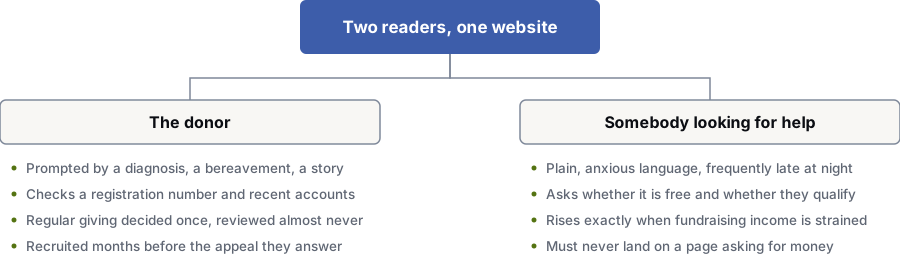
The donor
- Prompted by a diagnosis, loss or story
- Checks registration and recent accounts
- Sets up regular giving once, rarely reviews
- Recruited months before the appeal
Someone looking for help
- Plain, anxious words, often late at night
- Asks if it is free and if they qualify
- Need rises just as fundraising gets harder
- Must never land on a page asking for money
What people search
Searches such as “donate to [cause] charity”, grouped by intent
People ready to donate
Prompted by a specific event and usually acted on quickly. Generic terms are crowded. Terms tied to a cause or a moment rarely are.
- donate to [cause] charity
- best charity for [cause] uk
- how much of my donation goes to the cause
- charity christmas gift in someone’s name
- leave a gift in my will to charity
Someone looking for help
Plain, often anxious words, frequently late at night. These searches must never land on a page that asks for money.
- free debt advice near me
- [condition] support group [town]
- help with food this week [area]
- is [service] confidential
- who can i talk to about [problem] free
Volunteers and supporters
A steady, low-cost source of help and future donors. Usually served by one page that answers almost none of their practical questions.
- volunteer opportunities near me weekends
- charity shop volunteering [town]
- fundraising ideas for [cause]
- sponsored run for charity [city]
Funders, companies and due diligence
Low volume, high value, and read as evidence, not marketing. These visitors are checking whether you are safe to be linked with.
- [charity name] annual report
- charity of the year partner [city]
- corporate volunteering days [region]
- charity number lookup [name]
- grant funded projects [cause] evidence
These are example searches from keyword research and public search data. Before we suggest anything, we check how often people search for them in your area.
Where to spend
Search content first, then conversion fixes
In the order we'd put them. Start at the top.
Help written in the words people type
Service pages that answer eligibility, cost, confidentiality and what happens next, in plain words, near the top. The same content builds the authority donors check, which is why it usually beats the campaign microsite that got the budget instead.
A donation page that doesn't lose people at the last step
Suggested amounts tied to something concrete and true, a monthly default where right, a form that takes well under a minute on a phone, and a receipt and thank-you that feel personal. This usually brings in more than extra ad spend.
Press coverage built on data you already hold
Charities often hold data nobody else has: demand for a service, regional differences, what changed after a programme. Presented carefully it is newsworthy, and the coverage reaches donors, funders and the people who need your service at once, building the authority everything else relies on.
Your website
Is your website losing you work?
- A route for people seeking help, reachable from the first screen, with no donation ask at all
- Eligibility, cost, confidentiality and what happens after contact, at the top of every service page
- A donation form that takes under a minute on a phone, with regular giving given real prominence
- Suggested gift amounts tied to something concrete the charity can prove
- Registration number, registered address, trustees and latest accounts, all one click away
- Tax and receipting information written separately for each country you accept donations from
- A simple page on gifts in wills, with the wording a solicitor needs and what such gifts have funded
- Volunteering pages covering time commitment, location, checks needed and how to start
- Photos and stories used with recorded consent, and a published policy on how people are portrayed
- Pages that work on an old phone, a slow connection and a screen reader, because many service users have all three
Measuring results
How we measure success
These numbers show if your marketing brings in customers. Website visits alone don't.
- Regular givers recruited, and how many are still giving after twelve months
- Cost to raise a pound, by channel, not one yearly figure
- Average gift and total raised per appeal, after the cost of running it
- How many first-time donors give a second time, the first sign of a real relationship
- Legacy enquiries and pledges recorded, however far off
- Service users reaching the right page and getting in touch, counted only where safe and lawful
- Volunteer applications completed, not just started, and how many go on to a first shift
- Corporate partnership and grant enquiries through the site, tracked to a decision
Questions
Quick answers on charity marketing
Is the Google Ad Grant enough on its own for a charity?
Rarely. The grant is a restricted account: search ads only, no single-word keywords, a minimum quality level, required geographic targeting, and a click-through rate floor that can get it deactivated.
Run properly, it is worth the effort, but there are terms it won't win, and a small paid account is a better use of money there than forcing the grant against its rules. Check the current policy in Google's own documentation before planning around it.
Should donors and service users share a website?
They can share a domain, but not a page, a tone or a path. Someone looking for help who meets an appeal before the eligibility criteria often doesn't come back.
That means a clearly signposted route from the first screen, service content with no fundraising ask, and donor content that never uses a service user to persuade without their informed consent.
How do we move from one-off gifts to regular giving?
Change what you measure first. A campaign judged on total raised always favours single gifts, while a monthly donor is worth far more over any sensible timeframe.
Then change the ask: show the monthly option at least as prominently, tie the amount to something specific and true, make the first year of supporter emails about what the money did, and report cost per regular giver and twelve-month retention to your board.
Can we use photographs and stories of the people we help?
Only with informed, recorded consent that can be withdrawn, and even then not always. Safeguarding, data protection and fundraising codes all apply, and consent given mid-crisis isn't reliable.
Where consent isn't available or appropriate, the alternatives are often stronger than expected: a clearly labelled anonymised composite, the words of a staff member or volunteer, or the charity's own data about need.
December is most of our income. What should we be doing in June?
Building the base December depends on: recruiting regular givers, sending supporter emails that aren't appeals, publishing legacy information, and building the service and evidence content that makes you findable and credible.
June is also the time to fix the donation form, the grant account and the tracking. Leave it to late November and a good appeal can be ruined by an untested checkout.
Check your site before you spend more
Start with the free checkup. It shows what to fix first on your website, with no sign-up. Want the full plan for your charity business? Book a call, and we'll look at your market, your competitors and the searches that bring in customers.
Prefer to talk it over? Book a free call
Your BOOSTD score improves within 90 days, or your next month is free. After 6 months, more traffic or leads, or we keep working free (up to 6 free months in any 12 months). Read our guarantee
References
Sources for charity marketing agency
The official documents and research this page is based on. Platform rules change, so check the source before you act on a detail.
Related
More on charity marketing
Guides for charity
Other nonprofits businesses
Last updated · Published by Zubair Afzal, responsible editor