
Colleges & Career Training marketing
Higher education marketing agency for career-focused colleges
Higher education marketing for colleges, trade schools and career training that shows applicants the job a programme leads to and how to fund it.

How they choose
What makes them pick you
Know how they choose and you know where to show up.
- They start from the occupation, not the institution: what the job pays, what qualification it needs and how long that takes. Providers enter the picture only once those are settled.
- They look for evidence that people like them finished. Completion figures matter more than entry standards, because the fear is dropping out with the debt and no credential.
- Recognition is checked, sometimes carefully and sometimes by looking for a logo. Whether an employer, licensing body or another institution accepts the credential often decides it for career changers.
- Cost is read as a monthly figure after funding, not a headline price. A programme that looks expensive but explains the funding route clearly will out-recruit a cheaper one that doesn’t.
- Format and timing eliminate options fast: evenings, weekends, online, part-time, the next start date and whether it fits around existing work.
- A conversation with a person does more than any page, and speed decides who has it. The provider who calls back within the hour is often talking to someone who enquired at four institutions that evening.
- Family and partners are more involved than institutions expect, especially for people leaving a stable job. Material a spouse can read and feel reassured by carries real influence.
Before any institution
The first search is about the job, not about you
Applicants start from the occupation and work backwards to a qualification. A programme page written about the syllabus is not in that conversation at all.
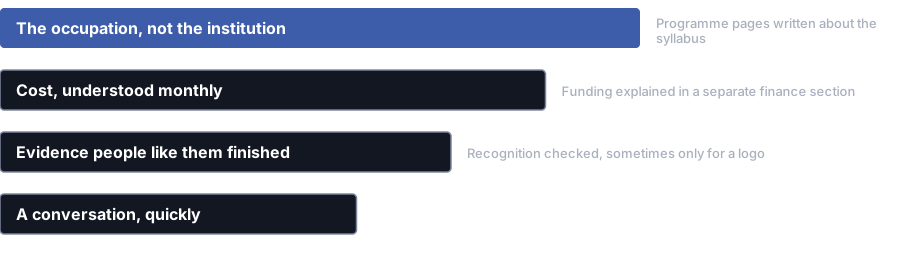
- 1The occupation, not the institution — The first search is what the job pays, what qualification it needs and how long that takes. No provider is being considered yet at all.Programme pages written about the syllabus
- 2Cost, understood monthly — Understood as a monthly figure after funding, not as a headline price. This is the most common silent drop-off in the category.Funding explained in a separate finance section
- 3Evidence people like them finished — Completion and continuation figures matter more than entry standards, because the fear is not being rejected. It is not finishing.Recognition checked, sometimes only for a logo
- 4A conversation, quickly — Format and timing eliminate options fast, and the provider who calls back within the hour is frequently the one talking to an enrolled student.
Timing
When your customers need you
Multiple intakes mean multiple deadlines, and demand builds and collapses around each. Planning by quarter averages those cycles together and hides both the underspend before a start date and the waste after it.
Funding calendars sit under the intake calendar and rarely line up with it. Aid, loan and sponsored-place windows create their own deadlines, and an applicant who misses one usually defers or disappears.
Some programmes are counter-cyclical. Retraining demand rises when a local industry contracts, so a regional redundancy announcement is an immediate demand signal for particular trades.
The consideration period varies enormously within one institution. A school leaver may decide in a fortnight; a thirty-eight-year-old retraining has usually been thinking about it for a year and needs different material.
Enquiry volume and enrolment volume decouple easily. Broad campaigns bring people exploring a career change with no timeline, and counting them as pipeline is how a report improves while the intake shrinks.
Common problems
Where college and career training marketing budgets leak
A prospective student is not comparing curricula. They want to know whether, after eighteen months and a lot of money, there is a job with their name on it, and whether the people saying so can be believed.
That question, and the funding question under it, decides most enrolments. The rest of a programme page is detail.
- The programme page sells the curriculum and never names the job.
- Module lists, credit hours and learning outcomes written for an accreditor. The reader wants to know which roles this leads to, what they pay locally, what licence or ticket they hold at the end and who recognises it. The institution usually has that information; it rarely reaches the page.
- The enquiry sits for four days before a human replies.
- This is the most expensive fixable problem in the sector. Prospective students enquire at several institutions in one evening, and the first person to reach them shapes the comparison. If response time is measured in days, no campaign improvement will move enrolments.
- Funding is the blocker and it is buried.
- Eligibility rules, what is covered, the monthly figure and what happens on withdrawal. Applicants who can’t resolve those questions don’t ask; they stop. Putting the funding path on the programme page itself, not in a generic finance section, recovers applications the follow-up never sees.
- The outcome claims are either absent or the kind that attract attention.
- Two failure modes, both costly. Saying nothing leaves the key question unanswered for sceptical students. Saying too much, such as a placement percentage with no definition, period or source, is exactly what regulators in several markets now look for. The workable position is a defined, sourced figure with its limits stated, even if unflattering.
- Spend is flat and the intakes are not.
- A budget divided by twelve puts equal money into the week before a start date, when applications are decided, and the week after, when the next deadline is four months away. Weighting spend to the intake calendar usually brings more enrolments from the same annual budget.
Where to spend
Start with search content, then conversion fixes
In the order we'd put them. Start at the top.
Occupation pages before programme pages
The search starts at the job, so content must too. A page per occupation covering what the role involves, what it pays locally, what credential it needs and which of your programmes leads to it reaches people months before any institution is on their list.
The application, and everything that stops it
Applications are abandoned at predictable points: a document upload requested too early, a funding question with no answer nearby, a form that doesn’t save progress on a phone. Fixing those recovers committed applicants, which is cheaper than finding new ones.
What students and graduates say about you
Where prospective students expect to be oversold, third-party accounts outweigh anything you publish. Ask graduates properly, respond to criticism without disclosing anything about an individual, and watch the forums and course-review sites where these decisions get tested.
What people search
“Trade school for electricians” and similar searches
Occupation first
The search happens before any institution is considered. This is where the programme has to appear.
- trade school for electricians
- how to become a dental hygienist
- hvac certification program near me
- welding school [city]
- how long does it take to become a paralegal
Cost and funding
The most common silent drop-off. Answered on the programme page, not in a finance section.
- is financial aid available for trade school
- student loan for a college course
- how much does nursing school cost
- part time courses while working full time
- what happens if i withdraw from a course
Comparison and legitimacy
Scepticism is the default. These searches are looking for a reason to rule you out.
- community college vs trade school
- is this bootcamp accredited
- accredited online business diploma
- apprenticeship or college which is better
- are online qualifications taken seriously by employers
Outcome evidence
What the reader wants and what the rules constrain. Both at once.
- electrician salary after apprenticeship
- job placement rate for [program]
- what jobs can i get with a business diploma
- graduate employment rate [college]
These are example searches from keyword research and public search data. Before we suggest anything, we check how often people search for them in your area.
Your website
What visitors need to see
- Every programme page names the roles it leads to and the credential earned at the end
- Accreditation or recognition stated with the body named and a route to verify it
- Completion and outcome figures with the definition, the cohort and the period shown
- Total cost, funding routes, eligibility and an indicative monthly figure in one place
- Every intake date with its real application deadline, kept current
- An application that saves progress and does not demand documents at step one
- A named advisor, a direct line and a stated response time
- Withdrawal, deferral and refund terms written in plain English, not buried in a policy file
- Timetable reality: hours per week, placement requirements and whether it fits around a job
The rules
Claims to avoid
Claims about employment, salary or job placement are regulated in most markets where career training operates. The rules generally require a stated definition, period and cohort, and a source that can be produced on request. An unqualified placement percentage is the most common finding against providers, and it is avoidable.
Accreditation, recognition and licensure must be described exactly as held, including where a programme is accredited by one body but doesn’t itself confer a licence. Implying graduates may practise where a further exam or registration is required is treated seriously by education regulators and the professional body.
Recruitment conduct rules in several jurisdictions govern how prospective students may be contacted, what deadline pressure may be applied and what must be disclosed before a financial commitment. Where agents or third-party lead sources are used, the institution normally remains responsible for what they say.
Requirements differ between countries, and between states or provinces, and they change. We draft to the constraints we understand apply to you, flag anything that needs an accreditor or counsel, and expect the institution to confirm final wording with its own regulator. Nothing here is legal advice.
Sources
The rules in full
Each rule above, linked to the body that publishes it. Which ones apply depends on where you work. Rules change, so check the latest version.
- Bars US Title IV institutions from misrepresenting their programmes, charges or graduates’ employability.
- 34 CFR 668 Subpart F
- Source: US: Department of Education, 34 CFR Part 668 Subpart F (eCFR)
- Prohibits aggressive and deceptive recruitment tactics by US Title IV institutions.
- 34 CFR 668 Subpart R
- Source: US: Department of Education, 34 CFR Part 668 Subpart R (eCFR)
- Sets out how UK consumer law applies to information, terms and conduct towards prospective students.
- CMA higher education
- Source: UK: Competition and Markets Authority, Consumer law advice for higher education providers
Questions
Questions about college and career training SEO and ads
Our outcome claims are restricted. Does that make us uncompetitive?
Usually the opposite. Prospective students here expect to be oversold, so a figure with its definition, cohort and period stated reads as more credible than a rounder, larger number with none of that.
The work is finding which of your real numbers can be published safely and giving them prominence, not hiding a defensible figure in a footnote.
We get plenty of enquiries and not enough enrolments. Where is it going wrong?
Start with response time and the funding step, in that order. If first human contact takes days, the enquiry has already spoken to a competitor.
Then look at where applications stop. Early document uploads and unanswered funding questions cause much of the abandonment, and both are fixable without more acquisition spend.
How should we budget across multiple intakes?
Against the intake dates, not the calendar. Demand for each start clusters before its deadline and falls away straight after, so an even monthly budget underspends the moments that decide applications.
The exception is content, which should run continuously. Occupation and funding material needs months to rank, so it must be live before the deadline arrives.
Should we publish completion rates if ours are not flattering?
That is the institution’s decision, and it depends on your market; in several, publication is not optional.
Where there is discretion, we would generally argue for publishing with context: the cohort, what counts as completion and what has changed since. Silence reads as a bad number anyway, and the students most likely to finish are the ones asking.
Can you write our compliance-sensitive copy for us?
We can draft to the constraints we understand apply to you, building the claim boundaries into the brief at the start, not at legal review.
What we cannot do is sign it off. Final wording on outcomes, accreditation and funding needs your own compliance function or counsel, and that step belongs in the schedule.
Find your quickest wins
Start with the free checkup. It shows what to fix first on your website, with no sign-up. Want the full plan for your college and career training business? Book a call, and we'll look at your market, your competitors and the searches that bring in customers.
Prefer to talk it over? Book a free call
Your BOOSTD score improves within 90 days, or your next month is free. After 6 months, more traffic or leads, or we keep working free (up to 6 free months in any 12 months). Read our guarantee
References
Sources for higher education marketing agency
The official documents and research this page is based on. Platform rules change, so check the source before you act on a detail.
Related
More on college and career training marketing
- enquiry nurture and reporting
- corporate training marketing
- charity and nonprofit marketingAlumni giving is fundraising, and it obeys fundraising rules.
Guides for college and career training
Other education businesses
Last updated · Published by Zubair Afzal, responsible editor