
Tutoring & Test Preparation marketing
Tutoring marketing for the call that comes the week after a bad report
Tutoring demand is triggered by an event — a report, an exam date, an assessment — and the window closes in a fortnight. The parent pays, the student attends, and the two are not asking for the same thing.
Prefer to talk it through? Book a strategy call
Demand shape
When tutoring demand arrives, and how
The calendar is dictated by school terms and examination boards, and it repeats precisely. Reports, mock results and public exam dates each produce a spike, and those dates are published a year in advance — which makes this one of the few local categories where next year’s peak weeks can be scheduled now.
The window after a trigger is short. Motivation to act on a disappointing report fades over roughly a fortnight; a parent who has not booked by then has usually decided to wait and see, and re-engaging them costs far more than reaching them the first time.
Summer is a real trough for examination work and a real opportunity for something else. Catch-up, transition to a new school and enrichment are different propositions and need their own content rather than a discounted version of term-time tutoring.
Assessment-triggered demand behaves nothing like exam panic. A family that has just received a diagnosis is careful, slow, asks about staff training, and once they commit tends to stay for years. It deserves separate content and a separate pace of follow-up.
Location matters less than it used to and has not stopped mattering. Online delivery widened the field, but for younger children and for anxious students a physical centre within a short drive still wins, and the search reflects that.
A fortnight-wide window
The trigger has a date. The motivation has a half-life
Reports, mocks and results are published a year in advance, so the spikes are knowable. What is less obvious is that a parent who has not booked within about a fortnight has usually decided to wait.
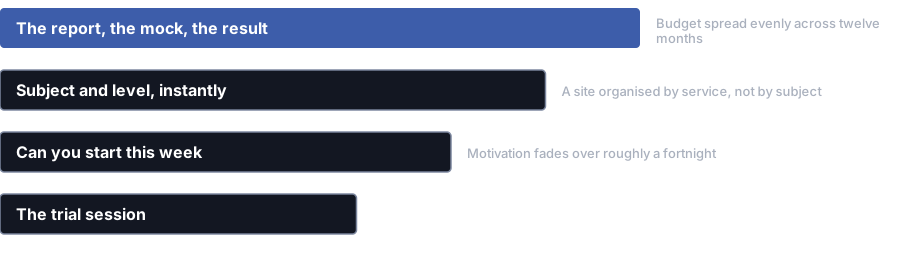
- 1The report, the mock, the result — Each produces a spike, and every one of those dates is published a year in advance by a school or an examination board.Budget spread evenly across twelve months
- 2Subject and level, instantly — A parent looking for help with year nine maths does not read a general tutoring page. The filter is applied before anything is read.A site organised by service, not by subject
- 3Can you start this week — Availability now beats a better centre with a three-week wait, because the entire purchase is motivated by wanting it handled immediately.Motivation fades over roughly a fortnight
- 4The trial session — The student decides the trial. A child who comes out saying it was fine will be booked again; a child who comes out silent will not.
Buying behaviour
How tutoring customers decide
Strategy follows this, not the other way round. Everything on this page is downstream of how the decision gets made.
- The first filter is subject and level, applied instantly. A parent searching for help with year nine maths does not read a general tutoring page, and a site organised by service rather than by subject and year loses them before anything else is considered.
- The second is whether you can start soon. Availability this week beats a better centre with a three-week wait, because the entire purchase is motivated by wanting the problem to stop.
- Vetting is checked and the language matters. Parents look for what background checks are held, whether tutors are qualified teachers, and whether anyone is ever alone with a child. Vagueness here is read as an answer.
- Price is compared quickly across three or four options, usually as an hourly figure, and the comparison is unforgiving unless the difference is explained. A free or low-cost assessment reframes it, which is why so many centres offer one.
- The trial session decides it, and the student decides the trial. A child who comes out saying it was fine will be booked again; a child who comes out silent will not, regardless of how impressed the parent was.
- Reviews are read for whether other parents saw a change and for how the centre handled a child who was struggling or difficult. Star ratings matter less than a specific account.
What usually goes wrong
Where tutoring marketing tends to fail
Nobody wakes up wanting a tutor. Something happens — a report comes home, a mock is failed, an exam date lands eleven weeks out, an assessment names something nobody had a word for before — and a parent starts searching that evening.
The whole commercial question is whether you are findable and bookable while that feeling lasts, and then whether anything keeps the family once the immediate problem has passed.
- The enquiry arrives at nine at night and is answered on Friday.
- Parents search after the children are in bed and after an argument about homework. That enquiry is live for a couple of days at most. Where a centre has no way to respond outside office hours — even to acknowledge, offer times and confirm a price — a large share of demand is simply handed to whoever replied first, and it never appears in any report as a loss.
- Everything is written for the parent and the child has to walk through the door.
- The parent pays and the student attends, and they are buying different things. A page full of grade improvement and progress tracking convinces one of them and quietly alarms the other, who is expecting more of the school day they are already failing at. Centres that say something open about what a first session is like, aimed at the student, turn more trials into ongoing bookings.
- The business empties in July and nobody planned for it.
- Exam-driven demand disappears the day the last paper is sat, and a centre built entirely on it spends a third of the year paying rent against a half-empty timetable. Summer catch-up, transition support for children changing school and early preparation for next year all represent real demand, but they are different propositions and cannot be sold in June with the same page that sold revision in March.
- One-to-one sells easily and groups sit half empty.
- A parent asked to choose will usually pick individual attention, and a centre that presents both without explaining the difference will sell the option that is capped by tutor availability and carries the thinner margin. Groups need to be sold as their own thing — a fixed schedule, a fixed cohort, a defined syllabus — and filled ahead of the term rather than seat by seat as enquiries arrive.
- The relationship ends the week the exam does.
- The crisis that brought the family in is over, so the reason to attend disappears with it. Almost no tutoring business has anything prepared for that moment — a conversation about next year, a lighter maintenance schedule over the summer, a sibling. The lifetime value difference between families who continue and families who do not is the largest single number in this business, and it is decided in one week.
Search behaviour
Tutoring searches, grouped by intent
Subject and level
How parents search. A generic tutoring page matches none of these.
- maths tutor near me
- english tutor for year 9
- gcse maths tutor online
- reading tutor for 8 year old
- a level chemistry tutor [city]
After the trigger
Short window, high urgency, decided within days.
- failed mock exam what to do
- how to improve a maths grade in three months
- sat prep classes near me
- my child is behind in reading
- 11 plus tuition [area]
Price and format
Compared quickly and unforgivingly unless the difference is explained.
- how much does a tutor cost per hour
- group tutoring vs one to one
- free tutoring assessment near me
- online vs in person tutoring for kids
Additional needs and confidence
Slower, more careful, and the longest-staying families you will have.
- dyslexia tutor near me
- tutor for adhd child
- help for a child who has lost confidence in maths
- tutor experienced with autism
These are examples of how customers in this market search, drawn from keyword research and public search data. They are illustrative, not a volume claim: we size the demand in your area before recommending anything.
Where the money goes
The tutoring marketing channels that earn their place
In priority order for this business, not a menu. Anything not on this list is something we would need a specific reason to recommend.
Being the centre that appears at nine at night
Most of these searches carry a location and end in the map results, so the profile, the subject list, the opening hours and a steady flow of recent parent reviews decide who gets contacted. It is the fastest-moving channel here and the one most centres have left half configured.
Paid search pointed at published exam dates
Examination timetables and reporting weeks are known a year ahead, which makes this one of the few local categories where paid budget can be scheduled rather than reacted to. Weight it into the fortnight after reports and the weeks before public exams, and turn it down where nobody is deciding anything.
A page per subject and a booking that finishes at 10pm
Two structural fixes. Pages that match how parents search — subject, year group, examination — instead of one page called tutoring. And a way to book or request an assessment that completes without a phone call, because the enquiry is being made after bedtime and will not survive until office hours.
What other parents say, and how you ask
Parents read reviews for a specific account of a child who was struggling, not for a star average. Asking properly at the right moment — after a report, not after a session — and replying without ever identifying a child produces the kind of review that persuades the next family.
The week the exam ends
The single highest-value moment in a tutoring business and almost always unmanaged. A prepared sequence around the end of an examination series — what next year looks like, a lighter summer option, a sibling assessment — is the difference between a two-term family and a three-year one, and it costs nothing to run.
The website
What a tutoring website has to do
- A page for each subject and year group, because that is the search and the shortlist
- Prices for one-to-one and for group sessions, stated per session with what is included
- Tutor vetting described exactly: which checks are held, by whom, and how recently
- A booking or assessment request that completes in one sitting at ten at night
- What the first session is like, written for the student as well as the parent
- Current availability by day and time slot, since after-school hours are the real constraint
- Online and in-centre presented as separate options with the difference explained
- Something honest for families who have just had an assessment or diagnosis
Measurement
Tutoring numbers we report on, and what we ignore
Sessions are not on this list. These are the numbers that tell you whether the marketing is producing customers.
- Sessions booked, not enquiries received
- Time from enquiry to first reply, measured overnight and at weekends as well
- Trial session to ongoing enrolment rate
- Average number of sessions per student before they lapse
- Share of students continuing past the exam or report that brought them in
- Group utilisation against seats available, by day and time
- Revenue per available tutor hour
- Sibling and referral share of new students
Constraints
Tutoring advertising rules: what is allowed, and what is not
Tutoring involves adults working with children, and the vetting regime differs by market — criminal record checking, barred-list checks, working-with-children registration and supervision requirements all sit under different names and different bodies. Marketing should state precisely which checks the business holds records for, because an imprecise safeguarding claim is both a trust failure and, where it misleads parents, potentially unlawful.
Claims about grades, examination results or admission to a selective school are outcome claims and are treated as such by advertising regulators. Reporting what a specific student achieved requires consent, and presenting a best case as typical is the pattern most likely to draw a complaint.
Photographs, first names, work samples and video of children are personal data belonging to a minor, and consent, where it is the basis relied on, normally has to come from a parent for younger children, be specific to marketing use, and be withdrawable. Several markets add further restrictions on identifying a child alongside an image or a location.
Requirements vary by country and often by region within it, and safeguarding rules in particular change. We draft to the constraints we understand apply to you, and we expect the business to confirm its vetting wording and consent practice with its own regulator or safeguarding lead. Nothing here is legal advice.
Primary sources
The tutoring rules above, at source
The rules this page refers to, linked to the regulator or rule-maker that publishes them. Which apply depends on where you operate, and they change, so check the current version.
- Safeguarding guidance for providers of tuition, clubs and activities, including staff checks.
Out-of-school settings
Safeguarding guidance for providers of tuition, clubs and activities, including staff checks.
Source: England: Department for Education, Out-of-school settings safeguarding guidance
- Explains which DBS check levels employers may request, including barred list checks for regulated activity.
DBS check eligibility
Explains which DBS check levels employers may request, including barred list checks for regulated activity.
Source: England and Wales: Disclosure and Barring Service, DBS check requests guidance for employers
- Explains how UK data protection law applies to children’s personal data, including consent.
Children and UK GDPR
Explains how UK data protection law applies to children’s personal data, including consent.
Source: UK: Information Commissioner’s Office, Children and the UK GDPR
Questions
Tutoring marketing questions, answered
How quickly do we need to respond to an enquiry?
Within the hour during the day, and with something automatic and useful outside it. These enquiries are made in the evening after a difficult conversation at home, and the motivation behind them fades within days.
If out-of-hours cover is impossible, the next best thing is an immediate acknowledgement that gives real information — available times, the price, what an assessment involves — so the parent has something to act on rather than a promise to call back.
How do we stop the business emptying every summer?
By selling something different rather than the same thing at a discount. Examination revision ends in June, but transition support for a child changing school, catch-up for a year that went badly and early preparation for next year are all real and all need their own pages and their own timing.
The other half is the retention conversation held before the last paper, not after it. Once a family has stopped attending for six weeks, they have usually stopped for good.
Should we push group sessions or one-to-one?
Both, but not with the same page and not at the same moment. One-to-one sells itself and will always be chosen when the two are presented side by side, which is why groups end up half full.
Groups work when they are sold as a defined thing — a fixed cohort, a fixed schedule, a stated syllabus, enrolment before the term starts. Marketed that way they carry the margin and let a centre grow past the number of tutor hours it can staff.
Can we advertise the grades our students achieved?
Carefully, and in some markets barely at all. Any statement about results is an outcome claim, needs consent if it identifies a student, and cannot present an exceptional case as though it were typical.
What tends to work better anyway is specificity without a promise: what the sessions consist of, how progress is reviewed, and what a parent will see after a term. Parents have heard grade claims from every centre they have looked at.
We are a single centre competing with national franchises. Is that winnable?
On subject and year specificity, on availability and on response speed, yes. Franchise sites are built to be adequate across every market they operate in, which leaves the detailed local pages — a particular examination board, a particular local school’s transition, a named tutor with a real background — open.
What is not winnable is a general brand-awareness contest, and it is not worth attempting.
Find out what is winnable for your tutoring business
Start with the free Growth Scan: an indicative read of your website and the few things to fix first, with no sign-up. BOOSTD is in early access, so the fuller picture for your tutoring business — your area, your competitors and the searches that matter — is worked through with our team on a strategy call. If we do not think we can move it, we will tell you.
Prefer to talk it through? Book a strategy call
If we don't deliver the work we agreed to deliver for reasons within our control, you don't pay for the undelivered work. Read our guarantee
References
Sources
The primary documents and published research this page relies on. Platform rules change, so check the source before acting on a detail.
Related
Where to go next
More to explore
Guides that answer the same questions
More in education
Related industries
Last updated · Published by Zubair Afzal (responsible editor), on owner authorisation