
Private & Independent Schools marketing
Private school marketing for two parents, a year of deciding and one open day
A school sells a small number of places, once a year, to families who take twelve months to decide and who weigh belonging as heavily as results. Miss the intake and the demand does not come back until the following autumn.
Prefer to talk it through? Book a strategy call
Buying behaviour
How private school customers decide
Strategy follows this, not the other way round. Everything on this page is downstream of how the decision gets made.
- It starts socially. Another parent at nursery, a colleague, a neighbourhood group. The search that follows is verification of a name someone already mentioned, which is why the school profile and what is written about you elsewhere carry so much weight.
- They build a shortlist of three to five and visit them. The visit is where the decision is largely settled, and what settles it is the atmosphere in the corridors and whether the pupils showing them round seem like people they want their child to become.
- Results function as a threshold rather than a ranking. Once a school clears the bar a family has in mind, further improvement in the table moves them very little, and fit takes over completely.
- The reaction of the child on the day carries enormous weight and is frequently decisive. A family that leaves with a child who says nothing usually does not register, whatever the adults thought.
- Logistics are routine and eliminate schools quietly: the bus route, the finish time against a working day, wraparound care, whether siblings at two schools can both be dropped off.
- Fees, bursaries and what counts as an extra decide the size of the field before anything else is considered. Uniform, trips, lunches and music lessons are the costs families feel misled about later.
- For boarding, the questions are different again — how often they can come home, who is awake at night, how homesickness is handled in the first fortnight.
A year, then a deadline
A missed intake cannot be recovered next quarter
Almost every other business on this site can catch up later. Here the places either fill by the registration deadline or they sit empty for a year, which is what makes the calendar unforgiving.
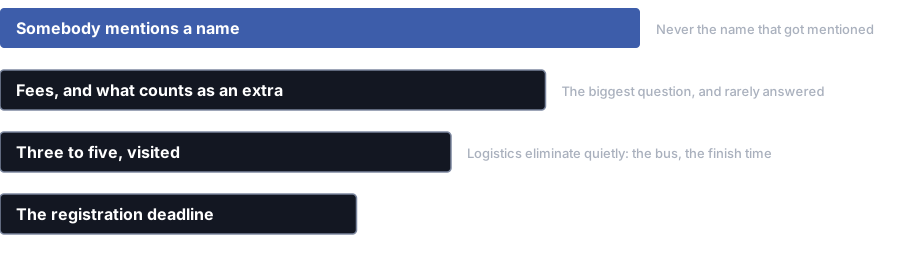
- 1Somebody mentions a name — It starts socially: another parent at nursery, a colleague, a neighbourhood group. The search that follows is verification rather than discovery.Never the name that got mentioned
- 2Fees, and what counts as an extra — This decides the size of the field before anything else is considered. Uniform, trips, lunches and music lessons are the common surprise.The biggest question, and rarely answered
- 3Three to five, visited — The visit largely settles it, and the atmosphere in the corridors does more than any results table. The reaction of the child is frequently decisive.Logistics eliminate quietly: the bus, the finish time
- 4The registration deadline — A missed intake cannot be recovered. The places either fill by the cut-off or they sit empty for an entire year.
What usually goes wrong
Where private school marketing tends to fail
A family choosing an independent school is making one of the largest discretionary purchases of their lives, over roughly a year, with a child who has opinions and a partner who may not agree. Very little about that resembles a marketing funnel.
What it resembles is a calendar. There is a registration deadline, an assessment date and a September start, and demand that arrives after those dates is not late — it is gone until the following year.
- The site was written for the governors and not for a parent.
- Mission statements, a message from the chair, a virtue list and a gallery of pupils in blazers. Nothing about fees, nothing about the bus, nothing about what happens on the first morning. A parent arrives with about six practical questions and leaves with none of them answered, which is why so many school sites produce visits and no registrations.
- Nobody plans the year backwards from the open day.
- The open day is where a family stops comparing and starts imagining, and it is the single event most closely tied to a registration. Yet it is usually promoted three weeks out with a poster and an email to a list. Working backwards — filling the day, confirming attendance, following up in the seventy-two hours afterwards while the impression is intact — changes the intake more than any amount of general awareness spend.
- Only one of the two decision-makers is being spoken to.
- Schools tend to write for the parent who asks about results. The other parent is asking whether a quiet child will be looked after, whether the pastoral system is real, and whether the family will feel out of place at the gate. If the site never addresses that, the school gets a visit and then a polite decline it never understands.
- The fee question is answered by everyone except the school.
- Families discuss fees on forums, in parent groups and with each other, using guesses. A school that publishes termly fees, states what is included, and explains bursary criteria honestly is not devaluing itself — it is removing the reason a family disqualifies itself before it has visited, and it answers a large volume of searches that competing schools have decided to ignore.
- Leavers at the transition years are treated as a pastoral matter.
- Attrition at the move from prep to senior, or at the point sixth form choices are made, is a commercial event with a number attached. Very few schools examine why families left, and fewer still market to their own current parents about the next stage. Sibling enrolment is the same opportunity in reverse and is almost never asked for directly.
Search behaviour
Private school searches, grouped by intent
Building the shortlist
Usually verification of a name a family has already heard. Reputation is being checked, not discovered.
- private schools near me
- independent school [city]
- private school open day
- prep schools in [area]
- best private secondary school [region]
Fees, bursaries and value
The highest-volume question and the one most school sites refuse to answer.
- private school fees per term
- how much is private school
- school bursary eligibility
- private school scholarship for music
- is private school worth the money
The admissions process
Deadline-driven. These searches cluster in the weeks before each cut-off.
- private school entrance exam
- when to apply for private school
- private school registration deadline
- in year admission private school
- what happens at a school assessment day
Fit and reassurance
Where the second parent is looking. Almost no school writes for these.
- private school for a shy child
- boarding vs day school
- small class sizes secondary school
- school support for dyslexia
- moving my child to private school mid year
These are examples of how customers in this market search, drawn from keyword research and public search data. They are illustrative, not a volume claim: we size the demand in your area before recommending anything.
Where the money goes
The private school marketing channels that earn their place
In priority order for this business, not a menu. Anything not on this list is something we would need a specific reason to recommend.
A site that gets a family to the open day
Everything else on this page depends on the site doing three things: naming the fees, making the open day bookable in one action from any page during the season, and answering the practical questions a parent has before they will spend a Saturday morning with you. Most school sites do none of the three.
Search organised around the admissions calendar
A page per entry point, clear fee and bursary content, and material written for the parent who is worried about fit rather than results. Published in the summer so it is ranking when the autumn enquiry season starts, not commissioned in October when the deadline is already visible.
The year between the first enquiry and the deposit
A family that enquires in September may not register until February. The gap is where schools lose people, and it is filled with a small number of useful messages — the open day, what the assessment involves, how bursaries are decided, a note from a current parent — rather than a monthly newsletter nobody asked for.
Paid, concentrated on the weeks that matter
Useful in a narrow band: the fortnight before each open day, the run-up to a registration deadline, and in-year admissions all year. Spending it evenly across twelve months is a common waste in this sector, because the audience is small, defined and only deciding at certain times.
The catchment is a travel time, not a county
Independent school catchments are drawn by bus routes and commutes rather than by distance on a map. Getting the profile, the travel information and the area content right for the places families travel from does more than broad regional visibility ever will.
The website
What a private school website has to do
- Termly fees stated, with what is included and what is charged separately
- Bursary and scholarship criteria, the deadline, and how a family applies
- Open day dates and registration in one action from every page during the season
- A page for each entry point, because a reception parent and a sixth form applicant share nothing
- Transport routes, pick-up points and the actual finish time against a working day
- Photographs of ordinary school days rather than staged prospectus shots
- A page written for the parent worried about a quiet or anxious child
- A named admissions contact with a direct line, and a stated reply time
- What the assessment day involves, described so a ten-year-old could be prepared for it
Measurement
Private school numbers we report on, and what we ignore
Sessions are not on this list. These are the numbers that tell you whether the marketing is producing customers.
- Registrations submitted per entry point against the intake target
- Open day registrations, and the attendance rate against them
- Enquiry to visit rate, and visit to registration rate
- Deposits paid and places accepted, which is the only figure that is real
- Sibling enrolments as a share of the intake
- Retention through each transition year, with reasons recorded for leavers
- Cost per enrolled pupil set against first-year fee income
- Where enrolled families travel from, checked against the assumed catchment
Constraints
Private school advertising rules: what is allowed, and what is not
Anything a school says about results, destinations or inspection outcomes has to be evidenced and current, and presented without selecting a flattering subset. Advertising standards bodies in most markets treat comparative and superlative claims about schools strictly, and a claim that was accurate three years ago is not a defence.
Photography and film of pupils needs a lawful basis under data protection law, often consent, with a paper trail. Marketing use is a separate permission from internal use, consent can be withdrawn, and the position on identifying children by name alongside an image differs by market and by the age of the child.
Where a school holds charitable status, or receives any form of public funding or tax relief, there are frequently conditions attached to how it may promote itself and how it must describe access, bursaries and public benefit. These vary considerably between jurisdictions.
Fee, bursary and refund information is consumer-facing contractual material in several markets, and the parent contract usually governs what may be stated. We draft to the constraints we understand apply, and we expect the school to confirm final wording with its own advisers and regulator. Nothing here is legal advice.
Primary sources
The private school rules above, at source
The rules this page refers to, linked to the regulator or rule-maker that publishes them. Which apply depends on where you operate, and they change, so check the current version.
- Requires advertisers to hold evidence for objective claims and bars misleading comparisons.
CAP Code section 3
Requires advertisers to hold evidence for objective claims and bars misleading comparisons.
Source: UK: Advertising Standards Authority, CAP Code section 3 (Misleading advertising)
- Explains how data protection law applies when schools take and publish photos or videos of pupils.
ICO: photos in schools
Explains how data protection law applies when schools take and publish photos or videos of pupils.
Source: UK: Information Commissioner’s Office, Taking photos in schools
Questions
Private school marketing questions, answered
Should we publish our fees on the website?
In almost every case, yes. Families discuss fees whether or not you take part, and the version circulating in a parents group is usually wrong and usually higher than the real number.
Publishing termly fees, naming what is extra, and explaining bursaries plainly removes the reason a family rules itself out before visiting. It also answers a search that runs all year and that competing schools have mostly abandoned.
Our intake is short and the deadline is eight weeks away. What can you do?
Less than we could have done in June, and we will say so rather than pretend otherwise. At eight weeks the realistic options are paid campaigns against a defined catchment, a properly promoted additional visit event, and disciplined follow-up of every enquiry already sitting in the system.
The larger part of the work is then making sure the same position does not recur. The following year is won in the summer term, before any family has started looking.
How much does the open day matter?
More than anything else you do. It is where a family stops comparing schools on paper and starts picturing their child in your corridors, and the registration decision is largely settled there.
That makes attendance the number worth working on, and the seventy-two hours afterwards the most valuable follow-up window in your year. Most schools spend heavily on being noticed and almost nothing on either.
Is retention really a marketing problem?
It is a commercial one, and marketing owns part of it. A pupil who stays another five years and a sibling who follows on are both places filled at no acquisition cost, which no campaign can match.
Practically that means exit reasons recorded properly at each transition, current parents told about the next stage before they start looking elsewhere, and siblings asked for directly rather than assumed.
Can you guarantee we will fill the intake?
No. Places filled depend on your fees, the schools around you, local demographics, the economy and what happens on the open day itself, and most of that is not ours to control.
What we commit to is a plan built against your admissions dates, reporting against registrations and deposits rather than website figures, and telling you plainly when the constraint is something marketing cannot fix.
Find out what is winnable for your private school business
Start with the free Growth Scan: an indicative read of your website and the few things to fix first, with no sign-up. BOOSTD is in early access, so the fuller picture for your private school business — your area, your competitors and the searches that matter — is worked through with our team on a strategy call. If we do not think we can move it, we will tell you.
Prefer to talk it through? Book a strategy call
If we don't deliver the work we agreed to deliver for reasons within our control, you don't pay for the undelivered work. Read our guarantee
References
Sources
The primary documents and published research this page relies on. Platform rules change, so check the source before acting on a detail.
Related
Where to go next
More to explore
Last updated · Published by Zubair Afzal (responsible editor), on owner authorisation