
Corporate Training & L&D Providers marketing
Corporate training marketing agency that reaches L&D early
Corporate training marketing that reaches the manager with a capability gap, then helps them get your programme past the approver and procurement.

Where to spend
Why B2B search comes before search content
In the order we'd put them. Start at the top.
Rank for the gap, not for the course title
The buyer searches the problem before the solution: first-time managers struggling, retention in a function, an audit finding to close. Content built around those gaps reaches them while the requirement is being written, months before any provider list exists.
Pages for the skills gap, not the course list
L&D buyers search the problem: onboarding new managers, a compliance deadline, a software rollout. Pages that explain the gap, the format that suits it and what changes afterwards rank for those searches and answer the questions a budget holder has to put in writing.
On the shortlist when buyers ask AI
HR and L&D teams ask AI assistants which providers run a given programme in their region. Clear pages per programme, with delivery formats, accreditation and who it suits, give those assistants something specific to repeat about you.
How they choose
How customers decide who to hire
Know how they choose and you know where to show up.
- The requirement comes first and the search second. A gap is identified internally, such as a promotion cohort with no management experience, a regulatory finding or a merger, and only then does anyone look for providers.
- A shortlist of three to five is assembled quickly from peer recommendation, an existing supplier framework, a directory or a search. Being unfindable at that moment is the most common way a provider loses a deal it never knew about.
- They ask for a pilot: a single cohort or short programme. How the pilot will be judged often matters more than the price of the full programme.
- Evidence of transfer decides it between comparable providers: what participants did differently afterwards, how that was observed and over what period. Satisfaction scores are table stakes, not evidence.
- Logistics rule you out fast: locations, languages, cohort sizes, virtual and in-person delivery, whether content can sit on the learning platform the client already runs, and how quickly a cohort can start.
- Then procurement applies its own criteria: insurance, data processing terms, accessibility conformance, financial standing, references, sometimes a security review. A preferred supplier who can’t clear that gate loses to one who can.
- Timing follows the budget cycle more than need. A well-run process can stall for two quarters because the money sits in a year that hasn’t started.
Chosen, then gated
The people who choose you are not the people who clear you
A shortlist is assembled quickly by somebody with a requirement, and then the decision travels into rooms you are not invited to. The material has to survive that journey without you.
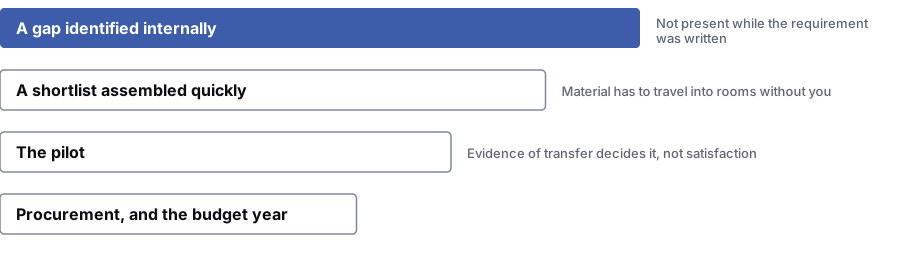
- 1A gap identified internally — A promotion cohort with no management experience, a regulatory finding, a restructure. The requirement comes first and the search comes second.Not present while the requirement was written
- 2A shortlist assembled quickly — Three to five names, from peer recommendation, an existing supplier framework, a directory or a search. Assembled fast and rarely revisited.Material has to travel into rooms without you
- 3The pilot — One cohort, a defined group, a short programme. How the pilot will be judged is frequently more important than the programme itself.Evidence of transfer decides it, not satisfaction
- 4Procurement, and the budget year — Insurance, data terms, accessibility, financial standing. A well-run process can stall two quarters purely over which year the money sits in.
Common problems
Corporate training marketing problems to fix first
A training provider isn’t selling learning. It is selling a head of function a way to close a gap already named internally, in an appraisal round, engagement survey, incident report or audit, using money in a particular budget line for a set number of months.
That is a B2B purchase with a champion, an approver and supplier onboarding, and it behaves more like enterprise software than any other page in this section.
- The site is a catalogue and the buyer has a problem.
- Course titles, durations, day-by-day agendas and a booking button. The reader has been told to fix retention among newly promoted managers and wants to know if you understand that. Organising the site around the gap, who it affects, what causes it and what a programme against it involves, matches how the requirement was written and will be searched.
- Evaluation stops at the feedback form.
- Every provider can show good end-of-course scores, so they differentiate nothing. A buyer justifying the spend needs something about behaviour at sixty or ninety days: what was observed, by whom, against what baseline. Being open about the limits of that measurement persuades more than a confident number.
- The champion has nothing to send upwards.
- The person who contacted you has to build an internal case for a finance approver and a department head, usually as a document, without you in the room. With only a web page and a confidential proposal, the case gets built badly or not at all. A forwardable programme outline, evaluation approach and indicative cost structure is one of the highest-return assets a provider can produce.
- Procurement asks for things nobody has written down.
- Employer liability and professional indemnity certificates, a data processing agreement, accessibility conformance for digital materials, a security questionnaire, financial statements, three comparable references. Assembled under pressure, these delay deals by weeks. Written once and kept current, the pack takes an afternoon.
- The pipeline is invisible until the budget year turns.
- Interest identified in one quarter is funded in another, so a monthly report makes the marketing look like it failed. Record where each account sits in its budget cycle and report opportunities by expected funding period, not enquiry date, so the plan is judged on the year it was designed for.
What people search
What people type, like “training for first time managers”
The capability gap
Searched while the requirement is being written, before any provider is named.
- training for first time managers
- how to improve retention in a sales team
- developing leaders after a restructure
- building coaching skills in middle management
- team training for hybrid working
Compliance and mandated training
Deadline-driven, defensible and the most predictable revenue in this sector.
- mandatory compliance training courses for employers
- anti harassment training provider
- health and safety training company [city]
- refresher training audit requirement
Evaluation and business case
The champion, building the argument for someone else. Where thought leadership travels.
- how to measure training effectiveness
- kirkpatrick level 3 evaluation example
- training roi business case template
- l&d budget planning for next year
Delivery and procurement
Late-stage, routine, and decisive. Usually unanswered on provider sites.
- scorm compatible training provider
- virtual instructor led training providers
- in house training vs public course cost
- training provider rfp requirements
These are example searches from keyword research and public search data. Before we suggest anything, we check how often people search for them in your area.
Your website
Make your site easy to buy from
- Pages organised by capability gap and by role, with the course catalogue underneath, not in front
- An evaluation approach described in plain English, including what gets measured at sixty or ninety days
- Delivery logistics: formats, cohort sizes, languages, locations and learning-platform compatibility
- A forwardable programme outline the champion can send to an approver without involving you
- A procurement pack: insurance, data processing terms, accessibility conformance and reference structure
- Accrediting or awarding body named and current where a programme carries one
- A pricing model explained — per cohort, per participant, per licence — even where the figure is bespoke
- Named facilitators with real backgrounds, because the buyer is partly buying the person in the room
Measuring results
How you'll know it's working
These numbers show if your marketing brings in customers. Website visits alone don't.
- Qualified opportunities from named target organisations
- Proposals issued and proposal-to-contract rate
- Pilot cohorts converted into full programmes
- Average contract value and the renewal rate on multi-year agreements
- Distinct stakeholders engaged per opportunity
- Time from first contact to signed order, plotted against the budget cycle of the account
- Expansion revenue from organisations already trained
- Deals lost at the procurement stage, recorded with the reason
The rules
What regulators expect
Where a programme is presented as meeting a statutory or regulatory training obligation, the claim is only safe if it names the requirement, jurisdiction and roles. Obligations differ between countries and often between states or provinces, and an employer relying on an overstated claim carries the consequence, so buyers scrutinise this wording.
Accreditation, awarding-body approval and CPD recognition must be described exactly as currently held, including scope. A body that approved one programme hasn’t approved a catalogue, and lapsed approvals presented as current are a common, avoidable finding.
Training delivery involves personal data about named employees, sometimes including assessment results and occasionally sensitive categories. Data processing terms, retention periods, sub-processors and cross-border transfers are routinely reviewed in supplier onboarding and must exist before the first request.
Accessibility conformance claims for digital learning are increasingly checked in public sector and regulated procurement, and the standard varies by market. We draft to the constraints we understand apply, and expect the provider to confirm regulatory, accreditation and data positions with its own advisers. Nothing here is legal advice.
Sources
Primary sources for these rules
Each rule above, linked to the body that publishes it. Which ones apply depends on where you work. Rules change, so check the latest version.
- Sets what a contract between a controller and a processor must cover, including sub-processors.
- UK GDPR Article 28
- Source: UK: UK GDPR Article 28 (legislation.gov.uk)
- Requires US federal agencies to develop, procure and use accessible information and communication technology.
- Section 508
- Source: US: General Services Administration, Section508.gov
Questions
New to corporate training marketing? Start here
Our sales cycle is nine months. How is marketing supposed to be measured?
By where accounts sit in their own budget cycle, not monthly enquiry counts. Recording expected funding period against each opportunity turns a flat-looking quarter into a readable pipeline and stops good work being cancelled in month four.
Alongside that, a few leading indicators help: stakeholders engaged per account, proposals issued and pilots agreed. They move well before contracts do.
We win on relationships and referrals. Why would we invest in marketing?
Because referrals are checked before they are acted on. A recommendation sends someone to your website, and what they find decides whether you make the shortlist or become a courtesy call.
The second reason is concentration risk. When a pipeline runs through a few relationships, one person changing job removes much of it, and rebuilding takes longer than maintaining a presence would have.
How do we prove training worked without overclaiming?
Describe the method, not just a result. What was observed, by whom, against what baseline, over what period, and what the approach can't tell you.
Buyers know isolating a programme’s effect is difficult. A provider who says so, then explains a practical way to get a useful signal anyway, is more credible than a clean percentage nobody believes.
Should we publish prices?
Publish the model even where the number is bespoke: per cohort, per participant or per licence, what a typical engagement includes and roughly where a first programme sits.
The reason is procedural. A champion can’t open a budget conversation with nothing, and a provider with no figure is often left out of the internal case.
What does the procurement pack need to contain?
It varies by client, but the recurring requests are consistent enough to prepare once: insurance certificates, a data processing agreement, accessibility information for digital materials, financial standing evidence, a completed security questionnaire and structured references.
It won’t win deals on its own. It stops you losing weeks on deals you have already won, which in long cycles is often worth more.
Get your free checkup
Start with the free checkup. It shows what to fix first on your website, with no sign-up. Want the full plan for your corporate training business? Book a call, and we'll look at your market, your competitors and the searches that bring in customers.
Prefer to talk it over? Book a free call
Your BOOSTD score improves within 90 days, or your next month is free. After 6 months, more traffic or leads, or we keep working free (up to 6 free months in any 12 months). Read our guarantee
References
Sources for corporate training marketing agency
The official documents and research this page is based on. Platform rules change, so check the source before you act on a detail.
Related
More on corporate training marketing
- capability content and thought leadership
- building a B2B pipeline
- college and career training marketing
- membership associationsProfessional bodies sell the same continuing development inside a renewal.
Guides for corporate training
Other education businesses
Industries close to corporate training
Last updated · Published by Zubair Afzal, responsible editor