
Government & Public Sector Suppliers marketing
Public sector supplier marketing for frameworks, tenders and bids
Public sector supplier marketing that gets you onto frameworks and through pre-qualification, and makes the evidence a buyer checks easy to find.

Your website
Is your website losing you work?
- Every framework, lot and agreement you are on, named, with the reference and the expiry date
- Accreditations shown with certificate number, issuing body, scope and expiry, and removed when they lapse
- Security clearance levels held, and the kinds of work they allow, stated without overclaiming
- Policies published as readable pages: data protection, environmental, equality, modern slavery, safeguarding
- Insurance levels, company registration details and financial standing a buyer can check
- Capability described using the classification codes buyers search and buy by
- Past public contracts named where the authority has published or allowed it, with scope and dates
- A named contact for bid teams, and a separate route for primes looking for subcontractors or consortium partners
- A page for buyers running early market engagement, saying clearly how to talk to you before a procurement starts
- A site that meets the accessibility standard you are bidding to deliver, with a tested conformance statement
Common problems
Why public sector supplier websites lose enquiries
Public sector supplier marketing works within a fixed system. Public bodies buy through frameworks, tenders, dynamic purchasing systems and call-offs, under rules designed to stop suppliers influencing the result, and no marketing changes that.
What marketing can change is whether you are on the list at all, whether you pass the selection stage, and whether a buyer finds the evidence they check where they expect it. The website comes first, which is why this page opens with it.
- The website is built as a lead funnel for a buyer who cannot use one.
- A procurement officer can't respond to a call to action, book a discovery call during a live tender or be nurtured into a purchase. They come to check things against a checklist, often in a hurry, after your name appeared on a list. A site built around capturing enquiries gives them none of it, and can cost you the evaluation unnoticed.
- The frameworks you are on are not listed anywhere.
- Buyers search frameworks by category and then check the supplier. If your site doesn't name the agreements, lots and reference numbers, you are relying on the portal listing to sell you, and it won't. It is the cheapest win in the sector, and many suppliers have never done it.
- You find out about the opportunity when the notice is published.
- By then the specification is written, often shaped by suppliers who were visible during market engagement, and you can only respond. Being present earlier isn't lobbying: it means publishing useful material about the problem, attending engagement events, and being easy to find when an officer researches options months ahead.
- Selection keeps failing on evidence you hold.
- An expired certificate, a policy last reviewed four years ago, insurance below the threshold, an unreachable referee, an accreditation whose scope didn't cover the work. These are admin failures, and a public evidence library kept current, with owners, review dates and versions, removes most of them.
- Social value is written the night before submission.
- It is a scored section, sometimes the deciding one, and generic commitments score badly with evaluators who read hundreds. It also becomes a contractual promise that gets audited. Gather evidence through the year — local jobs, apprenticeships, local supplier spend, carbon measurement, community work — so the section is specific and deliverable.
- Nothing on the site would survive a buyer checking it against public records.
- Contract award notices, published spend data and registers are public in most markets, so an inflated claim about who you work with, your accreditations or your clearance levels can be checked in minutes. When the evaluation is about checking claims, one overstated claim does more damage than a modest true one could help.
How they choose
How buyers choose between you and a rival
Know how they choose and you know where to show up.
- The buying route decides most of it. A framework call-off, an open tender, a direct award under the threshold and a prime's subcontract are four different competitions, and a supplier not on the right framework isn't in the running.
- Selection is a filter, not persuasion. Financial standing, insurance, accreditations, references and exclusion grounds decide who may bid.
- The award is a score against published criteria, with quality, price and social value each carrying a stated weight. The winning bid answers the question asked, in the format required, with evidence attached.
- Buyers manage their own risk above almost everything, avoiding any decision that could be challenged, audited or reported badly, so evidence they can check beats confident claims.
- References from similar authorities count for more than any case study, because a buyer trusts a peer who has already taken the same risk.
- Primes choosing subcontractors run their own checks, wanting suppliers who will pass the authority's scrutiny as well as theirs.
- Early engagement shapes what gets bought. An officer scoping a need talks to the market, reads what has been published, and decides who understands the problem before any notice appears.
Before the notice appears
How a public contract moves from early scoping to scored award
Before a notice exists, an authority is scoping its needs and talking to the market. After it, contact goes through set channels, and your marketing has already done whatever it was going to do.
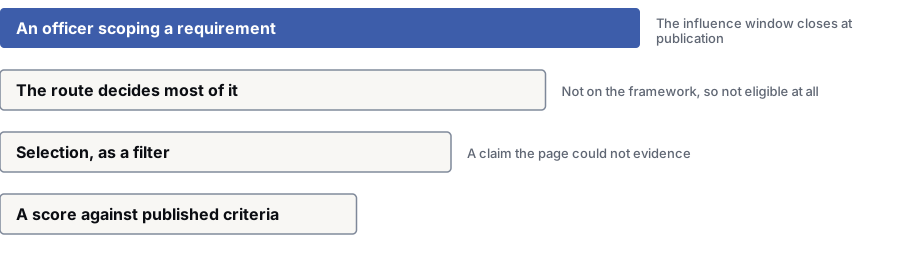
- 1An officer scoping a requirement — Months before any notice exists. The only stage where published content can shape the outcome.The window to influence closes at publication
- 2The route decides most of it — A framework call-off, an open tender, a direct award under threshold and a prime's subcontract are four different contests.Not on the framework, so not eligible at all
- 3Selection, as a filter — Financial standing, insurance, accreditations, references and exclusion grounds decide who may bid. None of it is persuasion.A claim the page couldn't prove
- 4A score against published criteria — Quality, price and social value each carry a stated weight. The winning bid is the one that answered the question asked.
What people search
“Options for [service] local authority” and similar searches
An officer scoping a requirement
Made months before a notice exists, by someone working out what is available and what it should cost. The only stage where content can shape the outcome.
- options for [service] local authority
- how are councils delivering [service]
- [category] framework which suppliers
- cost of [service] public sector benchmark
- market engagement [category] approaches
Checking a named supplier
Short, factual and unforgiving. The buyer is checking a claim, usually against a checklist, and a page that can't answer it fails.
- [company] iso 27001 certificate scope
- [company] modern slavery statement
- [company] accessibility statement conformance
- [company] public sector contracts awarded
- [company] cyber security accreditation
Finding categories and frameworks
Buyers search agreements and lots, not company names. That is why your own pages should name every framework you are on.
- [framework name] suppliers list
- dynamic purchasing system [category]
- approved supplier [category] nhs
- schools framework [category] suppliers
Primes and consortium partners
Another supplier looking for someone to deliver part of a bid. Low volume, high value, and almost nobody publishes for it.
- subcontractor for [framework] lot
- consortium partner [category] tender
- sme partner for public sector bid
- joint venture [service] government contract
These are example searches from keyword research and public search data. Before we suggest anything, we check how often people search for them in your area.
Where to spend
Start with B2B search, then search content
In the order we'd put them. Start at the top.
Tiny search volumes that decide big contracts
The terms that matter are searched a handful of times a month by people deciding millions of pounds of spending: framework names, lot numbers, classification categories, accreditation checks and the questions an officer asks while scoping. Judge them by volume and you will wrongly decide search doesn't apply.
An evidence library, published and kept current
Publish accreditations with scope and expiry, policies as readable pages, insurance and financial standing, named contracts where allowed, and capability in the buyer's classification terms. Give each item an owner and a review date, so nothing is four years old when someone checks it.
Described correctly when buyers research you
Procurement officers research shortlisted suppliers before a decision, increasingly with AI tools that summarise what the web says. Make accreditations, framework positions, contract history and policies easy to find on your own site and stated the same way everywhere, so the summary they read is accurate and current.
Measuring results
What good looks like
These numbers show if your marketing brings in customers. Website visits alone don't.
- Frameworks, agreements and purchasing systems joined, and the lots won on each
- Selection and pre-qualification stages passed and failed, with the reason recorded every time
- Invitations to tender received directly, not found by searching notice portals
- Bids shortlisted and won, with the score by criterion, including social value
- Early engagement conversations held with an authority before any notice was published
- Call-offs and direct awards received under frameworks you already hold
- Approaches from primes looking for a subcontractor or consortium partner
- Contract extensions and re-awards from authorities you already serve, the cheapest revenue in this sector
The rules
What you can say in your ads
Procurement rules limit contact, and your marketing must respect that completely. Once a procurement is live, communication goes through the specified channel and clarifications are shared with every bidder; approaching an evaluator can put your bid at risk or expose the authority to challenge. Any account-based activity needs a rule that stops it the moment an opportunity is published, and a way of knowing when that happens.
Hospitality, gifts and inducements to public officials are regulated far more tightly than in commercial selling, and in many jurisdictions are a criminal matter, not just a policy one. Clear event invitations, sponsored content and anything of value offered to someone involved in a buying decision internally before offering it.
Everything you publish becomes evidence. Accreditation scope, clearance levels, staff qualifications, insurance, financial standing and past contracts can be checked, often against public registers and award notices, and a claim that fails that check does far more damage than any advantage it gave. Publish what is current, dated and true, and take it down when it expires.
Social value, environmental and net zero commitments in your marketing can be quoted back to you in a bid, then audited as contract obligations, and environmental claims are regulated as advertising in more and more markets. Only commit to what you measure, state the basis, and keep the evidence where your bid team can reach it.
Some jurisdictions require registration of lobbying or of contact with public officials, with thresholds and definitions that vary a lot. If any of your activity might fall within them, that is a question for your company and its advisers before it is a marketing decision, and we flag it before going ahead.
Sources
Official sources for each rule
Each rule above, linked to the body that publishes it. Which ones apply depends on where you work. Rules change, so check the latest version.
- Restricts disclosure and obtaining of bid and source selection information in US federal procurements.
- FAR 3.104
- Source: US: Federal Acquisition Regulation 3.104, Procurement integrity (acquisition.gov)
- Makes bribery, including bribery of foreign public officials, a criminal offence in the UK.
- Bribery Act 2010
- Source: UK: Bribery Act 2010 (legislation.gov.uk)
- Requires paid lobbyists who communicate with federal public office holders to register.
- Lobbying Act (Canada)
- Source: Canada: Lobbying Act, R.S.C. 1985, c. 44 (Justice Laws)
Questions
Quick answers on public sector supplier marketing
Can we contact a buyer while a tender is live?
Generally no; it is one of the few serious mistakes you can make in this sector. Once a procurement is published, communication goes through the stated channel, and clarifications are shared with all bidders so nobody gets an advantage.
So the work has to happen earlier. Being known, published and easy to find before a notice exists is legitimate and useful; approaching an evaluator afterwards puts your bid and the authority's process at risk.
Is search worth anything when we sell through frameworks?
Yes, but differently from a lead-generation business. The searches that matter are few and specific: framework names, lot references, classification categories, accreditation checks and an officer's scoping questions.
A term searched twenty times a month can be the exact phrase used by the person writing a specification. Judged on volume it looks worthless; judged on who is searching, it is the most valuable traffic you can get.
Should public sector suppliers publish which frameworks they are on?
Almost always, with the agreement name, lot and reference number. Buyers search by framework and then check the supplier, and a site that doesn't name them leaves the portal listing to do all the work.
It also helps with primes putting a bid together, who look for partners already on the right agreement. A clear, current list is how they find you.
How much does the website matter if we win on the submission?
The submission wins the contract. The website decides whether you get to submit one, and whether the evaluator's check of your claims goes well.
Treat it as an evidence file: frameworks, accreditations with scope and expiry, insurance, policies, named contracts where allowed, and an accessibility statement based on a real test. That is a different site from a lead funnel.
What can marketing do about social value?
Collect the evidence all year, so the section is written from records: local jobs and apprenticeships, spend with small and local suppliers, carbon measurement and community work, with the results of each.
Then publish it. A buyer who can see what you do before reading the bid scores it differently, and you avoid promising something you will later be audited on and can't deliver.
Get a free website check
Start with the free checkup. It shows what to fix first on your website, with no sign-up. Want the full plan for your public sector supplier business? Book a call, and we'll look at your market, your competitors and the searches that bring in customers.
Prefer to talk it over? Book a free call
Your BOOSTD score improves within 90 days, or your next month is free. After 6 months, more traffic or leads, or we keep working free (up to 6 free months in any 12 months). Read our guarantee
References
Sources for public sector supplier marketing
The official documents and research this page is based on. Platform rules change, so check the source before you act on a detail.
- SAM.gov — United States federal contracting registration
- Find a Tender — United Kingdom public procurement notices
- CanadaBuys — Government of Canada tender opportunities
- US: Federal Acquisition Regulation 3.104, Procurement integrity (acquisition.gov)
- UK: Bribery Act 2010 (legislation.gov.uk)
- Canada: Lobbying Act, R.S.C. 1985, c. 44 (Justice Laws)
Related
More on public sector supplier marketing
Last updated · Published by Zubair Afzal, responsible editor