
Public Sector & Civic Organisations
Marketing for suppliers selling to government buyers
Government does not fill in a contact form. The purchase runs through a framework, a tender or a pre-qualification questionnaire, and the requirement is usually shaped before any of it appears in public. These pages are written for suppliers whose marketing has to support a bid rather than replace it.
Prefer to talk it through? Book a strategy call
The category
Public Sector & Civic Organisations: what the businesses have in common
Selling to government breaks most of the assumptions marketing is built on. There is no moment where a buyer becomes a lead, no way to shortcut the process, and no advantage in being persuasive at the point where a decision is scored against published criteria.
What remains is substantial and it is mostly done badly. Being known before a requirement is written, being easy to assess once it is, and being visible inside a framework you have already won are three jobs with real commercial value, and not one of them looks like a campaign.
Selling to it, or being it
Two unrelated jobs share the words public sector marketing
One is a supplier trying to be invited, shortlisted and scored well inside a route to market it did not design. The other is a public body trying to change take-up or behaviour, with no revenue involved at all.
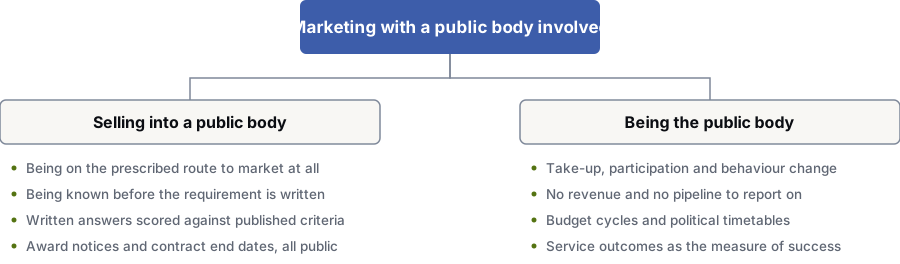
Selling into a public body
- Being on the prescribed route to market at all
- Being known before the requirement is written
- Written answers scored against published criteria
- Award notices and contract end dates, all public
Being the public body
- Take-up, participation and behaviour change
- No revenue and no pipeline to report on
- Budget cycles and political timetables
- Service outcomes as the measure of success
Where they split
Where one public sector strategy stops working
These differences are the reason the pages below are written separately rather than as one page with the business type swapped out.
- Central government and local bodies buy at different scale and speed. A national department procures through large formal competitions on long timetables; a council, school or health provider often buys below threshold, faster, and on a relationship an individual officer already has.
- Public bodies doing their own marketing have a different objective entirely. A transit operator, tourism board or public health team is trying to change take-up or behaviour rather than win revenue, so the measures are participation, awareness and service outcomes rather than pipeline.
- Technology suppliers face requirements no other category does. Security accreditation, data residency, assurance regimes and integration with legacy systems decide eligibility before the commercial case is examined at all, and that evidence has to exist both publicly and in the submission.
- Small suppliers and incumbents compete on different ground. Below threshold an SME can be approached directly and win on responsiveness; above it the process rewards documented scale, and a supplier crossing between the two is changing business model rather than tactics.
Questions
Public Sector marketing questions, answered
If procurement is a fair process, can marketing influence anything at all?
Not the evaluation, and it should not try. What it can influence is everything before the notice appears and everything about how easy you are to assess once it does.
Buyers research the market before they write a specification, they attend supplier days, they read what suppliers publish, and they form a view about who is credible. Being part of that picture is legitimate, and it is where much of the outcome is settled.
We are on three frameworks and nothing comes off them. Why?
Usually because the framework place has been treated as the finish line. Being listed makes you eligible; it does not make you visible to an officer filtering a catalogue of two hundred suppliers.
The work after award is catalogue entries written in the buyer’s language, capability evidence tied to the specific lots, and direct contact with the bodies entitled to buy from that agreement. That is a marketing programme, and it usually has no owner.
How much can we say about public work we have already delivered?
More than most suppliers assume, though it depends on the contract. Award notices are public records, so the existence of the contract is often already published even where the detail is not.
Where confidentiality applies, anonymised material still carries weight if it is specific about the problem, the method and the measurable outcome. Evaluators read a lot of it and they discount vagueness rather than anonymity.
Does our own website really affect a bid score?
It can, directly. Accessibility conformance, security practice and data handling are scored in many public evaluations, and a site that fails them undercuts the answers you have written about them.
It affects the informal assessment too. An officer checking three shortlisted suppliers forms a view in about a minute, and a badly maintained or inaccessible site is a poor first piece of evidence about how you would run a contract.
We also sell commercially. Should public sector work sit on the same website?
Usually yes, in a clearly signposted section rather than on a separate site. Public buyers need different proof, not a different company.
That section carries specific things: the frameworks and lots you sit on, security and accessibility statements, social value commitments with evidence behind them, relevant accreditations, and a named contact for procurement enquiries. Those pages do almost nothing for a commercial visitor and nearly all of the work for a public one.
Related
Where to go next
More to explore
Last updated · Published by Zubair Afzal (responsible editor), on owner authorisation