
Mining, Energy & Resources
Marketing to a resources market you can name buyer by buyer
The addressable market here is a list you could print. A small number of operators control the sites, procurement runs the relationship through vendor portals and pre-qualification, and the page that persuades a buyer is also read by a regulator, a community group and a graduate deciding where to apply.
Prefer to talk it through? Book a strategy call
The category
Mining, Energy & Resources: what the businesses have in common
Most writing about business-to-business marketing assumes a market of thousands of buyers who have to be found. This sector does not have one. It has a list, and everybody on that list either already knows you exist or could be told inside a week.
What follows from that is a different job. The work is being verifiable rather than being discovered: safe, capable, adequately insured, properly crewed and consistent with everything the company has already said in public. These pages are written on that basis.
A list, not a market
The buyer set narrows by document long before anyone quotes
This sector does not have thousands of buyers to find. It has a handful you could name, and most of the work is surviving the filters that decide who is permitted to make an offer at all.
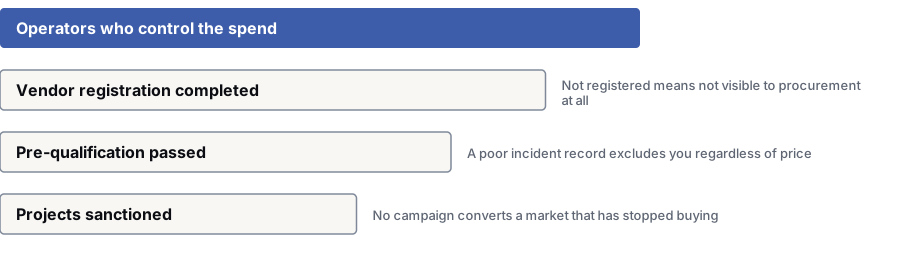
- 1Operators who control the spend — A handful of operators, contractors and engineering houses account for most of a basin or region.
- 2Vendor registration completed — Registration is administrative and slow, and it is entirely within the control of the supplier.Not registered means not visible to procurement at all
- 3Pre-qualification passed — Insurance limits, management system certificates and safety statistics are examined before any offer.A poor incident record excludes you regardless of price
- 4Projects sanctioned — Work appears when a project is approved and vanishes when a commodity price falls.No campaign converts a market that has stopped buying
Where they split
Where one resources strategy stops working
These differences are the reason the pages below are written separately rather than as one page with the business type swapped out.
- Producers and suppliers are opposite businesses. An operator sells a commodity into a market that sets the price and communicates mainly with capital, communities and candidates; a service or equipment supplier sells to that operator and communicates with procurement and engineering. Very little transfers between them.
- Explorers and juniors are running an investor relations exercise rather than a customer one. Their audience is capital markets, their communications are bound by continuous disclosure obligations, and content that works for them would be inappropriate for a contractor.
- Oil and gas and hard-rock mining share a vocabulary and not much else. Different service ecosystems, different geographies, different regulators and different cycles, so a supplier positioned across both generally has to say it twice rather than once.
- Consultancies serving the sector sell judgement against a deadline. Environmental, geotechnical and permitting firms are engaged because an approval, an assessment or a closure plan is due, so their demand tracks regulatory milestones rather than production.
Questions
Resources marketing questions, answered
Our entire market is a few hundred companies. Why would we do SEO at all?
Because the few hundred people who matter still search, and a lot of what they search for is you. Brand checks, capability queries and comparisons against an incumbent are low in volume and very high in consequence.
The measurement has to change with the market size. Counting sessions across a buyer set that small tells you nothing useful; knowing that four named accounts read your capability pages in the month before a tender went out tells you a great deal, and that is a tracking decision rather than a search one.
Procurement runs everything through a portal. What is the website for?
For the part of the decision that happens before the portal opens. Pre-qualification asks who you are, what you have done and whether you are safe to have on a site, and the evidence for that lives on your website long before a form is completed.
There is also a stage nobody logs. An engineer scoping the work decides which two or three suppliers get invited, and being one of them is the outcome. That is settled on reputation and findability rather than on the submission.
Should we be marketing for recruitment or for sales?
In this sector, usually both, and the recruitment side is normally the one being starved. Contracts that cannot be crewed are revenue that cannot be booked.
They also share infrastructure. The same site, the same evidence of how you operate and the same content about the work supports a client checking capability and a candidate deciding whether to leave a competitor.
How do we publish anything when legal reviews every word?
By writing things that survive review, which mostly means dropping claims you cannot evidence and keeping the ones you can. Legal rarely objects to a documented fact; it objects to adjectives.
Separating the categories early helps more than arguing about them. Disclosure-controlled material, technical capability content and recruitment content have different approval paths, and running them as one queue is why sites in this sector go two years without an update.
Our commodity price fell and marketing was cut first. Was that wrong?
It is understandable and it is usually expensive. Capital cycles turn, and the suppliers already known when projects restart do not have to rebuild from nothing.
The realistic answer is not to defend the same budget through a downturn but to change what it does. Keep the technical library current and the people visible, and stop the campaign spend that only pays back while projects are being sanctioned.
Where to start
Where resources marketing starts
This sector is covered on this page rather than split into separate industry pages. These are the services that apply, and the neighbouring sectors that sell to the same buyers.
Services that do the work
Sectors that share these buyers
More to explore
Guides that answer the same questions
Other sectors
Last updated · Published by Zubair Afzal (responsible editor), on owner authorisation