
Manufacturing & Industrial
Marketing for manufacturers whose buyers arrive with a spec
Industrial buying starts with a drawing, a tolerance or a part number and runs through engineering, purchasing and quality before anyone signs anything. These pages are written for makers selling through distributors and reps, where a single approved supplier position can be worth a decade of production.
Prefer to talk it through? Book a strategy call
The category
Manufacturing & Industrial: what the businesses have in common
Most manufacturing websites are built for a visitor who does not exist: a general business reader curious about the company’s heritage and values. The person on the site is an engineer with a drawing open in another window, looking for a dimension.
The commercial argument in this sector is narrow and it is worth stating plainly. Get specified, keep the channel on your side, and quote fast enough that a buyer with three suppliers on a list stops at yours. Everything on these pages follows from that.
Specified or quoted
Whether your name is already in the drawing changes everything
The specification is written months before purchasing gets involved. A manufacturer named in it is watching a decision be executed. One that is not is quoting against a schedule alongside two other suppliers.
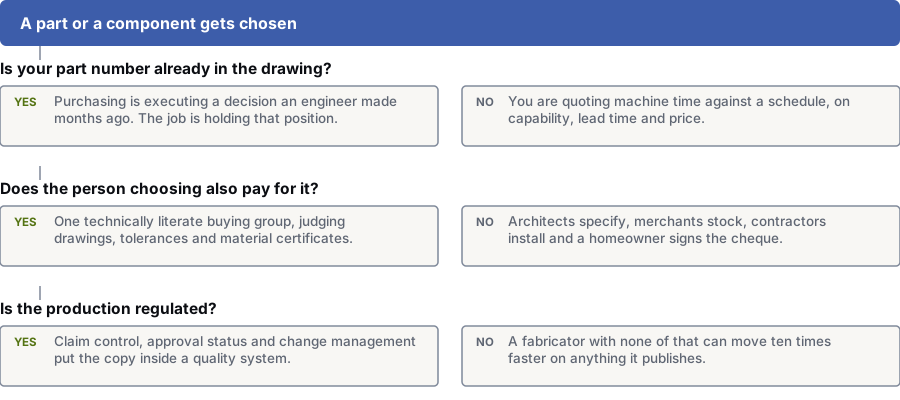
Is your part number already in the drawing?
Yes: Purchasing is executing a decision an engineer made months ago. The job is holding that position.
No: You are quoting machine time against a schedule, on capability, lead time and price.
Does the person choosing also pay for it?
Yes: One technically literate buying group, judging drawings, tolerances and material certificates.
No: Architects specify, merchants stock, contractors install and a homeowner signs the cheque.
Is the production regulated?
Yes: Claim control, approval status and change management put the copy inside a quality system.
No: A fabricator with none of that can move ten times faster on anything it publishes.
Where they split
Where one manufacturing strategy stops working
These differences are the reason the pages below are written separately rather than as one page with the business type swapped out.
- A company with its own catalogue and a company selling machine time are opposite businesses. Branded product manufacturers market a specification and defend a price; contract manufacturers and job shops sell capacity, capability and lead time to another manufacturer’s sourcing team comparing quotes against a schedule.
- Regulated production changes what may be published at all. A medical device or aerospace component carries claim control, approval status and documented change management, so marketing copy lives inside a quality system. A steel fabricator has none of that and can move ten times faster.
- Building products are chosen by people who never pay for them. Architects and specifiers decide, merchants stock, contractors install and a homeowner signs, which turns the work into a specification and channel exercise rather than a consumer one.
- Export-led manufacturers carry constraints domestic ones do not. Units of measure, certification recognition, tariff classification, language and territorial exclusivity all become marketing decisions rather than shipping ones.
Questions
Manufacturing marketing questions, answered
Our distributors own the customer relationship. What is left for us to market?
Demand, mostly. The manufacturer is the only party that can explain why a part performs the way it does, and the engineer looking for that explanation is not looking for a distributor.
The workable arrangement is generating interest at specification stage and routing the transaction to whoever covers that territory. A channel partner handed a buyer who already knows which part they want is being helped, not bypassed. What starts arguments is a public price list that undercuts the people carrying your stock.
Should we publish datasheets and CAD models openly, or gate them?
Publish them. Gating engineering data collects a small number of email addresses and loses a much larger number of specifications, because an engineer who cannot download a model in ten seconds drops your part from the assembly and picks one they can.
There are real exceptions: export-controlled material, drawings covered by a customer agreement, and anything that would disclose a process you compete on. Those are narrow. A standard product datasheet behind a form is a self-inflicted wound.
Search volume for what we make is tiny. Is any of this worth doing?
Judge it on order value rather than on volume, because the two are inversely related here. A term with thirty searches a month in a market where an approved supplier position runs for years is a different proposition from thirty searches for a consumer product.
The practical consequence is that the reporting has to change with it. Counting sessions in a market this small is meaningless; counting quote requests, drawings downloaded by named accounts and parts that reach approval is not.
Most of our business comes from trade shows. Does that change the plan?
It changes the emphasis rather than the plan. Shows still do real commercial work in this sector, because a large part of many markets walks the same halls each year and specification conversations start on a stand.
The failure is almost always what happens in the eleven months between. Badges are scanned, a spreadsheet is created, three people are called, and the rest go cold while the buying process they were in continues without you.
How do we market a component nobody ever sees?
By marketing to the person who designs it in rather than to the person who owns the finished machine. Application notes, failure modes, installation constraints and fair comparisons against the incumbent material are what that reader is looking for.
It also helps to be specific about where your part is the wrong answer. Engineers discount a supplier who claims universal suitability, and they remember one who told them a cheaper standard component would do the job.
More to explore
Guides that answer the same questions
Other sectors
Last updated · Published by Zubair Afzal (responsible editor), on owner authorisation