
Medical Devices marketing
Medical device marketing agency inside your cleared claims
Medical device marketing that builds demand within your approved claims, market by market. It speaks to the clinician and the procurement committee at once.

Where to spend
Spend on B2B search first, then search content
In the order we'd put them. Start at the top.
Show up for searches clinicians and procurement already make
Device category terms, technique questions, compatibility and consumables searches, and framework and contract queries are being made now inside the accounts you want. Answering them factually fits a tight claim set, because specifications and compatibility aren't clinical claims.
Evidence, instructions and specifications as web pages
Publish properly referenced studies with population and limitations stated, plus instructions for use, specifications, compatibility tables and service documents. Device buyers read this, every statement traces to a source, and most competitors keep it locked in PDFs.
A site that knows which market the reader is in
Product content that changes by market, a clear regulatory status statement for each, routing for healthcare professionals where required, and distributor coverage by country. One global page for a device cleared in one market and pending in another is a compliance problem first.
How they choose
How the shortlist gets made
Know how they choose and you know where to show up.
- Two buyers ask different questions, and either can stop the sale. The clinician asks if it works in their hands, with their technique and patients, alongside their existing instruments. Procurement asks about total cost across consumables and service, the contract route, framework availability and what happens when it fails.
- Evidence carries the argument, and its type matters. Peer-reviewed papers, registry data and health technology assessments outweigh a manufacturer's own summary, and a well-referenced evidence page is read by both clinical and finance sides.
- Installed equipment creates switching costs that outweigh any product comparison. If the capital equipment is already in the room, the consumable that fits it starts well ahead, and the case for change must cover everything else that would change too.
- Training, on-site support and service response often decide the outcome. A device that changes technique needs someone there for the first cases, and a clinician once left unsupported treats this as decisive.
- Contracts control access first. Group purchasing agreements, frameworks and tender cycles decide whether a product can be bought at all, and a device not on the right agreement often can't even be evaluated.
- Reimbursement and coding sit underneath everything. If the procedure isn't funded or the coding is unclear, the purchase stalls for reasons unrelated to the device.
Two buyers, two vetoes
What clinicians and procurement each need before buying a device
Device marketing is nearly always written for the clinician. The other buyer decides whether the purchase can happen at all, and hardly anyone in the sector targets them.
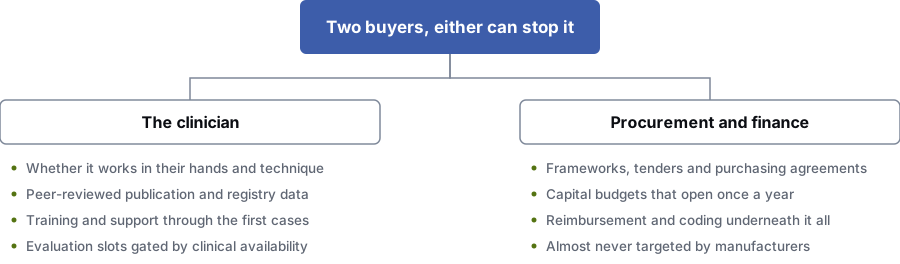
The clinician
- Whether it works in their hands
- Peer-reviewed papers and registry data
- Training and support for the first cases
- Evaluation slots set by clinic schedules
Procurement and finance
- Frameworks, tenders and purchasing deals
- Capital budgets that open once a year
- Reimbursement and coding underneath it all
- Almost never targeted by manufacturers
Common problems
Why medical device leads dry up
Most of what makes medical device marketing hard comes from one fact. What you may say depends on the device's classification, its clearance, approval or certification, and the indications those cover, and each can differ in every market you sell into.
That is no reason to market timidly. It is a reason to know exactly where the line sits before anyone writes a word, then build from evidence, specifications, service and education, not outcome claims you can't make.
To be clear about scope: this page is about marketing. Nothing on it is regulatory, legal or clinical advice, and we don't decide what a client may claim.
- The website says more than the clearance covers.
- Claims creep outwards, almost never on purpose. A conference line becomes web copy, a translation loses a qualifier, an old page survives a labelling change, a distributor strengthens a sentence. You end up with live claims nobody now at the company approved. The fix is a documented claim set for each market, applied consistently and re-checked on a schedule.
- One global site is serving markets with different approval status.
- A device may be cleared in one country, under review in a second and not submitted in a third, and one page can't describe all three. Unused country selectors and click-through pop-ups are not controls. Build in market-specific content, clear status statements and a distributor page per country from the start, because retrofitting is much harder.
- Regulatory sees the copy after it has been published.
- When review is the final gate, everything reaches it late, gets rewritten into something cautious, and the team stops proposing anything. Move the claim boundary to the start: an agreed set of permitted statements, each with its evidence attached. Review becomes a check, and output gets faster.
- The content answers the clinician and ignores procurement.
- A keen clinical champion doesn't produce a purchase order. Someone has to justify lifetime cost, including consumables, service and training, find the contract route and confirm the budget line. If none of that is on your website, the champion must build the case from scratch, and busy ones won't.
- Distributors publish claims you are accountable for.
- In many markets the manufacturer is responsible for how its device is promoted, whoever wrote the words, and distributor sites, reseller listings and marketplace entries drift, especially after translation. What works is written claim guidance, an approved-material library easier to use than writing something new, and regular checks of partner content.
What people search
What your customers search for
Clinical and technique searches
Made by clinicians and clinical engineers. Factual and led by specifications, so you can answer them without any outcome claim.
- single use bronchoscope compatibility with existing towers
- instructions for use for surgical stapler reloads
- reprocessing requirements for reusable instruments
- device compatible with existing endoscopy stack
Procurement and contract searches
Made by procurement, materials management and finance. Device makers almost never target them, so competition is low.
- gpo contract for infusion pumps
- nhs framework supplier for wound care
- total cost of ownership infusion pump comparison
- medical device distributor canada for diagnostics
Regulatory and quality searches
Made by quality, regulatory and biomedical engineering teams, and by distributors deciding whether to represent you.
- iso 13485 certified device manufacturer
- eu mdr class iia requirements explained
- difference between 510k cleared and pma approved
- unique device identification labelling requirements
Service and lifecycle searches
Made by existing users. The strongest sign of a consumable or replacement opportunity inside an account you already have.
- service contract response time for imaging equipment
- consumables compatible with legacy analyser model
- end of life support for discontinued device
- calibration interval for clinical measurement device
These are example searches from keyword research and public search data. Before we suggest anything, we check how often people search for them in your area.
Your website
What visitors need to see
- Product content for each market that states the device's regulatory status there, not one global description
- Indications for use published exactly as approved, and used as the source for every other claim
- Instructions for use, technical specifications and compatibility lists, downloadable, dated and version-controlled
- An evidence page citing publications in full, with population, method and limitations stated, not turned into a headline
- Separate contact routes for clinicians, procurement, distributors and adverse event reporting, with the reporting route easy to find
- Distributor and service coverage listed by country, so buyers can tell if the device is available to them
- Clear labelling where content is for healthcare professionals only, set up as a working control, not a checkbox
- A documented claims and review process that the people creating content can see and follow
Measuring results
The figures worth watching
These numbers show if your marketing brings in customers. Website visits alone don't.
- Evaluation and demo requests from named target accounts
- Trial placements started, and how many turn into a purchase
- Tender and framework invitations received, and the win rate
- Enquiries from distributors, reported by country
- Time from first contact to committee decision, by type of account
- Consumable reorder rate and attachment rate across installed devices
- Service contract renewals, as the sign of an account that will buy again
- How fast regulatory review turns round marketing material, and how much passes first time
The rules
What the rules allow
What you may say about a device depends on its classification and the indications covered by its clearance, approval or certification, and that differs by market. A statement accurate in one country can be an unapproved claim in another, and a device marketed legally in one jurisdiction may not be promotable at all elsewhere. We write to the indications and status you give us and don't go beyond them. Deciding what may be published, where and in what words, is for your regulatory affairs team, not us and not a copywriter.
We don't write or imply clinical outcomes. Claims about efficacy, safety, patient benefit or clinical performance against competitors belong in the approved labelling and in published evidence, cited as such. When we reference a study, the citation, population, method and stated limitations go on the page with it, and a manufacturer's own summary is labelled as exactly that. Wording that hints at a result without stating it, through images, testimonials or a vague verb, counts as a claim and gets removed.
Advertising medical devices to the general public is restricted or banned in a number of jurisdictions, and promotion before approval is restricted in most. Rules for material aimed at healthcare professionals differ again, as do rules on disclosing sponsorship, payments to clinicians and clinician relationships. Settle audience gating, market selection and pre-approval communication before planning content, because they change what a page can be.
Marketing material often falls within your quality management system. Claim review, version control, change history, approval records and archiving can all be audited, so the process behind a web page needs documenting like the rest of the technical file: an approval record for every published item and a scheduled re-review whenever labelling changes.
In many markets, content published by distributors, resellers and marketplace listings can still count as the manufacturer's, and translation is where claims most often drift. The controls that hold up are written claim guidance, an approved-material library easier to use than writing something new, and regular checks of partner sites.
Nothing on this page is regulatory, legal or clinical advice, and none of it replaces your own regulatory review. Requirements change, differ between markets, and depend on facts about your device that we are not the right people to judge. We commit to working inside the limits your regulatory team sets, flagging anything that looks like it crosses one, and stopping when unsure.
Sources
Rules and where to read them
Each rule above, linked to the body that publishes it. Which ones apply depends on where you work. Rules change, so check the latest version.
- Device labelling and advertising must not mislead about the device’s intended purpose, safety or performance.
- EU MDR Article 7
- Source: Regulation (EU) 2017/745 on medical devices, Article 7
- Sponsors must not promote or test market an investigational device until FDA approves it for sale.
- 21 CFR 812.7
- Source: US Code of Federal Regulations, 21 CFR 812.7
- A premarket submission showing a device is substantially equivalent to a legally marketed device.
- FDA 510(k)
- Source: US Food and Drug Administration, Premarket notification 510(k)
Questions
Questions about medical device SEO and ads
Can we publish clinical outcomes on a medical device website?
You can publish evidence, but not conclusions your labelling doesn't support. Use a properly referenced evidence page giving the citation, population, method, reported findings and stated limitations, presented as what the study found, not what your device does.
Trouble starts with the shortened version: a figure lifted from a paper into a headline, or a phrase that hints at a benefit. Your regulatory affairs team decides which statements you can use in each market, and we write to that list, never around it.
Our device is cleared in one market, not another. How does the site cope?
With content that changes by market, not a disclaimer. Each market gets a clear statement of regulatory status, and no global page describes the device in terms only true somewhere else.
An ignored country selector or a click-through pop-up isn't a control. The site has to show the correct version by default in each market, which is a build decision to make early.
Who signs off marketing claims, and how do we stop review becoming a bottleneck?
Your regulatory and quality teams sign off. What fixes the bottleneck is when they get involved. If review is the last gate, everything arrives late and comes back rewritten.
Agree a claim set at the start: for each market, the approved indications, permitted wording and evidence behind each statement. Content is written from that list, and review becomes a check, not a rewrite.
Can we run paid search for a medical device?
Sometimes. It depends on the device, the market and the audience, and ad platforms have their own healthcare restrictions and certification rules on top of your regulatory position.
Where allowed, the safer ground is professional and procurement searches: compatibility, service, consumables and contract routes, well away from anything close to a clinical claim. Advertising devices to the public is restricted or banned in a number of jurisdictions, so get a regulatory answer before any media plan.
Our distributors write their own copy. Should we be worried?
Usually, yes. In many markets the manufacturer is responsible for how a device is promoted, whoever wrote the words. Drift is worst after translation, when a qualifier drops out unnoticed.
Use written claim guidance in the distributor agreement, an approved library in the languages they need, and scheduled checks of partner sites. Making approved material easier to use than writing something new solves more than enforcement.
Our sales come through tenders and frameworks. What would marketing change?
Tenders decide who wins, rarely who gets considered. By the time a specification is written, its authors have formed a view from evidence they found, a clinician who asked for a product by name, and what your competitors published.
Marketing works before that point. It keeps you visible to the clinical champion, gives procurement a reusable total-cost case, and makes regulatory status and framework availability easy to find. It also speeds tender responses, because the material already exists.
See how your site stacks up
Start with the free checkup. It shows what to fix first on your website, with no sign-up. Want the full plan for your medical device business? Book a call, and we'll look at your market, your competitors and the searches that bring in customers.
Prefer to talk it over? Book a free call
Your BOOSTD score improves within 90 days, or your next month is free. After 6 months, more traffic or leads, or we keep working free (up to 6 free months in any 12 months). Read our guarantee
References
Sources for medical device marketing agency
The official documents and research this page is based on. Platform rules change, so check the source before you act on a detail.
Related
More on medical device marketing
- marketing for healthcare providers
- publication and congress-adjacent content
- the standards we hold our own content to
- suppliers making devices under contract
Guides for medical device
Other manufacturing businesses
Industries close to medical device
Last updated · Published by Zubair Afzal, responsible editor