
Contract Manufacturing & OEM marketing
Contract manufacturing marketing that wins programmes under NDA
Marketing for contract manufacturers and OEM suppliers that brings RFQs fitting your equipment. It is built on capability evidence, because your client list is under NDA.

How they choose
What customers check before they choose
Know how they choose and you know where to show up.
- The engineer checks your equipment list against the part first. Machine sizes, axis counts, press tonnage, oven capacity, cleanroom class and inspection equipment either fit the component or they don't.
- Certification scope decides eligibility. Medical programmes need ISO 13485, aerospace AS9100 and often a customer approval, automotive IATF 16949. Defence work may need export control registration before anyone can send you a drawing.
- Quote speed and the quality of design-for-manufacture feedback are read as a preview of working together. A supplier who spots the costly tolerance and suggests an alternative shows what no capability page can claim.
- Buyers check financial stability and spare capacity, because they are taking on a multi-year dependency. Can you handle double the volume, run the part on a second machine, cope if a key operator leaves?
- Location matters more than it used to. Dual sourcing across regions, tariff exposure, freight lead times and closeness to an assembly plant are now explicit selection criteria.
- Willingness to take a small first programme often decides who gets a trial. Buyers test a new supplier with a low-volume, low-risk part, and high stated minimums rule you out.
How a programme starts
How sourcing teams find and qualify a new contract manufacturer
A handful of quotes decides the year, and each one costs real engineering time. Being visible when a current supplier slips is worth more than any amount of general awareness.
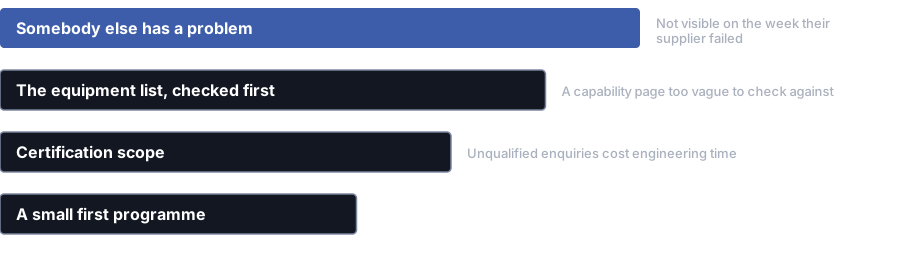
- 1Someone else has a problem — A supplier missing deliveries, a quality failure, a price rise, a plant closure or a reshoring decision. Almost every programme starts here.Not visible the week their supplier failed
- 2The equipment list, checked first — Machine sizes, axis counts, press tonnage, oven capacity and cleanroom class, all read against the part before any marketing.A capability page too vague to check
- 3Certification scope — Decides eligibility, not preference. Medical and aerospace each need their own scheme, and no relationship can replace it.Unqualified enquiries cost engineering time
- 4A small first programme — Buyers test a new supplier with a low-volume part. Being willing to take that job often decides who gets tried.
Timing
When your customers need you
Work arrives as programmes, not orders. One win can run for five years with scheduled releases, so a handful of quotes decides the year and the pipeline is measured in named opportunities.
The trigger is nearly always someone else's problem: a supplier missing deliveries, a quality failure, a price rise, a plant closure, a tariff change, reshoring or a new product. Being visible and credible that week is worth more than being visible all year.
Every quote costs money to produce. Engineering time spent quoting work you can't win is the most expensive marketing waste in this sector, and it never shows up in a marketing report.
You compete globally, on uneven terms. Price alone rarely wins. Landed cost, lead time, communication, tooling ownership and supply chain risk usually do.
Common problems
Where contract manufacturing marketing budgets leak
Contract manufacturing marketing sells something hard to advertise. You make someone else's product, to their drawing, at their volume and on their schedule, and your name never goes on the box.
No product photo means much, and you can't publish case studies. What you have is capability, certification, capacity and how well you respond when drawings land in your inbox. All four can be marketed properly.
- The proof you have is the proof you cannot use.
- Confidentiality agreements cover the parts, the tooling and often the fact that you work together at all, so most sites end up with a page of generalities. The alternative is an anonymised programme description: a component for a named sector, in a stated material, tolerance, yearly volume and certification, with nothing identifying the customer. Legal usually approves it, and it says more than a logo.
- The quotation arrives after the programme has been awarded.
- A sourcing manager sends the same drawings to four suppliers and forms a view from day one. A reply on day three, flagging a costly tolerance, looks competent. A reply on day eleven looks like a capacity problem. Most delay is chasing information the enquiry form never asked for, which makes form design a commercial issue.
- The site lists services and never states a limit.
- Buyers rule suppliers out faster than in. Maximum part size, minimum economic run, materials you don't process, tolerances you can't hold, sectors you aren't certified for and lead time let someone decide in thirty seconds, and remove quotes you were always going to lose.
- Capacity is perishable and the marketing plan is annual.
- An idle machine cell this quarter is revenue that never comes back. You need demand you can aim quickly: paid search on processes with spare capacity, outreach to sectors that suit the idle equipment, and a landing page for a specific machine group.
- Audit readiness lives in a filing cabinet.
- The quality manual, certification scope, traceability, approval process and inspection equipment decide whether a qualification succeeds, yet stay invisible until an auditor asks. Describe them publicly, including what a supplier audit involves and how first articles are approved. It shortens qualification and reaches buyers who search by requirement.
Where to spend
Start with B2B search, then the website
In the order we'd put them. Start at the top.
Capability pages built from the combinations buyers search
A sourcing engineer describes their need as process plus material plus certification plus sector, yet contract manufacturers rarely structure their sites that way. Build pages for the combinations you serve, and only those, so you show up while buyers are filtering.
An enquiry form that gets a quotable package first time
Allow drawing uploads. Ask for yearly and batch volumes, material, tolerance class, target price if shared, required date, certification needs and whether an NDA is needed first. Every field removes a chasing email, and chasing emails are where the eleven-day quote comes from.
Anonymised programme descriptions legal will approve
Build a library of what you have made, described by sector, component type, material, tolerance, volume and certification, with no customer named and no drawing shown. Most contract manufacturers lack this content, and it usually gets approved because it identifies nobody.
Know which enquiries were worth quoting
Record where every quote request came from and follow it to quoted value, win or loss, and the reason. Then you judge marketing on quotable work, and can tell a channel that wins programmes from one that creates engineering overtime.
What people search
“Iso 13485 contract manufacturer” and similar searches
Capability and certification searches
A sourcing engineer narrowing the field before any conversation. Certification plus process is the highest-intent combination here.
- iso 13485 contract manufacturer
- as9100 machine shop for aerospace brackets
- iatf 16949 injection moulding supplier
- itar registered precision machining
- contract manufacturer for wire harness assemblies
Sourcing, second source and reshoring
Sparked by a supply problem elsewhere. These buyers move fast and are unusually open to a supplier they have never heard of.
- second source supplier for machined components
- reshoring contract manufacturing united states
- nearshore contract manufacturer mexico
- contract manufacturer near assembly plant ontario
- low volume contract manufacturing uk
Process and qualification questions
Educational searches made mid-process, by buyers new to supplier qualification or checking their own approach.
- what is ppap level 3
- how to qualify a new contract manufacturer
- nda before sending drawings to a supplier
- minimum order quantity contract manufacturing
- contract manufacturing versus private label
These are example searches from keyword research and public search data. Before we suggest anything, we check how often people search for them in your area.
Your website
Your website checklist
- A full equipment list with machine sizes, capacities, axis counts and inspection equipment
- Certification scope stated precisely, including which sites and processes each certificate covers
- Stated limits: maximum part size, minimum economic run, materials you decline and realistic lead times
- Anonymised programme descriptions by sector, material, tolerance and yearly volume
- A quote form that accepts drawings and asks what your estimator needs to know
- A clear qualification path: what a supplier audit of your plant involves and how first articles are handled
- A named commercial contact with a direct line, because sourcing managers don't use general enquiry forms
- A confidentiality statement explaining how drawings and customer information are handled
The rules
Claims to avoid
Confidentiality governs every page. The supply agreement can restrict customer names, part photos, drawings, tooling images and even sector references, so get written permission before publishing anything. An anonymised description must be fully anonymous: a sector, a volume band and a tolerance, never detail specific enough for anyone in the industry to name the customer.
Certification claims must state their scope. A certificate covers specific sites and processes, and a company calling itself certified when only one of three plants is covered will be found out during qualification. Put certificate numbers, issuing bodies and expiry dates on the page.
Export control, defence registration and dual-use rules can limit who may receive technical details and from where, and they differ by jurisdiction and by the recipient's nationality. Registration status is a factual claim that gets checked. What you may publish about controlled capability is for your compliance team, not marketing.
Capability claims that turn into capacity promises create contract risk. Holding a tolerance routinely is a claim you can prove from inspection records. A delivery performance or capacity figure that isn't measured and current can resurface in a commercial dispute.
Sources
The official wording
Each rule above, linked to the body that publishes it. Which ones apply depends on where you work. Rules change, so check the latest version.
- Requires US manufacturers and exporters of defence articles to register with the State Department.
- ITAR Part 122
- Source: US: Directorate of Defense Trade Controls, 22 CFR Part 122 (eCFR)
- Treats release of controlled technology to a foreign person in the US as a deemed export.
- EAR Part 734
- Source: US: Bureau of Industry and Security, 15 CFR Part 734 (eCFR)
- Controls the export and transfer of military and dual-use goods and technology from the UK.
- Export Control Order
- Source: UK: Export Control Order 2008 (legislation.gov.uk)
Questions
Short answers on contract manufacturing marketing
Every customer programme is under NDA. What can a contract manufacturer publish?
More than most think. Almost every agreement bans naming the customer, the product and the drawing. Very few ban describing the type of work in general terms.
Use a programme description with the identity removed: a structural part for the rail sector, in aluminium, to a stated tolerance, yearly volume, certification and lead time. Have legal check the wording once, agree a template, and you have a format you can use for years.
Is publishing our equipment list handing competitors a map?
No. Competitors already know what you own. Equipment is bought at the same shows from the same dealers, and second-hand listings, job ads and supplier audits fill in the rest.
What the list changes is who can qualify you. A sourcing engineer whose part needs a specific machine size can't choose you if the site doesn't say you have it.
How do we get fewer enquiries we cannot profitably quote?
State your limits clearly and screen in the form, not a follow-up email. Minimum run, maximum part size, materials you decline and sectors you aren't certified for should be findable in seconds.
Total enquiries will fall, which looks like a step back in a marketing report but isn't. Quotes eat estimator and engineering time, so removing the ones you can't win improves margin directly.
Can marketing do anything about quotation turnaround?
Yes, because most delay is missing information, not estimating. An enquiry without volumes, material, tolerance class or a required date means days of chasing before work starts.
Design the form around what your estimators need and make the key fields required. That regularly takes days out of the cycle, and buyers read it as capability.
We have spare capacity on one process. Can marketing fill it quickly?
Partly. Paid search on that process and material, plus targeted outreach to sectors that use it, can bring quotable enquiries within weeks.
It can't shorten qualification. A new customer in a regulated sector may need months of approval before a first order, so the quick route mostly reaches buyers with an urgent gap or a failing supplier.
Get a free website check
Start with the free checkup. It shows what to fix first on your website, with no sign-up. Want the full plan for your contract manufacturing business? Book a call, and we'll look at your market, your competitors and the searches that bring in customers.
Prefer to talk it over? Book a free call
Your BOOSTD score improves within 90 days, or your next month is free. After 6 months, more traffic or leads, or we keep working free (up to 6 free months in any 12 months). Read our guarantee
References
Sources for contract manufacturing marketing
The official documents and research this page is based on. Platform rules change, so check the source before you act on a detail.
Related
More on contract manufacturing marketing
- manufacturers selling their own catalogue
- quote forms people finish
- more enquiries from accounts worth having
Guides for contract manufacturing
Other manufacturing businesses
Last updated · Published by Zubair Afzal, responsible editor