
Building Products & Materials marketing
Building products marketing agency that gets you specified
Building products marketing for manufacturers selling through a chain. Architects, distributors, contractors and end users each get the material their decision needs.

Common problems
Building products marketing problems to fix first
Building products are rarely sold to the person who chooses them. An architect writes the product into a specification. A distributor decides whether to stock it. A contractor installs it, or swaps it for something easier. Then someone who was never asked lives with it for twenty years.
Each of those four has a different question, vocabulary and moment of decision. Your marketing either serves all four on purpose, or only whoever the brochure was first written for.
- One brochure is being asked to serve four different buyers.
- The architect needs performance data, a specification clause and a detail drawing. The distributor needs margin, stock turn and lead time. The contractor needs fixing centres, tolerances and fitting time per square metre. The end user wants looks, cost and lifespan. One document written for all four reads as advertising to each, and none can act on it.
- Nothing on the site can be dropped into a specification.
- A specifier under time pressure wants a clause in their office format, performance figures with the test standard cited, a CAD detail, a model object and the declaration of performance. If those are missing, the practice specifies a competitor whose files are already in its library, and no brand advertising reverses that.
- You are competing with your own distributors for your own product names.
- Merchants and online stockists build a page for every product they carry, and together they outrank the manufacturer for its own range. Rather than fight, make your page worth visiting for what a distributor page can't carry: full performance data, the specification clause, installation details, warranty terms and a where-to-buy route back into your channel.
- The installer is treated as a cost, not an audience.
- The contractor decides whether your product goes in properly, whether they recommend it next time, and whether a warranty claim is your fault or theirs. Training, clear installation guides and short task videos are the cheapest way to win installer loyalty, and they cut warranty costs. Most manufacturers pay for a trade show stand instead.
- Product lifecycles outlast the website by decades.
- Something installed in 2011 still creates searches in 2031: a replacement panel, a compatibility question, a warranty document, a colour match. If a redesign deleted the page, those searches go elsewhere. Keep dated archive pages for discontinued lines, with documents attached and the current equivalent linked, to catch demand nobody else competes for.
Where to spend
Why search content comes before B2B search
In the order we'd put them. Start at the top.
Technical documents written to specification standard
Publish performance data with the test standard and tested assembly stated, clause text a practice can paste, detail drawings, installation instructions and declarations of performance, on web pages with the files attached. This decides whether you get specified, and manufacturers most often leave it out.
Show up for the code, standard and detail searches specifiers make
Specifiers search by requirement long before a product name: a fire classification, a thermal value, an acoustic rating, fixing to a certain substrate. Pages built around those requirements reach them before they have chosen anything.
Four routes through the site, not one brochure
Specifiers need technical documents and downloads; trade buyers stock, pricing structure and installation; distributors margin and support; consumers inspiration and where to buy. One product page can serve all four when the layers are properly separated.
A stockist and installer finder people can find
Where-to-buy searches carry some of the highest intent in the sector, yet the page is usually a postcode box that returns nothing useful. Build indexable pages for the areas you cover and accurate profiles for certified installers, so demand you created turns into sales instead of leaking to a merchant.
Timing
When people start looking
Demand is created long before the order. A specification written this quarter becomes a site delivery twelve months to three years later, so measure specification work on its own terms.
New build and renovation are two markets. New build runs on programmes, tenders and professional specifications. Renovation runs on homeowners, small contractors and merchant stock, and decides much faster.
Changes to codes and regulations create sudden bursts of demand. When a requirement changes, everyone specifying in that category searches for compliant options at once, and manufacturers with current documents published get considered.
Seasons follow the weather and the construction calendar. External products move with the building season, and the quiet months are when specification and documentation work must get done.
Four buyers, one product
How a building product moves from specifier to contractor
The product is chosen four times by four different people. Each judges something the others don't care about. A campaign aimed at only one of them lets the demand leak to someone else.
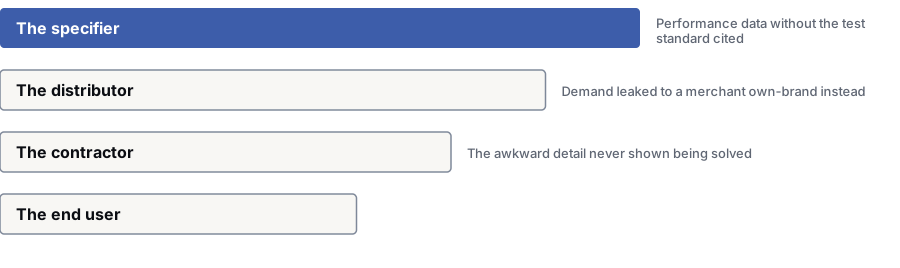
- 1The specifier — A specification written now reaches site one to three years later. It goes to whoever's documents need no phone call.Performance data with no test standard cited
- 2The distributor — Chooses on commercial terms more than the product: margin, stock turn, minimum order, lead time and whether contractors ask for it.Demand lost to a merchant's own brand
- 3The contractor — Chooses on installed cost and familiarity: labour time per square metre, and how forgiving the system is on an uneven surface.The awkward detail never shown being solved
- 4The end user — Comes in late and decides on looks, lifespan and installed cost, often after someone has suggested an alternative.
What people search
What people type, like “fire rated cladding a2-s1 d0 specification”
Specifier and technical searches
Made by architects, technologists and engineers writing a specification. High value, low volume, and answered by technical documents, not marketing pages.
- fire rated cladding a2-s1 d0 specification
- u value triple glazed window units comparison
- revit family for aluminium curtain walling
- acoustic rating internal partition 45db
- specification clause for rainscreen cladding
Contractor and installer searches
Searched on site, usually on a phone, usually mid-job. Best answered by a short video and a clear detail drawing.
- fixing centres for composite decking joists
- how to install cladding around an external corner
- membrane lap detail over blockwork
- recommended torque for structural fixings
Where to buy and distribution
The point where the demand you created either sells through your channel or leaks to a merchant's own brand.
- stockist near me for composite cladding
- trade counter insulation board manchester
- price per square metre for engineered flooring
- distributor for architectural hardware canada
End user comparison and durability
Homeowners and self-builders deciding on looks and lifespan. They use completely different words from specifiers.
- composite versus timber decking which lasts longer
- best cladding for coastal exposure
- how long does a flat roof membrane last
- do i need building regulations approval for new windows
These are example searches from keyword research and public search data. Before we suggest anything, we check how often people search for them in your area.
Your website
What your website needs
- A page per product with performance data as text, each figure linked to a test standard and tested assembly
- BIM objects and CAD details in the file formats specifying practices use
- Downloadable test reports, declarations of performance and warranty documents, each dated and versioned
- Specification clause text a practice can copy straight into its own document
- A stockist and certified installer finder with indexable pages for the areas you cover
- Installation instructions and short task videos for every product and its awkward details
- Archive pages for discontinued lines, keeping the documents and linking the current equivalent
- Separate, clear routes for specifiers, distributors, contractors and end users
How they choose
How buyers choose between you and a rival
Know how they choose and you know where to show up.
- The architect or technologist chooses on whether your documents let them specify without phoning you. Performance data with the test standard cited, a clause to paste, a detail drawing and a model object are either in their library, or a competitor's are.
- The distributor chooses on commercial terms more than the product. Margin, stock turn, minimum order, lead time, returns and whether contractors ask for it by name decide whether the range gets stocked.
- The contractor chooses on installed cost and familiarity. Labour time per square metre, how forgiving the system is, whether the awkward junction has a published detail and whether they have fitted it before matter more than unit price.
- The end user chooses on looks, lifespan and installed cost. They decide late, usually after someone has already suggested a product.
- Compliance evidence is a gate for everyone in the chain. Current test reports, declarations and classifications let a product into a project, and an expired document removes you without anyone telling you.
- Long-term support gets weighed. Whether spares, matching batches and warranty support will exist in fifteen years is a fair question for a product with a long service life.
The rules
What regulators expect
Performance claims in this sector are regulated claims. Fire classification, structural performance, thermal values, acoustic ratings and slip resistance come from a specific test on a specific assembly. A figure quoted without the standard, the test house and the tested build-up is incomplete at best, and at worst a misrepresentation that stays in a building for its whole life.
Marking and declaration rules differ by market and have drifted apart. CE marking, UKCA marking and other national schemes are not interchangeable, and a document valid in one market isn't automatically valid in another. Which declarations apply in each market is a question for your technical and regulatory team.
Warranty and guarantee statements are contractual promises, not marketing copy. Length, coverage, exclusions, what voids them and whether they transfer with the building must match the warranty document, because the website version is the one a homeowner produces in a dispute years later.
Environmental claims face growing scrutiny under advertising and consumer rules in most markets. Recycled content, carbon, recyclability and lifespan claims should trace to an environmental product declaration or similar verified source, with scope and boundaries stated.
Sources
See each rule in full
Each rule above, linked to the body that publishes it. Which ones apply depends on where you work. Rules change, so check the latest version.
- Explains declarations of performance and UKCA or CE marking for construction products in Great Britain.
- GB construction products
- Source: Great Britain: GOV.UK, Construction products regulation in Great Britain
- Sets EU rules for marketing construction products, including performance declarations and CE marking.
- EU CPR 2024/3110
- Source: EU: Regulation (EU) 2024/3110, Construction Products Regulation (EUR-Lex)
- Explains how UK consumer law applies to environmental claims, which must be truthful and substantiated.
- CMA Green Claims Code
- Source: UK: Competition and Markets Authority, Green Claims Code
Questions
Building products marketing, answered
Our distributors outrank us for our own products. Should we fight that?
Not directly, and not on product-name searches. Merchants have a page for everything they stock and more authority than any one manufacturer, so a head-on fight burns budget without changing the result.
Own what a distributor page can't carry: full performance data, the specification clause, detail drawings, installation content, warranty terms and a where-to-buy route back into your channel. The searches you lose still turn into sales, and the ones you win decide specifications.
Is BIM content worth what it costs to produce?
For products drawn into a model, usually yes, if the objects are accurate, current and in the software your target practices use. Once an object is placed in a model, removing it means someone has to redraw.
It isn't worth doing to tick a box. A badly built or out-of-date object does more harm than none, and most manufacturers underestimate the upkeep.
How do we reach architects without a budget for events and lunches?
Be easy to find when a specifier searches for a requirement, not a brand. Fire classifications, thermal values, junction details, substrate compatibility and code questions are searched a lot, and a clear, current answer gets you considered without meeting anyone.
Recorded technical sessions and clear written guides do a similar job for far less than presenting in person, and they work at two in the afternoon on a deadline.
Can we publish prices when we sell through distributors?
Yes, without a trade price. A guide rate per square metre or unit, what drives cost between specifications, and a note that final pricing comes from the stockist gives a specifier a budget figure without undercutting your channel.
Publishing nothing does more damage. A specifier who can't estimate a cost often specifies something they can, and you never find out.
We get specified and then substituted on site. What stops that?
Substitution usually happens for one of three reasons: availability, installed cost or unfamiliarity. Find out which one is behind it on your projects.
Availability is a distribution and lead-time problem. Installed cost is fixed by labour time and simpler details, not unit price. Unfamiliarity is fixed by installer training and clear documents, which is why contractors matter commercially.
How long before specification work shows up in revenue?
Longer than any normal reporting cycle. A specification written this quarter usually reaches site one to three years later, depending on the project and the construction pipeline.
So specification work needs its own measures: named projects, object downloads, samples sent to practices and clause usage. Judge it on this quarter's sales and it gets stopped just before it would have paid off.
Ready for more enquiries?
Start with the free checkup. It shows what to fix first on your website, with no sign-up. Want the full plan for your building products business? Book a call, and we'll look at your market, your competitors and the searches that bring in customers.
Prefer to talk it over? Book a free call
Your BOOSTD score improves within 90 days, or your next month is free. After 6 months, more traffic or leads, or we keep working free (up to 6 free months in any 12 months). Read our guarantee
References
Sources for building products marketing agency
The official documents and research this page is based on. Platform rules change, so check the source before you act on a detail.
Related
More on building products marketing
- coverage in trade and architectural press
- the contractors who install your product
- mapping how specifiers search
- developers running the projects you want
Guides for building products
Other manufacturing businesses
Industries close to building products
Last updated · Published by Zubair Afzal, responsible editor