
General Contracting marketing
General contractor marketing: you are selling project management, not trade work
A general contractor is hired to run other people’s trades, hold a schedule and tell the truth on a Friday afternoon. Homeowners, developers and businesses all buy that differently, and one undifferentiated website speaks to none of them properly.
Prefer to talk it through? Book a strategy call
Buying behaviour
How general contracting customers decide
Strategy follows this, not the other way round. Everything on this page is downstream of how the decision gets made.
- They ask for references and ring them, and the question they ask is about communication and finishing, not about the quality of the work.
- They compare payment schedules line by line. A deposit that looks large against the stage of work reached is one of the fastest ways to be removed from a shortlist.
- They want to know who will be on site daily, whether that person is an employee, and how many other projects that person is supervising at the same time.
- They check licensing, insurance and any bonding or warranty enrolment, and in commercial work this is a formal prequalification step with documents attached rather than a glance at a badge.
- Developers and property owners weigh schedule reliability against a financing or lease deadline, which makes a credible programme more persuasive than a lower price.
- Architects, designers and property managers refer a large share of the good work, and they refer the contractor who did not embarrass them last time.
What is being bought
They are buying management, and they check it like it
Every question a serious client asks is about coordination rather than craft. The quality of the work is assumed; whether the job finishes on time and on budget is what is being assessed.
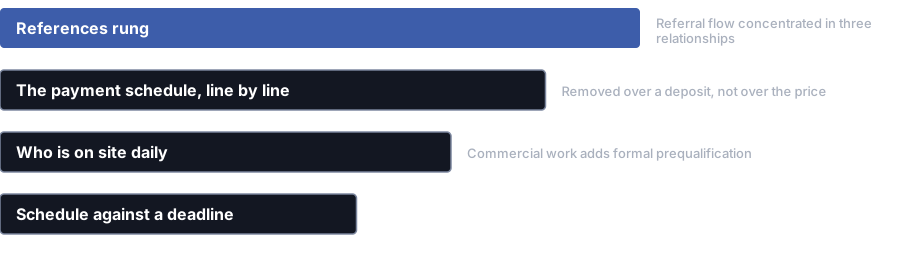
- 1References rung — And the question asked is about communication and finishing, not about the quality of the work, which is largely assumed.Referral flow concentrated in three relationships
- 2The payment schedule, line by line — A deposit that looks large against the stage of work reached is one of the fastest ways to be removed from a shortlist.Removed over a deposit, not over the price
- 3Who is on site daily — Whether that person is an employee, and how many other projects they are supervising at the same time as yours.Commercial work adds formal prequalification
- 4Schedule against a deadline — Developers weigh programme reliability against a financing or lease date, which makes a credible schedule more persuasive than a lower price.
Search behaviour
General contracting searches, grouped by intent
Homeowner searches for a builder
Nervous, mid-sized budget, and shortlisting on evidence rather than price.
- general contractor near me
- how to find a good general contractor
- general contractor vs subcontractor
- what does a general contractor charge
- home addition contractor [city]
Commercial and developer searches
A procurement mindset. Almost never served by a residential website.
- commercial general contractor [city]
- office fit out contractor
- retail construction contractor
- design build construction firm
- tenant improvement contractor near me
Process, contract and money questions
Fear-driven and high converting when answered without hedging.
- general contractor payment schedule
- what is a change order in construction
- how much deposit for a contractor
- who pulls the building permit
- construction contract what to look for
Schedule and permit questions
Where a contractor demonstrates competence before ever meeting the client.
- how long does a building permit take
- construction schedule delays what to do
- do i need a permit for a garage conversion
- what happens if a contractor misses the deadline
These are examples of how customers in this market search, drawn from keyword research and public search data. They are illustrative, not a volume claim: we size the demand in your area before recommending anything.
Measurement
General contracting numbers we report on, and what we ignore
Sessions are not on this list. These are the numbers that tell you whether the marketing is producing customers.
- Scoped bids issued, split by residential and commercial
- Bid-to-award rate and average time from enquiry to signature
- Weeks of committed backlog, tracked month over month
- Average project value by buyer type and by source
- Cost per awarded contract, measured over a window that matches the cycle
- Referral share of awarded work and how many sources it runs through
- Prequalification packs requested by commercial buyers
What usually goes wrong
Where general contracting marketing tends to fail
General contracting is the only trade in this sector that does not perform the work it sells. The framing, the electrical, the drywall and the tiling belong to somebody else; what the client is buying is the person who decides what happens on Tuesday and who tells them when it will not.
That changes the marketing completely. Nothing on a contracting website needs to prove you can swing a hammer. It needs to prove you can run eight trades, a permit office and a nervous client at the same time.
- The website advertises trades you subcontract.
- Listing framing, roofing, plumbing and electrical as services puts you in competition with the specialists who do them, on searches where a specialist will always look more credible. It also hides what you are good at. The client shortlisting a general contractor wants to know who supervises the site, how many projects you run at once, how subcontractors are selected and what happens when one of them lets you down — none of which appears on a services list.
- One page is trying to convince a homeowner and a developer.
- A homeowner extending a kitchen and a developer awarding a twelve-unit build are not the same buyer in any respect. One is spending savings and is frightened; the other is running a prequalification process, checking bonding capacity and comparing your schedule against a financing deadline. A single page written to reassure both ends up reassuring neither, and the commercial half of the business never starts because there is nothing on the site a procurement lead could act on.
- The schedule is the sale and it is never mentioned.
- Ask a client why they chose a contractor and the answer is almost never the craftsmanship, which they cannot assess anyway. It is that somebody explained the sequence, gave a realistic finish date and did not flinch when asked what happens if a trade falls through. Publishing how you build a programme, how often you report progress and what a two-week slip looks like is uncomfortable and converts better than any project photograph.
- Change orders come as a surprise, so the quote loses.
- Every client has heard a story about a price that doubled. A contractor who explains in advance what triggers a variation, how it is priced, who approves it and how long the approval takes removes the largest single reason a shortlisted firm gets dropped. The firms that avoid the topic are not avoiding the anxiety — they are just leaving it to be answered by a competitor.
- The pipeline is measured in leads and the business runs on backlog.
- Lead counts tell a contractor almost nothing. Two enquiries that become awarded projects worth six months of crew time are a better quarter than forty that become site visits. Reporting that does not track scoped bids, award rate and weeks of committed backlog cannot tell you whether to hire, whether to bid harder or whether the marketing is doing anything at all.
Where the money goes
The general contracting marketing channels that earn their place
In priority order for this business, not a menu. Anything not on this list is something we would need a specific reason to recommend.
Two site structures under one roof
The residential and commercial halves need separate paths from the first click — separate landing pages, separate proof, separate calls to action. Content on permits, programmes, change orders and payment stages captures the questions clients type and does the reassurance work before anybody picks up a phone.
Project pages that show how you run a job
A finished photograph proves the trades were competent. What sells a general contractor is the sequence behind it: the constraints, the programme, what was found on demolition and how it was priced. Project pages built that way, plus a plainly stated payment schedule, answer the two questions that decide the award.
Being findable by developers and property teams
Commercial work is awarded by people who prequalify. That means published capability — project types, typical values, insurance and bonding capacity, safety record, references willing to speak — presented so a procurement lead can shortlist you without a phone call. Very few contracting sites give them anything to work with.
Local visibility for the residential half
Homeowners searching for a builder start in the map pack, and the profile inputs you control — category, service list, project photographs, review arrival — decide most of it. This is the fastest-moving part of the programme and the one that fills the smaller projects between the large ones.
Reviews about communication, gathered on purpose
Contracting reviews are read for one thing: did this firm finish, and did they tell the client what was happening. Collecting reviews at handover, responding to the difficult ones without defensiveness, and keeping references who will take a call addresses the abandonment fear more directly than anything else you can publish.
The website
What a general contracting website has to do
- A plain statement of what you self-perform and what you subcontract
- Separate residential and commercial paths from the homepage onward
- Project pages that describe the programme and the constraints, not only the finish
- A payment schedule explained stage by stage, in ordinary language
- How change orders are triggered, priced and approved, written before anyone asks
- Who supervises the site daily, named, and how progress is reported
- Licensing, insurance, bonding and any warranty enrolment stated exactly as held
- Permit responsibility made explicit — who applies, who pays, who waits
- A commercial capability page a procurement lead could shortlist you from
- An enquiry form that captures scope, site address, budget band and target start
Constraints
General contracting advertising rules: what is allowed, and what is not
General contracting is licensed, registered or bonded differently almost everywhere, and the rules attach to advertising as well as to the work. Several jurisdictions require a licence or registration number to appear in advertising, restrict who may describe themselves as a builder or contractor, and set thresholds above which a specific registration applies. Marketing should state only the credentials held, under their correct names, and clients confirm current requirements with the licensing body that covers them.
Permit claims need care. Saying that you manage the permit process is a description of a service; implying that you can obtain an approval, shorten a review, or that work does not require a permit when it does creates a real problem for the client as well as for the firm. Permit thresholds and responsibilities vary by municipality, so this kind of content should describe the general process and direct readers to their local authority.
Consumer contract rules apply to residential work in most markets, and a number of jurisdictions impose written-terms requirements, deposit limits, cancellation rights and mandatory wording on contracts signed in a customer’s home. Payment and contract content should describe your own terms and point readers at the applicable consumer protection authority rather than offering guidance. Confirm the position with your own legal adviser.
Where new-build or major renovation work falls under a mandatory warranty or home-builder registration programme, membership is a fact to be stated accurately and never implied. Presenting a trade association membership as though it were a licence, or an expired enrolment as current, is the kind of claim that attracts a complaint from a competitor rather than a regulator finding you first.
Primary sources
The general contracting rules above, at source
The rules this page refers to, linked to the regulator or rule-maker that publishes them. Which apply depends on where you operate, and they change, so check the current version.
- Requires California licensed contractors to include their licence number in contracts and all forms of advertising.
Cal. B&P Code § 7030.5
Requires California licensed contractors to include their licence number in contracts and all forms of advertising.
Source: California Business and Professions Code § 7030.5 (US: California)
- Requires sellers in US door-to-door sales to give a written three-day cancellation notice and honour cancellations.
FTC Cooling-Off Rule
Requires sellers in US door-to-door sales to give a written three-day cancellation notice and honour cancellations.
Source: FTC, 16 CFR Part 429 (US)
- Gives consumers a right to cancel distance and off-premises contracts within the cancellation period.
CCRs 2013, reg. 29
Gives consumers a right to cancel distance and off-premises contracts within the cancellation period.
Questions
General contracting marketing questions, answered
Most of our work comes from architects and repeat clients. Why market?
Because that pipeline is concentrated in a handful of people, and it moves when they do. Three relationships producing most of your commercial work is a good year and a serious risk in the same sentence — one retirement or one change of employer removes a large share of next year’s backlog with no warning.
There is also a quieter effect. Architects and property managers check you online before they put your name forward, and a thin website makes a strong referral weaker. The work you already have is easier to defend than new work is to win.
How do we stop attracting projects that are too small?
Say what you build and roughly what it costs. A firm that publishes typical project types and value bands filters most of the mismatch out before it reaches a site visit, and site visits are expensive in this trade.
The enquiry form does the rest. Asking for scope, site address, target start date and a budget band is not a barrier to a serious client; it is a barrier to somebody who has not thought about any of those, which is exactly the enquiry you are trying to avoid.
Should we publish our payment schedule?
Yes, and it is usually one of the highest-converting pages on a contracting site. Clients are frightened of deposits because they have heard the stories, and the firm that explains its stages before being asked looks like the one with nothing to hide.
Describe your own terms rather than the law. Deposit limits and cancellation rights differ by jurisdiction, so the page should set out how you work and point readers at their consumer protection authority for the rules that apply to them.
Can the same website serve homeowners and commercial clients?
The same website, yes. The same pages, no. From the homepage onward the two buyers need separate paths, because a procurement lead is looking for insurance limits, bonding capacity, safety record and comparable project values, while a homeowner is looking for reassurance and photographs.
Running them together produces a site that reads as slightly wrong to both. Splitting them costs a few extra pages and usually opens the commercial half of the business for the first time.
How long before this shows up in signed work?
Longer than in the emergency trades, and the timeline belongs to the buying cycle rather than to the marketing. Residential enquiries can improve within a couple of months once the site and the enquiry form are fixed. Commercial work is budgeted months ahead of the invitation to bid.
Judge the first year on scoped bids, award rate and weeks of committed backlog. A contractor who watches signed revenue alone will cut a programme in month five that was filling the following spring.
Is it worth having project pages if every job is different?
It is worth more precisely because every job is different. A client cannot assess construction quality from a photograph, so what persuades them is the reasoning: what the site constraints were, how the programme was sequenced, what turned up unexpectedly and how it was handled.
Ten projects written that way will do more for a general contractor than a hundred gallery images, and they keep working for years because the questions they answer never change.
Find out what is winnable for your general contracting business
Start with the free Growth Scan: an indicative read of your website and the few things to fix first, with no sign-up. BOOSTD is in early access, so the fuller picture for your general contracting business — your area, your competitors and the searches that matter — is worked through with our team on a strategy call. If we do not think we can move it, we will tell you.
Prefer to talk it through? Book a strategy call
If we don't deliver the work we agreed to deliver for reasons within our control, you don't pay for the undelivered work. Read our guarantee
References
Sources
The primary documents and published research this page relies on. Platform rules change, so check the source before acting on a detail.
More to explore
Last updated · Published by Zubair Afzal (responsible editor), on owner authorisation