
Landscaping & Outdoor Living marketing
Landscaping marketing agency that books next season early
Landscaping marketing that fills maintenance routes before spring and books design-build work in the months your competitors go quiet.

Timing
When the enquiries come in
Your season is short and your selling season shorter. The enquiries that decide your summer arrive between late winter and early spring. Start marketing when the weather turns and you’ve already lost the properties you wanted.
Maintenance and installs peak at different times. Route enquiries bunch up at the start of the growing season, then level off. Project enquiries build through spring, hold through summer and fade once the job can’t finish before autumn.
Weather shifts these dates by weeks, but the order stays the same: renewals first, then new route customers, then project bookings. Plan around that order and let the dates move.
Autumn and winter services are the most under-sold part of the trade: clean-ups, snow clearing where it applies, lighting and cold-weather hardscaping. Firms that call themselves seasonal rarely market them.
Two businesses, one crew
Mowing is decided in a week. Patios take all spring.
Maintenance and design-build peak at different times, and customers judge them on different proof. One message for both is how firms miss the selling season.
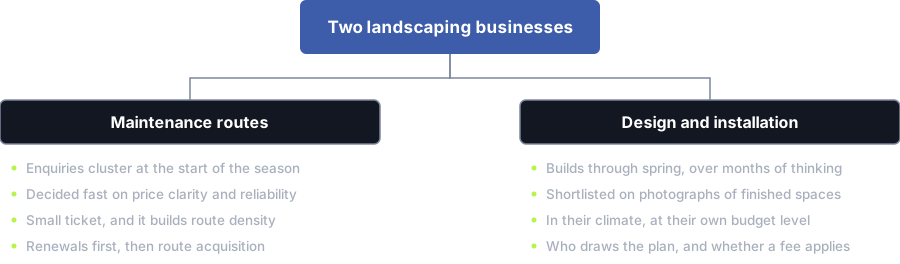
Maintenance routes
- Enquiries bunch up at the start of the season
- Decided fast on clear prices and reliability
- Small jobs that build route density
- Renewals first, then new route customers
Design and installation
- Builds through spring, over months of thinking
- Shortlisted on photos of finished spaces
- In their climate, at their own budget level
- Who draws the plan, and whether a fee applies
Your website
What your website needs
- Separate paths for regular maintenance and design-build projects
- A price range, or a clear explanation of how you quote maintenance
- What a maintenance visit includes, and what it leaves out
- A page per project: the site problem, the plan and the finished space
- Your service area as a drive time, with no list of every nearby town
- Whether there’s a design fee, and whether it comes off the build price
- Certifications for chemical use, tree work or irrigation, named correctly
- Off-season services with their own proper pages
- A way to book months ahead, plus an enquiry form for this week
- Photos taken in your own climate, with plants that survive it
What people search
Searches like “landscaper for weekly maintenance”
Regular maintenance searches
Small jobs, quick decisions. These fill your routes.
- landscaper for weekly maintenance
- lawn mowing service near me
- garden maintenance prices
- yard clean up service [city]
- lawn care company monthly cost
Design and installation searches
High value, months of thinking, decided on photos.
- landscape design company near me
- backyard makeover ideas before and after
- paver patio installation cost
- landscape designer or landscaper
- outdoor living space contractor
Specific outdoor projects
Give each one its own page. It beats a general services page every time.
- retaining wall builder near me
- artificial turf installation cost
- garden irrigation system installation
- outdoor lighting installer
- drainage solutions for a wet yard
Off-season and seasonal work
The searches that keep crews busy after the growing season ends.
- fall yard clean up near me
- when to book spring landscaping
- winter garden preparation service
- snow removal contract [city]
Plant, lawn and problem questions
Cheap to win, and a chance to show you know the local climate.
- why is my lawn turning brown
- best time to lay sod
- how much does lawn aeration cost
- grass that grows in shade
These are example searches from keyword research and public search data. Before we suggest anything, we check how often people search for them in your area.
Common problems
Why your landscaping marketing isn't bringing in work
Landscaping has two very different customers. One wants the grass cut every two weeks. The other has stared at a bare garden all winter and wants it rebuilt.
Selling a mowing route and a twenty-thousand-dollar patio have almost nothing in common apart from the truck. Mix them up and you spend money in the wrong month.
- Your marketing stops when the season stops.
- Many firms cut the budget in November and restart in April. That’s backwards. Clients decide on renewals over winter, install calendars fill for whoever asked first and clicks cost far less in the quiet months. Go silent for four months and you hand next season to a competitor.
- Maintenance and installs share one page and one message.
- Someone comparing mowing prices wants reliability, a price and a start date. Someone planning an outdoor kitchen wants photos, a designer they trust and a realistic timeline. Sell both from one page and mowing enquiries swamp the project ones.
- Your best project photos are stuck on the crew’s phones.
- People buy design-build work with their eyes, and most landscapers have years of before-and-after photos they never publish well. A project page showing the site before, the client’s brief, the slope or drainage problem and the finished space in good light sells for years.
- Clients drift away, and you blame the season.
- Maintenance clients rarely cancel; they just don’t reply to the spring email. If a fifth of your route drops off each winter, you win them back just to stand still. Start renewal messages in the off-season and explain any price change up front.
- You get more leads than your crews can handle.
- In peak season you run out of hours before demand. Buying more enquiries then means missed calls, slow quotes and bad reviews from people who waited. Once routes are full, cut drive time, raise prices on the worst properties and swap low-margin stops for better ones nearby.
Where to spend
Local SEO first, then organic search
In the order we'd put them. Start at the top.
Own the map around your routes
Maintenance lives on drive time, so own a tight radius rather than spreading thin across a county. Keep your Google Business Profile accurate, list mowing and design as separate services, add project photos and keep reviews coming.
Project pages and advice for your climate
Patios, retaining walls, irrigation, turf and drainage each need their own page. Writing about what grows and dies where you work proves local know-how a generic gardening article can’t. It’s slow to build and brings work for years.
Photos and reviews that sell the next garden
Homeowners choose a landscaper on pictures of finished work and what neighbours say. Ask every happy client for a review with a photo, reply to each one, and keep your Google profile's gallery current through the season. It turns one finished garden into the next three enquiries on the same street.
How they choose
How buyers choose between you and a rival
Know how they choose and you know where to show up.
- Maintenance clients pick on reliability and clear pricing, and decide fast. A price range, a clear list of what a visit covers and a reply within a day usually wins.
- Design-build clients shortlist on photos of finished spaces like theirs, in their climate and at their budget.
- Both read reviews for the same failures: crews that stopped turning up, quotes that changed and gardens left half-done.
- Local proof counts for a lot. A garden is the one home service the whole street can see and ask about.
- For chemicals, tree work or drainage, clients look for the specific certification and insurance. “Professional” on its own isn’t enough.
- Design clients want to know who draws the plan, if there’s a design fee and if it comes off the build price. Most landscaping sites don’t say.
Measuring results
Numbers that matter
These numbers show if your marketing brings in customers. Website visits alone don't.
- Maintenance contracts signed, and contracts kept from one season to the next
- Renewal rate by property type, and why clients cancel
- Design-build quotes sent and how many become jobs
- Average install value, and average yearly value per maintenance property
- Route density: stops per crew day inside your target area
- Weeks of install work booked before the season opens
- Cost per signed maintenance contract and per booked install, tracked separately
- Off-season revenue as a share of the yearly total
The rules
Before you publish an ad
Applying pesticides, herbicides and some fertilisers commercially needs a licence in most places, and the rules often cover advertising: limits on how treatments are described, a licence number on marketing, or bans on words that suggest a product is harmless. List only certifications you hold, and check current rules with the regulator that licenses applicators where you work.
Environmental and safety claims get checked. Under most consumer protection rules, calling a treatment organic, natural, pet-safe, child-safe or non-toxic is a claim you must back up, whatever the product label says. If you can’t, describe the method and let the reader judge.
Water restrictions, protected trees and invasive species rules vary by municipality and can change quickly. When telling homeowners what they may plant, remove or water, describe the general position, say local rules differ and send readers to their council or water authority.
Tree work has its own rules. In many markets, arborist qualifications, insurance and removal permits are separate from a landscaping licence. Advertising tree services you aren’t certified or insured for is a regulatory problem and an insurance problem.
Sources
Where these rules come from
Each rule above, linked to the body that publishes it. Which ones apply depends on where you work. Rules change, so check the latest version.
- Sets US standards for certifying applicators of restricted use pesticides.
- 40 CFR Part 171
- Source: US EPA, 40 CFR Part 171 (US)
- Treats pesticide label claims such as ‘safe’, ‘harmless’ or ‘non-toxic to humans and pets’ as false or misleading.
- 40 CFR 156.10
- Source: US EPA, 40 CFR 156.10(a)(5)(ix) (US)
- Treats ‘non-toxic’ claims for a product or service as needing substantiation and qualification.
- Green Guides § 260.10
- Source: FTC Green Guides, 16 CFR 260.10 (US)
Questions
Common questions about landscaping marketing
Is there any point marketing landscaping in the winter?
Yes. Winter is the most important time to market: clients decide on renewals, book installs and shortlist for spring, and it costs least to reach them.
Go silent from November to March and you start every April behind competitors who’ve been booking work for two months.
We already turn work away in summer. Why spend more on marketing?
Because turning work away calls for a better mix of jobs, not more enquiries. Swap your least profitable properties for better ones in the same drive time, and raise prices where a stop costs more than it earns.
A full season also lets you book further ahead, with better crew planning, less overtime and fewer missed dates.
Should we market maintenance and design-build separately?
Yes, almost always. They have different buyers, prices, decision speeds and proof, and in one funnel the cheap, frequent enquiry crowds out the rare, valuable one.
You don’t need two websites. You need separate pages, campaigns and reports. Then you can see if the install side is growing.
How much do project photos matter?
For design-build, your portfolio is the most valuable thing you own. For maintenance it barely matters. Put your photo effort where it pays.
A project page needs more than a finished shot: the site as you found it, the problem, the plan and the result in good light. Twelve pages like that beat a gallery of two hundred images.
Maintenance customers cancel over winter and come back in spring. Is that churn?
Some is a seasonal pause and some is churn in disguise, and most landscapers can’t tell which. A property that returns every April is a client; one that doesn’t is a loss you paid to win.
Track which properties return and ask the ones that don’t. You’ll usually find a few fixable causes, like an unexplained price rise, a missed visit or a crew change.
Show me what to fix
Start with the free checkup. It shows what to fix first on your website, with no sign-up. Want the full plan for your landscaping business? Book a call, and we'll look at your market, your competitors and the searches that bring in customers.
Prefer to talk it over? Book a free call
Your BOOSTD score improves within 90 days, or your next month is free. After 6 months, more traffic or leads, or we keep working free (up to 6 free months in any 12 months). Read our guarantee
References
Sources for landscaping marketing agency
The official documents and research this page is based on. Platform rules change, so check the source before you act on a detail.
Related
More on landscaping marketing
Last updated · Published by Zubair Afzal, responsible editor