
Windows & Doors marketing
Window and door marketing for a sale made at the kitchen table, not on the phone
Replacement windows and doors are quoted in the home, decided over weeks, and sold in a category with a reputation for pressure. The marketing job is a qualified appointment that gets kept — and an honest operator has an unusual amount to argue with.
Prefer to talk it through? Book a strategy call
The website
What a windows and doors website has to do
- A booking path that offers real time slots rather than a call-back promise
- What happens during the in-home appointment, including how long it takes
- A plain no-pressure commitment: quote validity, and how often you will follow up
- Clear cost guidance by opening type, with the factors that move the number
- Warranty terms separated into product and labour, with who honours each
- Rebate and financing explanations that describe eligibility without promising it
- Whether installers are employed or subcontracted, stated rather than implied
- Photographs of completed installations on houses in your own market
- Cancellation rights referenced accurately for the markets you sell in
- Reviews shown with dates, including responses to the critical ones
Where the money goes
The windows and doors marketing channels that earn their place
In priority order for this business, not a menu. Anything not on this list is something we would need a specific reason to recommend.
A site that sells the appointment
First here, because the site has one job. It has to explain what the in-home visit involves, how long it takes, who arrives and why a measured quote is the only accurate one — then make booking a specific time straightforward. Sites that ask for a message and promise a call back produce bookings that do not hold.
Closing the booked-to-sat gap
The most expensive number in this trade is the appointment nobody kept. Confirmation sequences, a named estimator with a photograph, a reminder that carries the no-pressure commitment, and an easy reschedule instead of a silent cancellation recover more revenue than an increase in traffic would.
Search ads on replacement and cost intent
Demand here is searched for explicitly, which makes paid search efficient when it is pointed at replacement and cost queries rather than broad home improvement terms. It also needs qualifying: homeowner status, property type and openings count separate a real appointment from a tenant pricing a curiosity.
Reviews aimed at the sales visit
Prospects read window reviews looking for pressure, price movement and pestering. Asking customers specifically about the estimator visit, and responding calmly to reviews that mention price, produces exactly the evidence a nervous homeowner is hunting for. In this category that is a competitive position, not housekeeping.
Visibility across the installation radius
Installation is limited by drive time and crew scheduling, so the profile, the service area and the review base should reflect where you install. Project photographs by neighbourhood and accurate hours do most of the work; claiming a radius you will not drive produces appointments you cancel.
Demand shape
When windows and doors demand arrives, and how
This is replacement demand with a long fuse. Homeowners tolerate a draughty window for years and act on a trigger — a heating bill, a house purchase, a rebate deadline, a failed seal that finally fogged the glass — which means the marketing has to be present continuously rather than at a moment of urgency.
Seasonality is real but softer than in the heating trades. Enquiries build in spring and again ahead of winter, and rebate programme deadlines create their own artificial peaks that can be more pronounced than the weather ones.
The consideration window commonly runs several weeks from first search to signed contract, with two or three in-home visits inside it. Attribution set to a short window will credit the last click and misread where the shortlist was formed.
Door-only demand behaves differently from window demand: a front or patio door is a smaller, faster, more aesthetic decision, and it is frequently the entry point to a larger window project later.
Three visits, one decision
Quotes differ by thousands and nobody explains why
A homeowner books two or three in-home appointments expecting exactly that, and then spends the week afterwards trying to work out what the difference was.
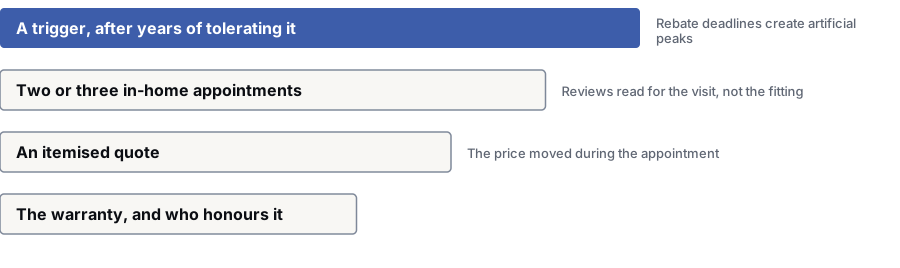
- 1A trigger, after years of tolerating it — A heating bill, a house purchase, a rebate deadline, or a seal that finally failed. Homeowners live with a draughty window for years first.Rebate deadlines create artificial peaks
- 2Two or three in-home appointments — Booked with all of them at once, expecting the quotes to differ by thousands with no obvious reason for the gap.Reviews read for the visit, not the fitting
- 3An itemised quote — A plainly itemised quote beats a lower total that is not, because somebody comparing three visits is trying to establish what is different.The price moved during the appointment
- 4The warranty, and who honours it — Warranty terms decide more than product brand does, particularly who covers the labour portion and whether it survives a change of ownership.
Search behaviour
Windows and doors searches, grouped by intent
Cost and comparison research
Highest volume in the category and where most companies refuse to answer.
- window replacement cost
- how much to replace a patio door
- vinyl vs fiberglass windows
- triple pane windows worth it
- cost to replace windows in a whole house
Ready to get a quote
Appointment intent. The point of the whole programme.
- window replacement companies near me
- door installation near me
- window installers [city]
- free window quote in home
- best replacement window company
Problem and trigger searches
Something failed. Cheap, specific, and closer to a visit than they look.
- foggy window between the panes
- draughty windows what to do
- front door will not close properly
- window seal failed repair or replace
- condensation on the inside of windows
Rebates, financing and efficiency
Decision-moving and the area where claim discipline matters most.
- window replacement rebate
- energy efficient window grant
- window financing monthly payments
- do new windows lower heating bills
Sales-process and trust searches
The category’s reputation, typed out. A company with nothing to hide should be on these pages.
- window salesman high pressure tactics
- can i cancel a window contract
- how long does a window quote take
- questions to ask a window installer
These are examples of how customers in this market search, drawn from keyword research and public search data. They are illustrative, not a volume claim: we size the demand in your area before recommending anything.
What usually goes wrong
Where windows and doors marketing tends to fail
Almost everything that decides a window or door sale happens after the website has done its job, in a homeowner’s kitchen, with a tape measure on the table. That makes the website’s purpose unusually narrow and unusually measurable: get the right person to agree to an appointment, and give them enough reason to still be there when the estimator knocks.
The brief below is written backwards from that appointment, because a site optimised for enquiry volume in this category simply produces more people who wanted a price over the phone.
- The site is built to collect leads, not to book a visit.
- A generic contact form gets filled in by people expecting a number by email, and they cancel when they discover a two-hour appointment is involved. The page has to sell the appointment itself — what happens during it, how long it takes, who arrives, that measurements are needed for a real price, and that there will be no second visit and no follow-up pressure. That framing raises the share of bookings that are kept far more than any headline change.
- Nothing addresses what the homeowner is bracing for.
- This category carries a sales reputation earned by companies that ran long presentations, today-only pricing and discounts that appeared on the way out of the door. Every homeowner booking an in-home quote has heard about it. A company that says plainly how long the visit lasts, that the quote is valid for a stated period, and that nobody will be telephoned repeatedly is answering the loudest objection in the trade before it is spoken.
- Rebates and financing are mentioned and never explained.
- Efficiency incentives and monthly payment options move a large share of these decisions, and most sites reduce them to a badge. What works is explaining what the programme covers, what qualifies, what paperwork is involved and how you help with it — while never stating an amount as though approval were guaranteed, because eligibility is decided by somebody else and the rules change.
- Cost questions are refused, so the research happens elsewhere.
- Homeowners search for window replacement cost in enormous volume and most companies answer with a form. A page explaining what moves the price — opening count, frame material, glazing specification, structural condition, access, whether the trim is replaced — earns the visit and filters out people whose expectations were never realistic. Silence sends that homeowner to a competitor or to a forum full of guesses.
- Success is measured in leads, so nobody sees the real leak.
- Between an enquiry and revenue sit four separate numbers: appointments booked, appointments kept, quotes issued, contracts signed and not cancelled. Reporting that stops at the first one hides the fact that a third of the bookings evaporated, and it makes every channel look interchangeable when they produce very different sit rates.
Measurement
Windows and doors numbers we report on, and what we ignore
Sessions are not on this list. These are the numbers that tell you whether the marketing is producing customers.
- In-home appointments booked, by channel
- Appointments kept as a share of appointments booked
- Quote-to-close rate and the average discount given to reach it
- Average contract value and average openings per contract
- Cost per sat appointment, which is the only cost number worth comparing
- Cancellations inside the statutory cancellation window
- Door-only jobs that later become window projects
Constraints
Windows and doors advertising rules: what is allowed, and what is not
Selling in a customer’s home is separately regulated in many markets. Direct and in-home sales commonly attract a statutory cancellation or cooling-off right, mandatory written notice of that right, and restrictions on taking payment during the cancellation period, and the length and wording differ by country, state and province. Marketing that describes a signing incentive or a same-day price has to be consistent with those rules, and clients confirm the current position with their own consumer protection authority.
Energy performance claims are substantiated claims. Statements about efficiency, heat loss or bill reduction generally need to rest on published product ratings under a recognised measurement scheme rather than on estimates, and comparative claims invite challenge from competitors as readily as from regulators. The defensible approach is to publish the rating and let the reader draw the conclusion.
Rebate and incentive content should describe the programme and never guarantee an outcome. Eligibility depends on the property, the specification, the installer’s accreditation and the programme’s own budget, all of which change, so amounts should be attributed to the administering body with a date attached and reviewed whenever the programme moves.
Consumer finance advertising carries its own disclosure requirements. Monthly payment figures, interest-free periods and deferred payment offers usually require specified wording, and responsibility sits with the advertiser as well as the lender. Confirm the required disclosures with your finance provider before anything is published.
Manufacturer partnerships and co-op funded advertising come with brand rules attached. Dealer status, certification tiers and product imagery are typically governed by an agreement that dictates logo use, claim wording and approval steps, and stating a partnership level the business has not been granted is both a contractual and an advertising problem.
Primary sources
The windows and doors rules above, at source
The rules this page refers to, linked to the regulator or rule-maker that publishes them. Which apply depends on where you operate, and they change, so check the current version.
- Requires sellers in US door-to-door sales to give a written three-day cancellation notice and honour cancellations.
FTC Cooling-Off Rule
Requires sellers in US door-to-door sales to give a written three-day cancellation notice and honour cancellations.
Source: FTC, 16 CFR Part 429 (US)
- Gives consumers a right to cancel distance and off-premises contracts within the cancellation period.
CCRs 2013, reg. 29
Gives consumers a right to cancel distance and off-premises contracts within the cancellation period.
- Sets the disclosures a US credit advert must make when it states terms such as a payment amount or rate.
Regulation Z § 1026.24
Sets the disclosures a US credit advert must make when it states terms such as a payment amount or rate.
Questions
Windows and doors marketing questions, answered
A third of our appointments are not there when we arrive. What fixes that?
Almost always the booking experience rather than the reminder. Homeowners who agreed to a vague call-back, without knowing the visit takes two hours or that measurements are required, cancel when reality arrives. Selling the appointment properly on the page removes most of that before it happens.
After that it is confirmation mechanics: a named estimator with a photograph, a reminder that repeats the no-pressure commitment, and a reschedule link that is easier to click than it is to simply not answer the door.
Can we really market against our own industry’s sales reputation?
You can, and in this category it is one of the few real differentiators available. Homeowners arrive expecting a long presentation and a price that drops when they hesitate, and a company that states its visit length, its quote validity and its follow-up policy is answering an objection every competitor is leaving open.
The condition is that the sales process has to match. Publishing a no-pressure commitment and then running a discount-on-the-doorstep close produces reviews that are considerably worse than saying nothing.
Should we publish window prices?
Publish the range and the reasoning, not a fixed number. What moves a window quote — opening count and size, frame material, glazing specification, the state of the surrounding structure, access, whether trim is replaced — can be explained plainly without pretending a price exists before a measurement does.
The alternative is losing the highest-volume search in the category to whoever was willing to be useful, and then paying for the same homeowner again later through advertising.
How should we handle rebates on the website?
Explain the programme, name the body administering it, date the page and describe what tends to qualify. That is useful and it is a large source of search demand.
What you should not do is state an amount as though the homeowner will receive it. Eligibility depends on the property, the specification, your accreditation and the programme’s remaining budget, and a figure quoted as fact becomes a complaint when it does not arrive.
Is buying leads worth it in this trade?
Sometimes, but only if you measure the right thing. Lead sources in this category vary enormously in the share that become kept appointments, and two sources at the same cost per lead can differ by a factor of three by the time an estimator is sitting at a table.
Cost per sat appointment is the only comparison that means anything. Once you track it, most companies discover the cheap sources are not cheap and one or two are worth far more than they were being paid.
Our manufacturer offers co-op advertising funds. Does that change the plan?
It changes what is affordable rather than what is right. Co-op money usually comes with rules about brand presence, claim wording, approved creative and evidence of spend, so the practical work is building campaigns that qualify without letting the manufacturer’s message displace your own.
The failure mode is advertising that sells the product brand rather than your company. Homeowners can buy that brand from three other dealers in the same city, so the differentiation still has to be yours.
Find out what is winnable for your windows and doors business
Start with the free Growth Scan: an indicative read of your website and the few things to fix first, with no sign-up. BOOSTD is in early access, so the fuller picture for your windows and doors business — your area, your competitors and the searches that matter — is worked through with our team on a strategy call. If we do not think we can move it, we will tell you.
Prefer to talk it through? Book a strategy call
If we don't deliver the work we agreed to deliver for reasons within our control, you don't pay for the undelivered work. Read our guarantee
References
Sources
The primary documents and published research this page relies on. Platform rules change, so check the source before acting on a detail.
More to explore
Guides that answer the same questions
More in home services
Last updated · Published by Zubair Afzal (responsible editor), on owner authorisation