
Solar Installation marketing
Solar marketing agency for buyers who check every number
Solar marketing for installers whose numbers stand up to checking, with savings shown as models and policy pages kept current, for buyers who do the maths.

The rules
The rules on claims
Savings claims are the main risk in solar marketing, and several markets police them. Consumer protection regulators have acted over savings figures, payback periods and bill reduction claims that couldn’t be backed up. Present predictions as models with inputs, assumptions, ranges and a date, and never state a savings figure or payback period as fact.
The body that runs an incentive or rebate decides who qualifies, not the installer. Programmes vary by country, state, province and sometimes utility, have budget caps and conditions, and close or change with little notice. Describe the programme, name who runs it, add a date and never present an amount as approved. Check with the programme administrator before publishing.
In many markets, installer accreditation and electrical licensing are needed before customers can claim incentives, and each is regulated separately. State only credentials you hold, under the correct scheme names, and remove any that lapse at once. Competitors report each other, and incentive programmes run audits.
Door-to-door and unsolicited selling has a long history in this industry, and several places attach restrictions, cancellation rights and record-keeping duties to it. If you sell this way, your marketing must follow those rules; check with your consumer protection authority.
Solar finance, power purchase agreements and leases are regulated products in most markets. Advertising monthly payments, escalator clauses or transfer terms usually needs set disclosures, shared with the finance provider. Check the wording with your provider before publishing.
Sources
Check the rules at the source
Each rule above, linked to the body that publishes it. Which ones apply depends on where you work. Rules change, so check the latest version.
- Requires a California solar disclosure document covering total cost, anticipated savings and their assumptions.
- Cal. B&P Code § 7169
- Source: California Business and Professions Code § 7169 (US: California)
- Requires sellers in US door-to-door sales to give a written three-day cancellation notice and honour cancellations.
- FTC Cooling-Off Rule
- Source: FTC, 16 CFR Part 429 (US)
- Sets the disclosures a US credit advert must make when it states terms such as a payment amount or rate.
- Regulation Z § 1026.24
- Source: CFPB, Regulation Z, 12 CFR 1026.24 (US)
Common problems
Why solar ads and SEO fall flat
Solar buyers read for weeks before calling anyone. They arrive doubting the whole industry, and check your numbers against their bill and three forum threads.
Your content also goes off. When a tariff or rebate changes, much of what you published becomes wrong, and installers who keep up earn trust for it.
- Your site promises savings you can’t stand behind.
- Headline savings and payback figures make you look like every company the homeowner was warned about, and they depend on usage, tariffs, roof direction, shading, export rules and future prices the page doesn’t know. Show your method: inputs, assumptions, the range and what changes the answer.
- A policy change breaks your site and nobody notices for months.
- Feed-in rates, net metering rules and rebate budgets change, sometimes with a few weeks’ notice. Pages written as if today’s rules are permanent slowly become misinformation, and a homeowner who spots an old figure stops trusting the rest. Every policy page needs a date, named sources and an owner.
- You handle the industry’s reputation by ignoring it.
- Pushy door-to-door selling and inflated savings have made many homeowners hostile before you say hello, and non-stop cheer sounds like more of the same. Name the problem, explain how your sales process differs and show what a bad solar deal looks like.
- Enquiries arrive with no roof details, no bill and no usage.
- A solar quote depends on roof direction, pitch, shading, age and structure, plus the household’s power use. A form asking only for name and postcode brings enquiries that need a site visit to rule out. Ask for property type, roof age, rough yearly usage and daytime occupancy; hardly anyone drops out, and estimators save hours.
- You report in weeks, but the decision takes months.
- Homeowners often research solar for a whole season before asking for a quote, then spend weeks comparing three proposals. A 30-day report credits the last click and undervalues the content that built the shortlist, so working marketing looks like a failure.
How they choose
Who decides, and what they look for
Know how they choose and you know where to show up.
- They read for weeks first. By the time they enquire, they often know more about tariffs than the salesperson expects.
- They compare proposals that don’t line up: different panels, inverters, outputs and assumptions. They lean towards whoever explains the differences without knocking the others.
- They check the predicted output and its assumptions harder than the price. If the model looks optimistic, they distrust the whole quote.
- They check installer accreditation, electrical licensing and who does the install, especially if they’ve read about warranties lost when a company closed.
- The warranty set-up decides many sales. They want to know what the panel maker, inverter maker and installer each cover, and for how long.
- Staying power matters more than in most trades. A 25-year performance warranty is only worth what the company behind it is worth in year twelve.
Months of research before a quote
Why buyers often know more about tariffs than the salesperson
People read for months before contacting anyone. The shortlist forms in a stretch that leaves no trace in your reports.
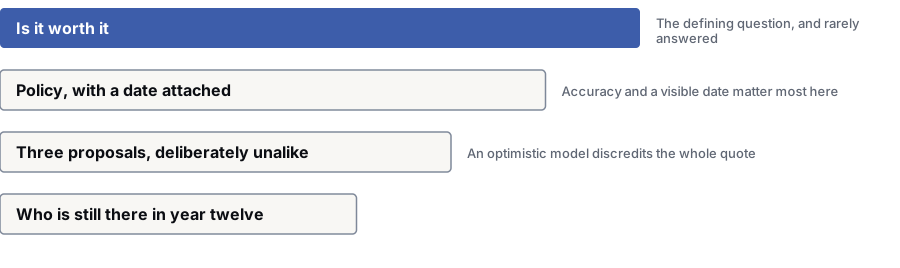
- 1Is it worth it? — Months of reading before anyone is contacted. They often know more about tariffs than the salesperson.The key question, and rarely answered
- 2Policy, with a deadline — An incentive announcement, a tariff cut or a power price rise moves enquiries more than any weather.Accuracy and a visible date matter most here
- 3Three proposals, hard to compare — Different panels, inverters, outputs and assumptions. Buyers check the model harder than the price.An optimistic model sinks the whole quote
- 4Who is still there in year twelve — A 25-year warranty is only worth what the company behind it is worth in year twelve, and buyers know it.
What people search
Searches such as “is solar worth it”, grouped by intent
Is it worth it? The payback maths
The big question in solar. Long, doubtful searches that rarely get a clear answer.
- is solar worth it
- solar panel payback period
- how much do solar panels save
- do solar panels increase home value
- solar panels for a north facing roof
Policy, tariffs and rebates
Where accuracy and a visible date matter more than anywhere else.
- net metering rules [state]
- solar rebate eligibility
- feed in tariff rates explained
- what happens to solar credits when i sell my house
Technical comparison
A buyer trying to compare three proposals that don’t line up.
- string inverter vs microinverter
- how many solar panels do i need
- solar battery worth the cost
- best solar panels for hot climates
Choosing an installer
Late in the process, and shaped by the industry’s reputation.
- solar installers near me
- how to choose a solar company
- solar company reviews [city]
- questions to ask a solar installer
- solar door to door sales scam
People who already have solar
A growing group few installers serve, and they need help now.
- solar inverter replacement cost
- add battery to existing solar system
- solar panel repair near me
- my solar company went out of business warranty
These are example searches from keyword research and public search data. Before we suggest anything, we check how often people search for them in your area.
Where to spend
Organic search first, then search content
In the order we'd put them. Start at the top.
Clear answers to the payback question
The biggest solar searches are sums and comparisons, and most sites answer them badly. Pages that show your method, state assumptions, give ranges and explain what changes the answer reach homeowners while the shortlist forms.
Policy pages you keep up to date
Tariff, rebate and net metering pages are your most valuable content and go stale fastest. Each needs a visible date, named sources, a review schedule and an owner, so a rule change leads to a rewrite, not a year-old figure hurting your credibility.
A quote form that checks the property first
Roof direction, pitch, shading, age and household usage decide whether there’s a job at all, so build a form that asks for them. Show predicted output next to its assumptions in proposals; it saves estimator time and shows you’ve nothing to hide.
Stand apart from door-to-door sellers
Prospects expect to be misled, so they read reviews for pressure, over-promised output and silence after install. Ask for reviews once the system is switched on, and answer performance complaints with measured output data.
Local proof beats national lead sellers
National lead sellers and comparison sites own the generic searches, but can’t show installs on nearby streets, local grid connection know-how or an accurate service area. That local detail is yours.
Your website
Turn more visits into enquiries
- Predicted figures always shown with their assumptions and a range
- A visible publish or review date on every page that mentions policy
- Named sources for every tariff, rebate or net metering rule you describe
- Accreditation and electrical licensing stated exactly as held, with the issuing body
- Warranties split into panels, inverter and installation, with how long each lasts
- Whether your install crews are employees or subcontractors
- A quote form that asks for roof direction, age, shading and yearly usage
- A clear account of your sales process, including that nobody knocks on doors
- Pages for people who already have solar: repairs, expansions and battery add-ons
- Photos of your own finished installs, on local roof types
Measuring results
Results you can check
These numbers show if your marketing brings in customers. Website visits alone don't.
- Qualified site assessments booked, with usage data attached
- Proposal-to-signature rate, and how long it takes
- Average system value, split between new installs and add-ons
- Cost per booked assessment, over a period that matches the buying cycle
- Pipeline value before and after any incentive change, tracked separately
- Share of enquiries from your own channels versus shared lead sellers
- Reviews collected after switch-on, not at signing
- Share of signed installs that came from referrals
Questions
Quick answers on solar marketing
Can we advertise the savings a customer will get?
Not as a fact. Savings and payback depend on usage, tariffs, roof direction, shading, export rules and future prices, so any single figure is a model. Presenting it as a result is what draws regulator attention.
Showing the maths works better anyway: inputs, assumptions, a range and what changes the answer. A reader who checks and finds you were careful is much closer to buying.
The rules keep changing. Is content still worth writing?
Yes, and more so in solar, because constant change is why most existing content is poor. Most solar pages have no date and no sources, so an installer with accurate policy pages becomes the local go-to.
The catch is upkeep: give each page a date, named sources, a review schedule and an owner, so a tariff change leads to a rewrite within days.
How do we deal with prospects who assume we are a scam?
Name the worry and skip the cheerful sales talk. People who’ve met door-knockers or read about vanished installers are watching for warning signs, not enthusiasm.
Publish how your sales process works, what a bad proposal looks like, what happens to a warranty if a company closes and what your figures assume. Hardly any solar company explains the risks.
Should we buy solar leads?
Carefully, and never as your main source. Shared solar leads are often sold to several installers at once, so each job becomes a race to phone first and the homeowner learns to expect pressure.
They can fill gaps while your own demand builds, if you measure cost per booked assessment. They can’t build the trust a long research stage depends on.
An incentive programme in our market just closed. What now?
Expect a sharp dip after the deadline rush, and plan for it. Sales won before a deadline are borrowed from the next quarter, and firms that hired for the spike struggle most.
Use the quiet spell for work that doesn’t depend on incentives: existing solar owners, battery add-ons, fair comparisons at the new prices and your referral base. Update your policy pages first, because prospects check those.
How long does it take before marketing produces installations?
Longer than in any other home services trade: months often pass between first search and quote request, then weeks more before a signature.
Early on, judge the marketing on qualified assessments booked and readership of your research pages. Solar marketing cut at month four is usually cut just before it starts to work.
Check your site before you spend more
Start with the free checkup. It shows what to fix first on your website, with no sign-up. Want the full plan for your solar business? Book a call, and we'll look at your market, your competitors and the searches that bring in customers.
Prefer to talk it over? Book a free call
Your BOOSTD score improves within 90 days, or your next month is free. After 6 months, more traffic or leads, or we keep working free (up to 6 free months in any 12 months). Read our guarantee
References
Sources for solar marketing agency
The official documents and research this page is based on. Platform rules change, so check the source before you act on a detail.
Related
More on solar marketing
Last updated · Published by Zubair Afzal, responsible editor