
Water Damage Restoration marketing
Water damage restoration marketing for homes, plumbers and insurers
Water damage restoration marketing that reaches the homeowner searching at 2am, the plumber in the same basement and the adjuster checking your invoice.

Where to spend
Spend on local SEO first, then the website
In the order we'd put them. Start at the top.
Show up at the hour the water is found
Most water losses are found at night and at weekends, so your Google Business Profile has to show you’re open then, with a category, services and response details that match what you do. Own a realistic area; don’t claim a whole city.
One site for two very different visitors
A homeowner standing in water needs a phone number and a calm account of the next two hours. A property manager or adjuster needs response times, certifications, equipment capacity and how you document a file. Give each their own path from the first click.
Reviews from people who had a terrible day
Restoration reviews come from people whose homes were damaged, so they’re harder to earn and more persuasive. Ask once the equipment is out and the report handed over, never during demolition.
How they choose
How customers decide who to hire
Know how they choose and you know where to show up.
- A homeowner in a flooded basement decides in minutes, picking whoever answers, can get a truck there soonest and sounds experienced.
- They ask who pays before what it costs. A company that explains the claim process calmly, without promising an outcome, wins more jobs than one that changes the subject.
- Plumbers refer the firm that turned up fast last time and didn’t embarrass them in front of their customer. Reliability matters far more than price.
- Property managers and adjusters judge you on paperwork across many jobs. They want a clear scope, photos, moisture logs and invoices that match.
- People check certifications more here than in most trades. A homeowner can’t tell if a building has been properly dried or just looks dry.
Three routes in
Homeowners, plumbers and adjusters each hand out jobs differently
Each judges a restoration firm on different proof. Only one of them can be reached through search at the moment of the loss.
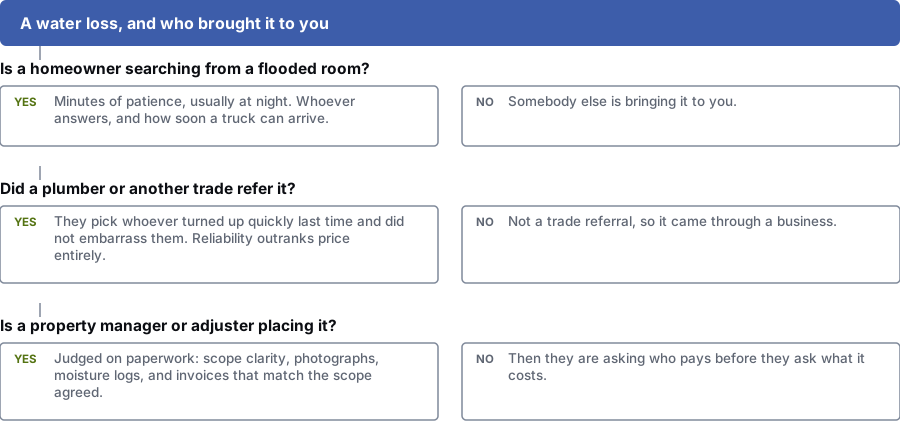
Is a homeowner searching from a flooded room?
Yes: Minutes of patience, usually at night. Whoever answers, and how soon a truck can arrive.
No: Someone else is bringing it to you.
Did a plumber or another trade refer it?
Yes: They pick whoever turned up fast last time and didn’t embarrass them. Reliability beats price.
No: Not a trade referral, so it came through a business.
Is a property manager or adjuster placing it?
Yes: Judged on paperwork: a clear scope, photos, moisture logs and invoices that match the scope.
No: Then they’ll ask who pays before they ask what it costs.
Common problems
What's holding your water damage restoration marketing back?
Water damage is the most common loss in homes, and it gets worse fastest. Hours matter, and so does who’s in the room when the water is found.
The person searching is frightened, the person paying is usually an insurer, and the person who decides which firm gets called is often a plumber holding a wrench.
- Your referral relationships are favours, with no programme behind them.
- Ask most water damage firms where their best jobs come from and they name two or three plumbers. Ask how they keep in touch or what happens after a job is sent: usually nothing. Keep a named partner list, write a one-page handover guide and tell partners what happened to the last job they sent.
- Your site answers the wrong question first.
- The most searched water damage questions aren’t “who should I call?” but “who pays?”, “should I claim?” and “what does my deductible mean?” Sites that jump straight to services skip what the visitor came for. Explain which losses are worth claiming and which are cheaper to pay directly, and you win both kinds of job.
- Your files are built for the job and not for the invoice.
- Drying is easy to do and hard to prove. Patchy moisture readings, missing photos and a scope that doesn’t match the invoice slow payment, the adjuster gets cautious and the next job goes elsewhere. Publish your documentation standards where the people who hand out jobs will read them.
- Time is your strongest argument, and you never make it.
- Water damage gets worse by the hour. Clean water becomes contaminated, and drywall, insulation and subfloor that could have been dried must be ripped out. Explain what changes between hour six and hour forty-eight; it gives people a reason to call now, not wait for the insurer on Monday.
What people search
Searches like “water in basement who to call”
The moment it happens
Minutes of patience, usually at night, often on a phone held in wet hands.
- water in basement who to call
- burst pipe flooded my house
- emergency water extraction near me
- ceiling dripping water after upstairs leak
- sewage backup in basement cleanup
Who pays, and whether to claim
The most searched research question in the whole category.
- does insurance cover a burst pipe
- should i claim water damage on insurance
- water damage deductible worth claiming
- who pays for water damage from an upstairs flat
- how much does water damage restoration cost
Drying, timing and what happens next
Asked during the job as often as before it. Good answers build trust.
- how long does it take to dry a flooded basement
- does wet drywall need to be replaced
- how long before mould grows after water damage
- do i need to move out during water damage repair
Referrers and commercial buyers
Not homeowners. They use different words and need their own page.
- emergency water mitigation contractor commercial
- property management water damage vendor
- 24 hour water extraction commercial building
- restoration contractor for plumbers
These are example searches from keyword research and public search data. Before we suggest anything, we check how often people search for them in your area.
Your website
What a good site does
- A number that reaches someone at 3am, with your hours stated accurately
- A first-two-hours page: what to turn off and what not to touch
- Claiming versus paying directly, explained, including how the deductible works
- Certifications named, with the issuing body and who holds them
- How you document a job (readings, logs, photos), written for adjusters
- A separate partner section for plumbers, property managers and letting agents
- Response times by area that you can meet every time
- Photos of your own drying equipment and crews, with no stock disaster images
Measuring results
What good looks like
These numbers show if your marketing brings in customers. Website visits alone don't.
- Emergency calls answered overnight and at weekends
- Jobs from each named referral partner, counted every quarter
- Average invoice value, split between insured and cash-paying jobs
- Time from first call to equipment on site
- Days from invoice to payment, a sign of paperwork quality
- Cost per job from paid channels, kept separate from referred jobs
- Lapsed partners: referrers who sent jobs last year and haven’t this year
The rules
Stay inside the ad rules
Insurance content is the main constraint. You can explain how a claim generally works, what a deductible is and what documentation helps. You can’t say a claim will be approved, offer to absorb or discount a deductible, or say you act for the insurer. Waiving a deductible is treated as fraud in several places, and negotiating a claim for a policyholder can require a public adjuster licence. Check with the relevant regulator.
Assignment of benefits and direct billing are regulated differently across markets, and some places restrict a contractor’s wording when billing an insurer. If you offer to bill the insurer, describe what the paperwork does and don’t imply the customer carries no financial risk.
Restoration certifications are issued to named people and firms under separate schemes, and they lapse. Name the certifying body, say what it covers and keep the claim current; a lapsed credential on your site is misrepresentation. Keep mould content on the remediation side and don’t describe health effects.
Sources
The rulebooks, linked
Each rule above, linked to the body that publishes it. Which ones apply depends on where you work. Rules change, so check the latest version.
- Makes it a felony for a contractor to pay, waive or rebate an insurance deductible on property repairs.
- Fla. Stat. § 817.234
- Source: Florida Statutes § 817.234(7)(d) (US: Florida)
- Bars Florida contractors from advertising, offering or handling public adjuster services unless licensed as one.
- Fla. Stat. § 626.854
- Source: Florida Statutes § 626.854(16) (US: Florida)
- Voids assignment of post-loss benefits under Florida property policies issued on or after 1 January 2023.
- Fla. Stat. § 627.7152
- Source: Florida Statutes § 627.7152(13) (US: Florida)
Questions
What people ask about water damage restoration marketing
How do we get more work from plumbers?
Treat plumbers as an audience. List every plumbing company in your area, give them one page on what happens when they pass on your number, and make the handover one call from a wet basement.
Then report back: the scope, the timeline and that their customer was looked after. Almost nobody does this, and it turns one referral into a habit.
Is paid search worth it when the clicks are this expensive?
It can be, with firm limits. Emergency water damage clicks are some of the priciest in local search, and a loose campaign spends a month’s budget on people researching insurance and renting dehumidifiers.
Keep it tight: a realistic radius, call-focused ads, extra weight on nights and weekends, and research searches excluded. Then it covers areas where you don’t yet rank.
Should we take jobs that fall under the deductible?
Yes. Many firms turn them down, usually a mistake. A loss below the deductible is a simple cash job, with no adjuster, no scope negotiation and no ninety-day wait for payment.
Almost nobody publishes anything useful about it. Content that helps someone decide whether to claim wins the job either way.
Do reviews matter when the customer is in a crisis?
They matter more. Someone choosing at 2am has no other way to judge whether to let a stranger cut open their ceiling, and review count and recency decide most of those thirty seconds.
The hard part is asking. Ask when the equipment is gone, the paperwork handed over and the building visibly dry, not while they’re living around fans.
What should the site say about insurance?
Explain the process, but don’t promise the outcome. How a claim is reported, what an adjuster looks for, what documentation helps and what a deductible means are all safe to publish.
Never promise coverage, suggest the deductible can be absorbed or imply you act for the insurer. Those cross a line that varies by place and can have serious consequences; check the wording with your regulator.
Get a clear first step
Start with the free checkup. It shows what to fix first on your website, with no sign-up. Want the full plan for your water damage restoration business? Book a call, and we'll look at your market, your competitors and the searches that bring in customers.
Prefer to talk it over? Book a free call
Your BOOSTD score improves within 90 days, or your next month is free. After 6 months, more traffic or leads, or we keep working free (up to 6 free months in any 12 months). Read our guarantee
References
Sources for water damage restoration marketing
The official documents and research this page is based on. Platform rules change, so check the source before you act on a detail.
Related
More on water damage restoration marketing
- restoration company website designsA call-first emergency line and claim-safe wording.
- marketing for fire, mould and general restorationThe wider restoration category.
- marketing for plumbers
Guides for water damage restoration
Other home services businesses
Last updated · Published by Zubair Afzal, responsible editor