
Electrical Contracting marketing
Electrician marketing that puts your licence first, where most sites bury it
Electrical work is three businesses in one van: after-hours faults, planned upgrades like panels, generators and EV chargers, and contract work for builders and property managers. Each is bought differently, and marketing that averages them wins none of them properly.
Prefer to talk it through? Book a strategy call
Buying behaviour
How electrical customers decide
Strategy follows this, not the other way round. Everything on this page is downstream of how the decision gets made.
- For a fault they call the first credible result that is open, and they read the reviews more carefully than in most trades because the downside is fire rather than inconvenience.
- For an upgrade they compare two or three written quotes and weigh whether the price includes the permit, the inspection and any making good afterwards — the exclusions decide more of these than the headline figure.
- Licence verification happens here. A meaningful share of homeowners look the number up with the provincial or state authority before booking, particularly after reading a warning article.
- EV charger buyers arrive partly informed by the vehicle manufacturer and the utility, and they are testing whether you know the load calculation and rebate rules better than they do.
- Builders and property managers choose on schedule reliability, invoicing discipline and whether you can staff their calendar; the website matters mostly as a credibility check before a first meeting.
- Anything involving a generator or a heat pump circuit becomes a technical conversation, and the contractor who explains it clearly on the phone often wins without a third quote being sought.
Three demand streams
Where an electrical job came from decides how it is won
Fault, upgrade and contract work arrive through different doors and are decided on different things. Running one plan across all three is why the upgrade work, where the ticket lives, gets so little attention.
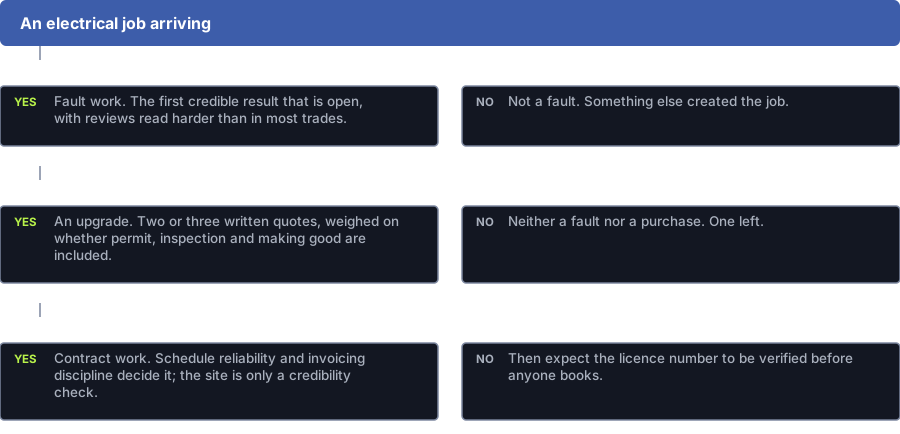
Is something broken right now?
Yes: Fault work. The first credible result that is open, with reviews read harder than in most trades.
No: Not a fault. Something else created the job.
Did another purchase create the work?
Yes: An upgrade. Two or three written quotes, weighed on whether permit, inspection and making good are included.
No: Neither a fault nor a purchase. One left.
Is the buyer a builder or a property manager?
Yes: Contract work. Schedule reliability and invoicing discipline decide it; the site is only a credibility check.
No: Then expect the licence number to be verified before anyone books.
What usually goes wrong
Where electrical marketing tends to fail
Electrical contracting is sold on a credential the customer cannot verify and would not understand if they could. That single fact should shape most of what is on the website, and it almost never does.
The second fact is that a lot of electrical companies are running three businesses out of one office — faults, upgrades and contracts — while reporting them as one number.
- The licence is on the van and nowhere on the website.
- Homeowners letting an electrician into a house are buying safety they have no way to assess. The licence class, the number, the insurance and the fact that permitted work is inspected by an independent authority are the strongest trust signals in the trade — and they are usually reduced to a "licensed and insured" badge in a footer. Stating what you hold, and explaining what an inspection means for the customer, is what separates you from the handyman quoting half your price.
- Three revenue streams share one set of campaigns.
- A fault callout, a panel upgrade and a fifty-unit fit-out have different buyers, different decision windows and completely different payment terms. When all three run through one phone number, one form and one reporting line, the campaign optimises toward the cheapest and most frequent enquiry, which is the callout. The upgrade and contract work quietly starves while the reporting looks healthy.
- EV charger demand arrived and nobody claimed it.
- Someone who has just ordered an electric car searches for installation cost, charger type, and whether their panel can take the load. That is a research sequence rather than a callout, and it is still thinly served in most markets. The installers winning it have a page that handles panel capacity, load calculation, permit responsibility and rebate eligibility honestly — not a line item on a services list.
- The permit question is answered by a competitor.
- Do I need a permit, who pulls it, how long does the inspection take, and what happens if the previous owner did work without one. These are among the most common electrical searches and among the worst answered. They come from people who are about to spend money, and answering them plainly is both a ranking opportunity and the fastest way to look like the professional in a market full of contractors avoiding the question.
Search behaviour
Electrical searches, grouped by intent
Fault and emergency
Short decision window, settled on proximity and whether a person answers.
- emergency electrician near me
- half the house has no power
- breaker keeps tripping
- burning smell from outlet
- power flickering whole house
- electrician open now
Panel and service upgrades
Costed, compared, and where the average ticket lives.
- 100 amp to 200 amp panel upgrade cost
- do i need to upgrade my electrical panel
- federal pacific panel replacement
- knob and tube wiring replacement cost
EV charger installation
A newer demand stream with research behaviour of its own.
- ev charger installation cost
- level 2 charger installation near me
- does my panel support an ev charger
- tesla wall connector installer
- ev charger rebate
Permits, inspections and licensing
High intent, poorly answered, and the fastest trust to build.
- do i need a permit to add an outlet
- how to check if an electrician is licensed
- electrical inspection failed what now
- who pulls the electrical permit
Commercial and contract
A different buyer, and one who rarely converts on a first visit.
- commercial electrical contractor [city]
- electrical contractor for property management
- tenant fit out electrical
- standby generator installation for business
These are examples of how customers in this market search, drawn from keyword research and public search data. They are illustrative, not a volume claim: we size the demand in your area before recommending anything.
Where the money goes
The electrical marketing channels that earn their place
In priority order for this business, not a menu. Anything not on this list is something we would need a specific reason to recommend.
Local visibility for fault demand
Fault calls are settled from the map results, and the inputs are practical: the correct primary category, an accurate service list, real hours, photographs of real crews, and a steady arrival of reviews. It is the fastest-moving part of an electrical campaign and the base everything else sits on.
Upgrade, charger and permit content
Panel upgrades, EV chargers and permit questions are where the higher-value work is decided, and they are answered badly in most markets. Pages that handle load calculation, permit responsibility and rebate eligibility properly earn enquiries worth several times a callout, and keep doing it without a per-click cost.
Paid search split by job type
Useful for immediate fault coverage and for claiming charger demand before it gets expensive, but only when the campaigns are separated by job type. Run together, the automation buys callouts because they are cheaper, and the upgrade budget disappears into low-value clicks nobody notices.
A site that proves the credential
Licence class and number, insurance, the permit and inspection process, and a plain account of how you charge — placed where a cautious homeowner will see them rather than in a footer. Then separate paths for service calls, planned upgrades and commercial enquiries, because one page cannot serve all three.
Reviews that describe the work, not the visit
Electrical reviews carry unusual weight because the customer cannot inspect the result. A process that prompts people to describe the specific job — a panel replaced, a charger installed, an inspection passed — produces text that reassures a nervous reader far better than a five-star rating with no words attached.
The website
What an electrical website has to do
- Licence class and number stated in full, with the issuing authority named
- Insurance cover stated plainly rather than implied by a badge
- Separate paths for service calls, planned upgrades and commercial enquiries
- A permit and inspection page explaining who pulls it and what happens next
- A properly built EV charger page covering panel capacity, cost factors and rebates
- Panel upgrade content that explains why an older service becomes a constraint
- The callout or diagnostic charge explained before the customer has to ask
- Photographs of finished work — labelled panels, tidy conduit, completed installs
- Tap-to-call for faults, and a considered quote request for planned upgrades
Measurement
Electrical numbers we report on, and what we ignore
Sessions are not on this list. These are the numbers that tell you whether the marketing is producing customers.
- Booked jobs split into fault, upgrade and contract work
- Average ticket by job type, tracked separately rather than blended
- Quote-to-close rate on panel, generator and charger work
- Cost per booked job by channel, never cost per click
- Calls answered, including the after-hours share
- EV charger enquiries as a standalone line
- Commercial enquiries and tender invitations received
Constraints
Electrical advertising rules: what is allowed, and what is not
Electrical work is licensed or otherwise regulated in the main English-speaking markets — through contractor licensing across most of North America and Australia, and through Building Regulations notification and competent-person schemes in England and Wales — and licence classes, scopes of practice and supervision rules differ by jurisdiction. Marketing should name the licence held and the authority that issued it, and should not advertise work outside that scope. Confirm the current wording with your own licensing body before it is published.
Permit and inspection claims need care. Explaining that permitted work is inspected by an independent authority, and saying who is responsible for pulling the permit, is fine. Implying an inspection outcome, suggesting work can proceed without a permit where one is required, or describing yourself as an inspecting authority is not.
Rebate and incentive programmes for chargers, generators and electrification change frequently and vary by utility and jurisdiction. Marketing can explain how a programme generally works and point at the official source, but stating that a customer will receive a specific amount is a claim about somebody else’s decision. Clients verify current programme terms before publication.
Primary sources
The electrical rules above, at source
The rules this page refers to, linked to the regulator or rule-maker that publishes them. Which apply depends on where you operate, and they change, so check the current version.
- Requires California licensed contractors to include their licence number in contracts and all forms of advertising.
Cal. B&P Code § 7030.5
Requires California licensed contractors to include their licence number in contracts and all forms of advertising.
Source: California Business and Professions Code § 7030.5 (US: California)
- In Ontario, anyone hired for home electrical work must be a licensed electrical contractor; the work is notified to ESA.
ESA licensed contractors
In Ontario, anyone hired for home electrical work must be a licensed electrical contractor; the work is notified to ESA.
Source: Electrical Safety Authority, Finding the right contractor (Canada: Ontario)
- The Building Regulations standard for electrical safety in dwellings in England.
Approved Document P
The Building Regulations standard for electrical safety in dwellings in England.
Questions
Electrical marketing questions, answered
How do we get more panel upgrades instead of service calls?
By marketing them as a separate product with their own pages, their own campaigns and their own conversion action. Upgrade buyers are researching over a fortnight, not calling in a panic, and a page explaining why an older service is a constraint reaches them while they are still deciding whether to bother.
The other route is the work you are already doing. Every fault call is a chance to note the panel type, the service size and the wiring vintage, and a follow-up built on what the technician saw produces quoted upgrade work at close to no acquisition cost.
Is EV charger installation worth marketing separately?
In most markets, yes. It behaves like its own category — the searches are specific, the buyer is researching for days rather than minutes, and the competition is thinner than for general electrical terms.
It also tends to enlarge the job. A load calculation on an older home frequently shows the service cannot take the charger without an upgrade, which turns a modest install into a much larger piece of work you were going to be on site for anyway.
Should we publish our callout or diagnostic fee?
Usually yes. Homeowners assume electrical pricing is unpredictable, and an unanswered question is a reason to keep scrolling to the next company.
Stating the charge, and whether it comes off the repair, removes the hesitation and filters out the people who were never going to accept it. That saves your phone time as well as theirs.
How do we compete with unlicensed handymen on price?
Not on price, and not by attacking them. On the things they cannot offer: a licence a customer can verify, insurance that would respond, permitted work an inspector signs off, and a company that will still exist if something goes wrong in two years.
That argument only works if it is visible. It fails silently on almost every electrical website, because the credential gets treated as a footer detail rather than the main reason to choose you.
Can marketing help with commercial and builder work?
It can, but not in the same way. Nobody wins a fit-out contract from a search advertisement. What marketing does here is make you credible when a general contractor, developer or property manager checks you out before a first conversation or a tender invitation.
That means a real commercial section: project types, crew capacity, certifications, insurance limits, safety record and references. It is slower and less measurable, and it is often the part of the business that holds steady when residential demand softens.
Find out what is winnable for your electrical business
Start with the free Growth Scan: an indicative read of your website and the few things to fix first, with no sign-up. BOOSTD is in early access, so the fuller picture for your electrical business — your area, your competitors and the searches that matter — is worked through with our team on a strategy call. If we do not think we can move it, we will tell you.
Prefer to talk it through? Book a strategy call
If we don't deliver the work we agreed to deliver for reasons within our control, you don't pay for the undelivered work. Read our guarantee
References
Sources
The primary documents and published research this page relies on. Platform rules change, so check the source before acting on a detail.
More to explore
Guides that answer the same questions
More in home services
Last updated · Published by Zubair Afzal (responsible editor), on owner authorisation