
Home Renovation & Remodelling marketing
Home renovation marketing for buyers who choose you months before they call
A kitchen or whole-home renovation is researched for months, quoted by three companies, and decided on evidence and nerve rather than availability. The marketing job is to be visible, credible and reassuring across that whole period — not to be first to answer the phone.
Prefer to talk it through? Book a strategy call
Buying behaviour
How home renovation customers decide
Strategy follows this, not the other way round. Everything on this page is downstream of how the decision gets made.
- They look for a long time before making contact — following on social platforms, saving photographs, and reading reviews without ever completing a form.
- They shortlist on visual evidence of work that resembles their own house, their own budget bracket and their own era of property.
- They read the worst reviews first, looking specifically for projects that overran, budgets that moved, and communication that broke down halfway through.
- They want to know who will be in the house, whether the trades are employed or subcontracted, and who they ring when something goes wrong on a Tuesday.
- Payment structure is weighed heavily. A deposit that looks large relative to the stage of work is one of the most common reasons a shortlisted company gets dropped.
- The first meeting is a real sales conversation, and the homeowner is assessing whether you listened at least as much as whether you can build.
Months before contact
The shortlist forms while nobody is filling in anything
Three to nine months commonly pass between the first search and a signed contract, and almost none of that period produces a measurable event. It is still where the decision is made.
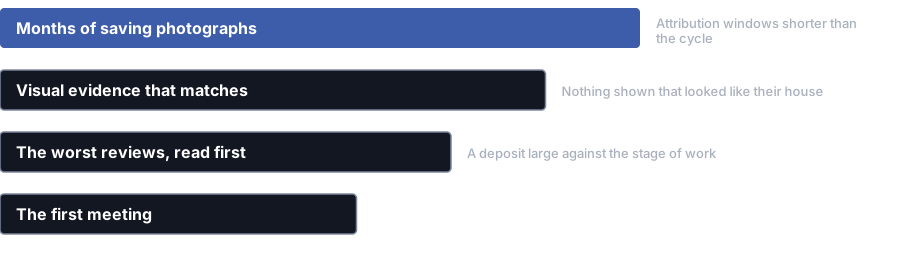
- 1Months of saving photographs — Following, saving images and reading reviews without ever completing a form. The shortlist is quietly forming through all of it.Attribution windows shorter than the cycle
- 2Visual evidence that matches — Work resembling their own house, their own budget bracket and their own era of property, rather than a portfolio of your best jobs.Nothing shown that looked like their house
- 3The worst reviews, read first — Looking specifically for projects that overran, budgets that moved, and communication that broke down halfway through the job.A deposit large against the stage of work
- 4The first meeting — A real sales conversation, in which the homeowner is assessing whether you listened at least as much as whether you can build.
Demand shape
When home renovation demand arrives, and how
Demand follows planning cycles rather than weather. Enquiries cluster in the new year and early spring for work that will happen months later, and the companies with a full summer are the ones that were visible in January.
The gap between first search and signed contract commonly runs three to nine months, so the content a homeowner reads in February is what earns the meeting in May. Attribution windows shorter than that will systematically misreport where the work came from.
Life events drive more renovation than any marketing message does — a new baby, a move, an inheritance, a return to working from home. That demand cannot be created, only met, which puts the weight on being findable and credible at the moment it appears.
What usually goes wrong
Where home renovation marketing tends to fail
Renovation does not behave like the rest of the trades. Nothing has broken, nobody is standing in water, and the homeowner has been thinking about this for the better part of a year.
That changes what the marketing is for. It is not there to be first to answer. It is there to be present, credible and reassuring across a long, anxious comparison that the homeowner can abandon at any point.
- The portfolio lives on somebody’s phone.
- Renovation is bought on visual evidence, and most companies have thousands of photographs and almost none of them published usefully. A proper project page — before, during and after, the brief, the constraints, roughly what it cost and how long it took — does more selling than any other asset a renovation company can build. A dozen of them beat any amount of advertising, and they keep working for years.
- Every enquiry is treated as a lead, so none of them are qualified.
- A form asking for a name and a message produces enquiries with no budget, no timeline and no address. Renovation quoting is expensive — site visits, measurements, drawings, supplier pricing — so an unqualified enquiry is not neutral, it is a cost. Asking about scope, rough budget range, property type and intended start date filters gently, and it tends to raise the quality of who bothers to complete it rather than reduce the volume that matters.
- Nothing happens between the quote and the decision.
- The homeowner takes weeks. They talk to a partner, check with a bank, and read reviews at midnight. Most renovation companies send a document and wait. A structured follow-up — references willing to talk, a walk-through of the schedule, an explanation of what the contingency covers, photographs of a comparable finished project — moves more revenue than another month of advertising, because it addresses the real reason for the delay.
- The money conversation is avoided until it is too late.
- Homeowners are frightened of deposits, variations, and a builder walking off mid-project. Sites that refuse to discuss ranges, payment stages, or what happens when something unexpected appears behind a wall leave that fear intact, and it resurfaces later as a lost quote. Explaining how you charge, when payments fall due and who carries which risk is uncomfortable to write and is usually the highest-converting page on the site.
Where the money goes
The home renovation marketing channels that earn their place
In priority order for this business, not a menu. Anything not on this list is something we would need a specific reason to recommend.
A portfolio that carries the sale
First, and by a distance. Project pages with real photography, the brief, the constraints and the outcome are what a homeowner shortlists on. The build has to make those pages fast, browsable on a phone at eleven at night, and easy to add to without a developer, because the portfolio grows every month.
Content written for a six-month decision
Cost guides, project-type pages and process explanations reach homeowners long before they are ready to enquire, and keep earning for years afterwards. This is the only channel that reaches the research phase, which in renovation is where the shortlist is formed.
Visual proof, published consistently
Renovation is one of the few trades where people follow a company for months without contacting it. Work in progress, finished rooms, and clear explanations of what went wrong on site build a familiarity that a single website visit does not, and the audience is already in a buying frame of mind.
Staying present while they decide
A homeowner who enquires in February and signs in July needs a reason to remember you in May. A modest sequence of completed projects, planning guidance and quote follow-up keeps you in the conversation, and it is usually the cheapest revenue available to a renovation company.
Reviews and references that answer the fear
Homeowners read renovation reviews hunting for overruns, disputes and abandonment. A consistent process for collecting reviews at handover, plus references who will take a phone call, speaks directly to the anxiety that stops renovation quotes converting.
Search behaviour
Home renovation searches, grouped by intent
Early inspiration and research
Months out, no company in mind, and where the shortlist is quietly formed.
- kitchen renovation ideas small kitchen
- open plan living room before and after
- how long does a home renovation take
- basement renovation ideas
- do i need an architect for a renovation
Cost research
The highest-volume commercial questions, and the ones most sites refuse to answer.
- kitchen renovation cost
- how much does a bathroom remodel cost
- cost to renovate a whole house
- average renovation cost per square foot
- is it cheaper to renovate or move
Choosing a contractor
Shortlist stage. Portfolio and reviews decide most of it.
- home renovation companies near me
- best kitchen renovation contractors [city]
- questions to ask a renovation contractor
- how to check a contractor is insured
Contract, deposit and risk
Fear-driven searches that a straight answer converts into trust.
- how much deposit should i pay a contractor
- renovation contract what to include
- contractor took deposit and disappeared
- what is a contingency in a renovation budget
Specific project types
Where a dedicated page beats a general services page every time.
- kitchen extension builders near me
- loft conversion cost
- basement finishing contractor
- accessible bathroom renovation
These are examples of how customers in this market search, drawn from keyword research and public search data. They are illustrative, not a volume claim: we size the demand in your area before recommending anything.
The website
What a home renovation website has to do
- Individual project pages with before, during and after photography
- Honest cost ranges by project type, with the factors that move them
- A payment schedule explained in plain language, stage by stage
- What happens when something unexpected is found, and who carries the cost
- The people who will be in the house, named, with their trades
- Insurance, warranty and registration details stated rather than implied
- An enquiry form that asks about scope, budget range and intended start date
- A described process from first call to handover, with realistic timelines
- Reviews and references presented next to the projects they relate to
Constraints
Home renovation advertising rules: what is allowed, and what is not
Renovation contracting is a consumer contract in most markets, and a number of jurisdictions impose cooling-off periods, deposit limits, mandatory written terms and specific cancellation wording on work sold in a customer’s home. The rules differ substantially by province, state and country, so contract and deposit content should describe your own terms and point readers at the applicable consumer protection authority. Confirm current requirements with your own regulator or legal adviser.
Registration, bonding and warranty requirements for home improvement contractors vary widely — some markets require registration or enrolment in a warranty programme for major renovations, others do not. Marketing should state only what the business holds, using the correct programme name, and should not present a trade association membership as if it were a licence.
Finance offers carry their own advertising rules. Showing monthly payment figures, interest-free periods or third-party lending usually requires specific disclosures, and responsibility sits with the advertiser as well as the lender. Confirm the required wording with the finance provider before anything is published.
Primary sources
The home renovation rules above, at source
The rules this page refers to, linked to the regulator or rule-maker that publishes them. Which apply depends on where you operate, and they change, so check the current version.
- Requires sellers in US door-to-door sales to give a written three-day cancellation notice and honour cancellations.
FTC Cooling-Off Rule
Requires sellers in US door-to-door sales to give a written three-day cancellation notice and honour cancellations.
Source: FTC, 16 CFR Part 429 (US)
- Gives consumers a right to cancel distance and off-premises contracts within the cancellation period.
CCRs 2013, reg. 29
Gives consumers a right to cancel distance and off-premises contracts within the cancellation period.
- Sets what UK financial promotions for consumer credit must include, such as a representative example.
FCA CONC 3.5
Sets what UK financial promotions for consumer credit must include, such as a representative example.
Source: FCA Handbook, CONC 3.5 (UK)
Questions
Home renovation marketing questions, answered
Our work comes from word of mouth. Why market at all?
Because word of mouth still ends in a search. A homeowner who is given your name looks you up, finds three photographs and a contact form, and quietly compares you with two companies that published twenty projects each. The referral got you considered; the website decides whether you stay on the list.
The second reason is concentration. Referral flow tracks the last two years of work, so a quiet period compounds — fewer projects means fewer referrers means a thinner year after that. Search and portfolio work is what breaks that cycle.
How do we stop getting enquiries with no budget?
Change what the form asks and change what the site says about money. A form that requests scope, a rough budget range, property type and intended start date filters most of the browsing out before it reaches your calendar.
Publishing clear ranges does the same job earlier. Someone who discovers on the website that a full kitchen starts well above what they had in mind simply does not enquire, which is a far better outcome than a site visit and a wasted quote.
Should we publish prices for renovations?
Not a fixed price, but do not dodge the question either. Every competitor answers with "it depends", which sends the homeowner to whichever company was willing to be useful.
A range by project type, the factors that move it, and a plain explanation of why a firm number needs a site visit earns trust and captures a large volume of cost searches your competitors are ignoring.
How long before marketing produces signed projects?
Longer than in the emergency trades, and the timeline is set by the buying cycle rather than by the work. Enquiries can improve within a couple of months once the portfolio and the enquiry form are fixed, but the gap between first contact and a signed contract is commonly three to nine months.
That has a practical consequence: judge the first year on qualified enquiries, site visits and pipeline value rather than signed revenue, or you will cut a programme in month four that was working in month seven.
Is social media actually worth the effort for a renovation company?
For this trade specifically, yes — more than for any other in the sector. Renovation is visual, aspirational and slow, which is exactly the behaviour those platforms reward, and homeowners follow builders for months before enquiring.
What does not work is treating it as an advertising channel with occasional finished photos. The material that performs is progress, problems and process — the wall that had to come down, the joist nobody expected — because that is what makes a stranger trust you with a house.
Find out what is winnable for your home renovation business
Start with the free Growth Scan: an indicative read of your website and the few things to fix first, with no sign-up. BOOSTD is in early access, so the fuller picture for your home renovation business — your area, your competitors and the searches that matter — is worked through with our team on a strategy call. If we do not think we can move it, we will tell you.
Prefer to talk it through? Book a strategy call
If we don't deliver the work we agreed to deliver for reasons within our control, you don't pay for the undelivered work. Read our guarantee
References
Sources
The primary documents and published research this page relies on. Platform rules change, so check the source before acting on a detail.
More to explore
Last updated · Published by Zubair Afzal (responsible editor), on owner authorisation