
Attractions & Visitor Venues marketing
Visitor attraction marketing that fills quiet days too
Visitor attraction marketing that fills quiet weekdays as well as weekends, moves with the forecast, and wins school and group bookings months ahead.

Timing
How demand moves through the year
Your capacity can't be stored. When a day closes, the hours nobody bought are gone, so this is a business about filling capacity, not chasing volume.
For anything outdoors, the weather moves demand overnight and people often decide that morning. That is a reason to have wet-weather and sunny-weather messages written, approved and ready to run.
The year piles into school holidays, bank holidays and a few seasonal events, which bring in a big share of annual takings. The real question is the weeks either side.
Group and school bookings run on a separate clock. One organiser plans six to twelve months ahead against a checklist, the bookings are steadier than family visits and land on weekdays when you have space, and most attractions barely market to them.
Local repeat visitors and people travelling from further away are different businesses. The local family could buy an annual pass and return in six weeks; the family who drove two hours comes once a year, and their value is in booking ahead and spending on site.
Passes and memberships turn a seasonal spike into year-round income. A pass holder costs nothing to win again, and still buys coffee.
Filling each day
How families pick a day out, often on the morning itself
You are selling each day's capacity, not chasing volume. The choice is made by a group, often that same morning, and a child can veto it.
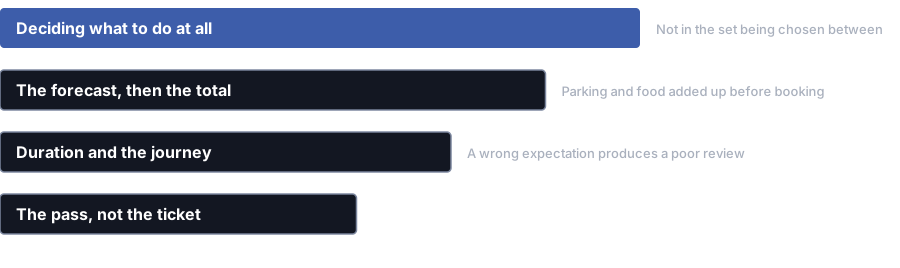
- 1Deciding what to do at all — Undecided, filtering on weather, the children's ages and travel time. They don't yet know your venue exists.Not among the options being weighed
- 2The forecast, then the total — The forecast comes first for anything outdoors. The total cost for the group decides it, not the adult ticket price.Parking and food added up before booking
- 3How long, and how far — Families check whether this fills a day or an afternoon. Travel time or parking rules out more options than price does.A wrong expectation leads to a poor review
- 4The pass, not the ticket — A pass holder is the cheapest visitor you will ever have, and the reason a quiet weekday brings in any money at all.
Your website
What visitors need to see
- The full price for a group, including every ticket type, concession, family rate and booking fee, shown before checkout
- Opening times by date, not a general statement, with last entry and anything closed today made obvious
- A booking process that works on a phone on a bank holiday morning, payment step included
- What there is to do if it rains, stated clearly, with the covered and indoor areas named
- Getting here: parking cost, public transport, coach drop-off and how long the walk is from each
- A proper accessibility page covering step-free routes, sensory provision, carer tickets and assistance animals
- A group and school section with lead times, ratios, risk assessments and curriculum links as web pages, not attachments
- Height, age and health restrictions stated where they apply, so a family doesn't travel to find out
- The annual pass offered when someone buys a single ticket, with the savings shown clearly
- Photos and visit times that help people judge whether this is two hours or a full day out
What people search
“Things to do in [city] with kids” and similar searches
Deciding what to do
Undecided, local or visiting, and usually filtering by weather, children's ages and travel time. They don't yet know your venue exists.
- things to do in [city] with kids
- days out near me this weekend
- rainy day activities [area]
- free things to do [town] half term
- best days out for toddlers [region]
Named venue and practicalities
They have nearly decided and are checking the details. Ticket resellers often answer these before the attraction does.
- [attraction] opening times
- [attraction] ticket prices
- [attraction] parking cost
- how long do you need at [attraction]
- is [attraction] worth it with a 3 year old
Groups, schools and corporate
One organiser with a group behind them, deciding months ahead against a checklist, not on impulse.
- school trips [region] key stage 2
- coach parking [attraction]
- corporate away day venue [city]
- birthday party venue [town] age 8
- group discount [attraction]
Passes, seasons and events
Where repeat business comes from. A pass holder is your cheapest visitor, and the easiest to bring back on a quiet day.
- annual pass [attraction] price
- is an annual pass worth it
- christmas events near me for families
- summer holiday events [area]
- membership vs single tickets [attraction]
These are example searches from keyword research and public search data. Before we suggest anything, we check how often people search for them in your area.
Common problems
Why visitor attraction leads dry up
Visitor attraction marketing deals with stock that vanishes every evening. The hours nobody bought on a wet Tuesday can't be sold in August, so an empty weekday is a more urgent problem than a sold-out Saturday is a win.
Almost everything below follows from that, and from how people decide: often that same morning, as a group, right after checking the forecast.
- Every day is priced the same, so the quiet days stay quiet.
- A wet Tuesday in February and a sunny Saturday in August are different products sold at one price. Advance-booking rates, timed entry and a proper off-peak price move visitors into the capacity you have, without blanket discounts that teach people to wait. One price all year ends up discounting the busy days too.
- The campaign calendar can't keep up with the forecast.
- Demand turns on the weather and people often decide that morning, yet marketing is planned quarterly. Keep a small set of pre-approved messages — wet weather, sudden sunshine, an unfilled half-term day — with creative built, audiences saved and budget rules agreed, so switching one on takes minutes.
- A reseller outranks you for your own name.
- Ticket agents and aggregators bid on your brand name, sell your capacity with a fee added and keep the customer. Some of that reach is worth having; losing the visitor who searched for you by name is not. Protect it with branded paid search, a page that answers practical questions better, and a real advantage for booking direct.
- The price is not visible until the last step.
- A booking fee, parking charge or compulsory donation added late in checkout is the fastest way to lose a family who had decided to come, and in more and more markets a legal problem. Show the full cost for a family of four up front.
- The annual pass is sold at the exit, not at the checkout.
- The best moment to sell a pass is while someone buys a single ticket and can see two visits cost more than a year. Offering it on the way out, after a long day with a queue behind, works far less well. This checkout choice is worth more than most campaigns.
- School and group business lives in one person's inbox.
- Group organisers book far ahead, on weekdays when you have space, against a checklist: ratios, risk assessments, curriculum fit, coach access, somewhere for packed lunches, a free teacher place. Without published material and a tracked pipeline, you can't tell in March whether June is booked or follow up organisers who went quiet.
Where to spend
Spend on local SEO first, then conversion fixes
In the order we'd put them. Start at the top.
Make the day-out shortlist before anyone types your name
Much of this demand starts as "things to do near me", filtered by distance and opening hours. Accurate hours by date, fresh photos, the features families filter on and reviews mentioning queues and parking put you on the shortlist, and catch visitors already nearby.
Fix the checkout, where marketing money leaks away
Ticket selection a tired parent can finish in a couple of minutes, the total cost visible early, the annual pass offered at the right moment, and a process that holds up on a slow connection on a bank holiday morning. Most attractions find more revenue here than in extra advertising.
A review score that sells the day out
Families pick a day out by star rating and the last few reviews, often on the way there. Send every visitor the review link that evening while the day is fresh, answer complaints about queues and prices in public, and keep photos current. A rising score on Google and Tripadvisor does more for walk-up visits than another advert.
How they choose
How customers decide who to hire
Know how they choose and you know where to show up.
- A group decides, and a child often has a veto. Content showing what the day looks like matters more than heritage or collections.
- For an outdoor venue, people check the forecast first, and a clear answer about what to do in the rain wins bookings a general description never will.
- The total cost for the group decides it, not the adult ticket price. Parking, food, booking fees and extras inside all get added up before anyone commits.
- How long the visit takes is a real filter: a day or an afternoon? Get it wrong and you get a poor review, even after a good visit.
- Travel time and the hassle of parking or public transport rule out more options than price does, especially for families with young children.
- Recent reviews and photos carry extra weight, because visitors want to know about queues, crowds and whether anything is closed today.
- School and group organisers choose on the paperwork: curriculum links, risk assessments, adult ratios, coach access, a place to eat lunch, and how fast their enquiry was answered.
- Local repeat visitors choose on what is new. A new trail, an event, a seasonal opening or a temporary exhibition brings an April family back in October.
Measuring results
What we track each month
These numbers show if your marketing brings in customers. Website visits alone don't.
- Tickets sold by date, split between direct and reseller, with the margin difference shown
- Revenue per visitor including catering, shop and parking, not just admissions
- Capacity used by day of the week, so quiet days stand out instead of being averaged away
- Annual passes sold with single tickets, and how many renew a year later
- Group and school bookings confirmed, with lead time, group size and how many rebook the next year
- Advance bookings as a share of all admissions, the number that makes staffing possible to plan
- Cost to win a booked visit, compared with revenue per visitor, not the ticket price
- Organiser enquiries answered within a day, tracked through to a confirmed date
The rules
The rules on claims
How you show prices is the live legal question for attractions. Several markets now require the total unavoidable cost up front, not built up through checkout, which affects booking fees, compulsory donations, card charges and parking sold as an extra. Showing the full cost for a group early is safer and better for sales.
Accessibility information is a statement of fact about your site, not a marketing claim, and must be checked on the ground. Describe step-free routes, sensory provision, carer or companion tickets, accessible toilets and your assistance animal policy precisely enough for a visitor to decide; get it wrong and they make a wasted journey and a justified complaint.
Anything aimed at schools and children brings safeguarding into your marketing. Photos of children need recorded consent, group booking material should match the ratios and risk assessment standards organisers work to, and advertising aimed at children is separately restricted in many markets.
Venues with animals, rides or food service have licensing rules that limit what you may advertise and when. Welfare standards, ride safety records and inspection results are facts, not positioning, and more regulators treat conservation, welfare or environmental impact claims as environmental claims that must be backed up.
Sources
Rules and where to read them
Each rule above, linked to the body that publishes it. Which ones apply depends on where you work. Rules change, so check the latest version.
- Prices must include mandatory fees, taxes and charges; revealing them later in the purchase (drip pricing) is unlawful.
- CMA209
- Source: CMA price transparency guidance (UK)
- UK advertising rules for marketing addressed to, targeted at or featuring children.
- CAP Code section 5
- Source: ASA/CAP Code, section 5: Children (UK)
- Environmental claims must be truthful, clear, substantiated and must not omit material information.
- CMA Green Claims Code
- Source: CMA Green Claims Code (UK)
Questions
Things to know about visitor attraction marketing
Should a visitor attraction publish the full price including the booking fee?
Yes. A fee revealed at the last step is the surest way to lose a family who had decided to come, and in several markets the rules on showing a total price have tightened.
Show what a family of four pays, including compulsory parking. If the total is high, use the page to explain what the day includes rather than letting the number surprise them at checkout.
A ticket reseller ranks above us for our own name. What can we do?
Protect your branded search and give people a reason to book direct. Paid search on your own name is cheap, and a page answering opening times, prices, parking and what is closed today usually beats the reseller on practical questions.
Make booking direct better: no added fee, easier changes, the annual pass at checkout, priority on event dates. Resellers earn their place on spare capacity, not on visitors who already know you.
How do we market anything when the weather decides everything?
Prepare the messages, not the calendar. Before the season, build and approve a small set of campaigns — wet weather, unexpected sunshine, an unfilled half-term day, a quiet weekend — with creative made, audiences saved and budget rules agreed.
Then on a Thursday evening you choose which to switch on, in minutes. Commissioning a campaign after the forecast changes is always a week late.
Should we push annual passes to first-time visitors?
Yes, while they are buying a single ticket, when the saving is obvious and the visit already decided. It works far better than the same offer at the exit.
A pass holder costs nothing to bring back, visits on quiet weekdays, brings guests and spends on food and in the shop, exactly the demand a fixed-capacity business needs on days it isn't full.
How do we win more school bookings?
Publish what the organiser is checking and answer quickly: curriculum links by age group, risk assessment material, adult-to-child ratios, coach access and parking, where lunch can be eaten, and what a teacher place includes.
Treat it as a pipeline, not an inbox. Record every enquiry with date and group size, reply the same day, follow up the quiet ones, and contact last year's organisers in the term they plan.
Want to know what you could win?
Start with the free checkup. It shows what to fix first on your website, with no sign-up. Want the full plan for your visitor attraction business? Book a call, and we'll look at your market, your competitors and the searches that bring in customers.
Prefer to talk it over? Book a free call
Your BOOSTD score improves within 90 days, or your next month is free. After 6 months, more traffic or leads, or we keep working free (up to 6 free months in any 12 months). Read our guarantee
References
Sources for visitor attraction marketing
The official documents and research this page is based on. Platform rules change, so check the source before you act on a detail.
Related
More on visitor attraction marketing
Guides for visitor attraction
Other arts & Recreation businesses
Industries close to visitor attraction
Last updated · Published by Zubair Afzal, responsible editor