
Waste & Environmental Services marketing
Waste management marketing for customers buying protection from their own liability
A business that produces waste stays responsible for it after your lorry leaves. That single fact explains why a commercial contract is won on permits, paperwork and evidence of destination, and why a price per lift is the last thing the buyer settles.
Prefer to talk it through? Book a strategy call
Search behaviour
Waste and environmental services searches, grouped by intent
Householder or one-off job
Fast, local, price-led and decided within a day. Valuable volume, entirely different from the contract business, and it should never be the first thing a procurement lead sees.
- skip hire prices near me
- rubbish removal [town] same day
- how to get rid of a mattress
- garden waste collection cost [area]
- man and van clearance [postcode]
A duty holder checking the rules
Made by the person who carries the liability. These searches signal an account that is either being set up or being reviewed after somebody was asked a question they could not answer.
- who is responsible for waste duty of care
- waste transfer note requirements business
- check licensed waste carrier register
- how long to keep waste documentation
- hazardous waste consignment note explained
Commercial contract and multi-site procurement
Low volume, very high value, and researched over weeks by somebody comparing coverage, permits and reporting rather than price per lift.
- national commercial waste contract provider
- multi site waste management tender
- confidential document destruction contract
- waste reporting for esg disclosure
- single supplier waste contract [sector]
Specialist and emergency work
The highest-margin demand in the category, usually urgent, and always constrained by whether the operator holds the right licence for that specific material.
- licensed asbestos removal contractor [region]
- contaminated land remediation consultant
- oil spill response contractor [area]
- clinical waste collection [sector]
- grease trap emptying commercial kitchen
These are examples of how customers in this market search, drawn from keyword research and public search data. They are illustrative, not a volume claim: we size the demand in your area before recommending anything.
What usually goes wrong
Where waste and environmental services marketing tends to fail
The two demand streams in this business are visible in the search terms above long before anyone reads a strategy. A householder wants a price and a date. A compliance manager wants to know whether using you keeps their organisation legal, and will get to price after that question is settled.
Almost every marketing problem a waste business has comes from serving both of those readers with one page, one tone and one argument.
- One website is selling a skip and a national contract.
- The householder wants a price and a date. The procurement lead wants permits, coverage, documentation and references. Neither can find what they came for on a homepage trying to serve both, and the commercial buyer in particular reads a consumer-facing site as evidence that you are not the right size of company. Two clearly separated routes from the first screen solves more here than any campaign.
- The permits, registrations and permissions are not published.
- A buyer checking whether you can lawfully handle their material wants the carrier registration, the permit numbers, the sites those permits cover and the waste streams included. Publishing them with numbers and expiry dates lets a compliance manager verify you in minutes against a public register, which is precisely the reassurance they are looking for and something remarkably few operators put on a website.
- Price is the only thing on the page, in a market that is not bought on price alone.
- A rate per lift is easy to publish and easy to undercut, and it invites every conversation to become a comparison of pence. The contract buyer’s actual questions are whether you keep them legal, whether the documentation arrives without chasing, whether the collection happens when the yard is full, and whether the reporting supports their own disclosures. Price matters, but it is not the first filter, and leading with it forfeits every other argument.
- There is no evidence of what happens after collection.
- Increasingly the client needs to state where their material went and what proportion was recovered, because they are reporting it themselves. An operator who can describe the route by stream — what is sorted where, what is recovered, what goes to disposal — with figures taken from their own records, is selling something a competitor quoting a lower rate cannot match.
- The environmental claims would not survive being questioned.
- Round numbers, unqualified recycling percentages and general statements about sustainability are exactly what advertising and competition regulators in several markets have been targeting. They are also a liability for the client, who may repeat the claim in their own reporting. A narrower, evidenced, dated claim is both safer and more persuasive to the only person who reads it carefully.
- Every tender response is rebuilt from scratch.
- Permits, insurance, accreditations, policies, method statements, incident history and references are requested in almost every submission, and they are usually gathered under deadline pressure from several people’s inboxes. Maintained as a published library with owners and review dates, the same material shortens every bid, survives staff turnover and answers the direct buyer who is checking you before making contact.
Buying behaviour
How waste and environmental services customers decide
Strategy follows this, not the other way round. Everything on this page is downstream of how the decision gets made.
- The producer of the waste remains legally responsible for it in most regimes, so the first question a commercial buyer asks is whether using you keeps them compliant. Everything else follows that.
- They check that the registration and permits cover the material and the sites involved, and increasingly they check it against a public register rather than taking a certificate at face value.
- They test whether the documentation arrives without being chased, because a transfer note or consignment note that cannot be produced at an audit is the buyer’s problem rather than yours.
- Coverage decides eligibility for multi-site accounts. An operator who cannot service every location, directly or through a managed subcontract, will not be shortlisted regardless of price.
- Reporting has become a selection criterion in its own right, because clients need waste and recovery data for their own disclosures and would rather receive it than assemble it.
- Reliability is judged on missed collections, response when a bin is overflowing before the scheduled visit, and how quickly somebody answers when a site has a problem.
- For specialist and hazardous work, the licence is the entire filter. If you do not hold the right one for that material, no commercial argument exists.
- Householders choose on a completely different basis: price, availability this week, and whether the reviews suggest you will turn up on the day you said.
What is being bought
The liability does not transfer with the skip
In most regimes the producer of the waste remains legally responsible for it, which means every question a commercial buyer asks is really about whether using you keeps them compliant.
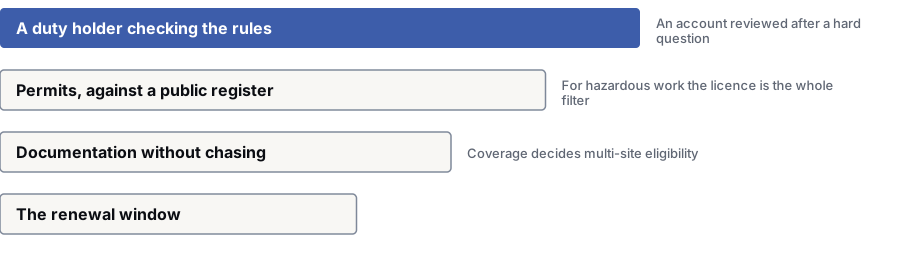
- 1A duty holder checking the rules — The producer of the waste stays legally responsible in most regimes, so the first question is whether using you keeps them compliant.An account reviewed after a hard question
- 2Permits, against a public register — Checked that the registration covers the material and the sites involved, and increasingly checked against a register rather than your site.For hazardous work the licence is the whole filter
- 3Documentation without chasing — A transfer or consignment note that cannot be produced at an audit becomes the problem of the buyer, which is exactly why they test it early.Coverage decides multi-site eligibility
- 4The renewal window — Contracts run for years, so most available revenue changes hands at renewal, on a date knowable in advance for every account you did not win.
Where the money goes
The waste and environmental services marketing channels that earn their place
In priority order for this business, not a menu. Anything not on this list is something we would need a specific reason to recommend.
Depot-level visibility for the work that travels least
Collection is a geographic business bounded by round economics, and the immediate demand is searched locally. A profile per depot with the services offered from that site, clear coverage statements for the areas served, and reviews that speak to turning up when promised. It is also how the domestic stream is captured without it dominating the site.
Explaining duty of care to the person who carries it
What documentation a business must keep and for how long, how waste is classified, what happens at an inspection, what changes when a stream becomes hazardous. This is the material a duty holder searches before they are ready to buy, and publishing it well is how a waste company becomes the obvious call rather than one of three quotes.
The handful of terms a compliance manager types
Stream, sector and permit-level language rather than category words. Specific materials, specific regulated processes, specific documentation, specific sectors. Individually these searches look negligible in a volume tool; together they are the entire addressable demand for the contracted side of the business.
Immediate collection demand, without buying the contract terms
Skip hire, clearance and same-day collection are searched with intent to book, and paid search works well for them. The discipline is keeping that spend away from the contract vocabulary, where the click price is high, the sales cycle is months long and an ad will never be what wins a tender.
Only where the contract value justifies the click price
Reaching facilities, estates, environmental and procurement managers by role is possible here and expensive, so it earns its place only for multi-site or specialist contracts with a contract value that carries the cost. For a single-depot operator selling collections, the same money does more in local search.
Measurement
Waste and environmental services numbers we report on, and what we ignore
Sessions are not on this list. These are the numbers that tell you whether the marketing is producing customers.
- Contracted accounts won and the annual contract value they represent, by waste stream
- Contract retention at renewal, which is where the economics of a collection round are decided
- Cost to acquire a contracted account, set against contribution over the contract term rather than the first invoice
- Duty of care audits and client inspections passed without a documentation finding
- One-off and domestic jobs booked, reported separately so they never flatter the contract numbers
- Tonnes collected per round and vehicle utilisation on booked work
- Permitted site throughput against consented capacity, so the marketing does not sell what cannot be processed
- Tenders and pre-qualifications submitted, shortlisted and won, with the losing reason recorded
- Recovery and diversion evidenced per client, because it is what the client repeats in their own reporting
The website
What a waste and environmental services website has to do
- Carrier, broker and dealer registration numbers, permit numbers and the sites they cover, published and current
- The waste streams you are permitted to handle, and a plain statement of the ones you are not
- What happens to material after collection, by stream, with destinations and recovery routes described
- The documentation a client receives as standard, including transfer notes, consignment notes and destruction certificates
- Separate routes from the first screen for a householder and for a business buyer
- Published prices for standard domestic services, and a clear explanation of what drives commercial pricing
- A coverage map by depot showing which services are available where
- An emergency and out-of-hours contact route, with the response capability stated accurately
- Accreditations and management system certifications with certificate numbers, scope and expiry
- The reporting a contracted client receives, with a real example of what the data looks like
Constraints
Waste and environmental services advertising rules: what is allowed, and what is not
Everything published about permits, registrations and licences has to match the document exactly. Registration and permit scope covers named sites, named waste codes and named activities, and describing the business as licensed for a stream that sits outside that scope is discoverable in minutes against a public register. Publish the numbers, the scope and the expiry, and take the page down when a permission lapses.
Marketing must never imply that a customer’s duty of care transfers with the material. In most regimes the producer remains responsible for the waste it creates, including for checking that whoever takes it is authorised and for keeping records. Copy suggesting that the problem becomes yours the moment the lorry leaves misstates the law and creates a liability for the client rather than reassurance.
Environmental claims are the most closely scrutinised language in this sector. Recycling rates, diversion, recovery, carbon savings and general sustainability statements are treated as substantiable claims by advertising and competition regulators in a growing number of markets, and guidance on green claims has tightened significantly. State the figure, the basis, the period and what is excluded, or do not state a figure at all.
Specialist streams carry their own licensing regimes and their own advertising constraints. Asbestos, clinical and healthcare waste, confidential document destruction, hazardous and radioactive materials, and contaminated land work each require specific permissions, and confidential destruction additionally engages data protection obligations and recognised destruction standards.
Enforcement history, prosecutions and permit breaches are public in many jurisdictions, and a buyer running due diligence will find them. That is an argument for accuracy rather than for silence: an operator that describes an incident, what changed and what has been in place since is in a considerably stronger position than one whose website implies a record it does not have.
Primary sources
The waste and environmental services rules above, at source
The rules this page refers to, linked to the regulator or rule-maker that publishes them. Which apply depends on where you operate, and they change, so check the current version.
- Requires businesses that carry, broker or deal in waste in England to register with the Environment Agency.
Waste carrier register
Requires businesses that carry, broker or deal in waste in England to register with the Environment Agency.
Source: England: GOV.UK, Register as a waste carrier, broker or dealer
- Sets out the waste producer’s legal duty of care, including checking who takes the waste and keeping records.
Waste duty of care
Sets out the waste producer’s legal duty of care, including checking who takes the waste and keeping records.
- Explains how UK consumer law applies to environmental claims, which must be truthful and substantiated.
CMA Green Claims Code
Explains how UK consumer law applies to environmental claims, which must be truthful and substantiated.
Source: UK: Competition and Markets Authority, Green Claims Code
Questions
Waste and environmental services marketing questions, answered
Should we publish our permit and registration numbers?
Yes. The commercial buyer is checking whether using you keeps them compliant, and a number they can verify against a public register does that faster and more convincingly than any description.
Publish the registration and permit numbers, the sites covered, the waste streams included and the expiry dates, and keep them current. Competitors already know what you are permitted to handle, because it is a matter of public record. The buyer is the one who cannot easily find it.
Can we say we send zero waste to landfill?
Only if you can evidence it for the specific streams and period you are describing, and only if you state what the claim covers. Green claims are being scrutinised closely by regulators in several markets, and an unqualified statement of that kind is exactly the shape they have targeted.
It also matters commercially, because clients repeat your figures in their own reporting. A narrower claim with the basis and period attached is more useful to them and considerably safer for both of you than a round number nobody can trace.
Is it a problem running skip hire and contracts on one site?
It is, when they share the same entry point. A householder wants a price and a date and will not read a compliance page. A procurement lead wants permits, coverage and reporting, and reads a consumer offer as a sign you are not the right supplier.
The answer is not two websites in most cases, it is two clearly separated routes from the first screen, with navigation, language and proof appropriate to each. Both audiences are worth having and neither should have to wade through the other.
Every enquiry becomes a price per lift. How do we change that?
By changing what the enquiry arrives knowing. When the first contact happens after somebody has read your permit detail, your documentation standard and your description of where material goes, the conversation starts from suitability rather than from rate.
It also helps to publish what drives commercial pricing — stream, contamination, frequency, access, weight — because a buyer who understands the variables stops treating quotes as interchangeable.
What genuinely wins a multi-site contract?
Coverage, evidence and reporting, roughly in that order, with price as the filter applied among the suppliers who clear all three. An operator who cannot service every site, directly or through a managed arrangement, does not get shortlisted.
After that it is the documentation trail and the data. Buyers are being asked to account for their waste, so the supplier who delivers accurate, timely, reportable information is solving a problem the client would otherwise have to solve themselves.
Find out what is winnable for your waste and environmental services business
Start with the free Growth Scan: an indicative read of your website and the few things to fix first, with no sign-up. BOOSTD is in early access, so the fuller picture for your waste and environmental services business — your area, your competitors and the searches that matter — is worked through with our team on a strategy call. If we do not think we can move it, we will tell you.
Prefer to talk it through? Book a strategy call
If we don't deliver the work we agreed to deliver for reasons within our control, you don't pay for the undelivered work. Read our guarantee
References
Sources
The primary documents and published research this page relies on. Platform rules change, so check the source before acting on a detail.
More to explore
Last updated · Published by Zubair Afzal (responsible editor), on owner authorisation