
Industrial Manufacturing marketing
Industrial manufacturer lead generation engineers find
Industrial manufacturer lead generation that puts your datasheets and drawings in front of engineers. They search by material, standard and part number, not brand name.

How they choose
Why they pick one business over another
Know how they choose and you know where to show up.
- The engineer decides whether you are a candidate before speaking to anyone, based on whether your documents answered their question. If the drawing, material data and tolerances were there, you are in. If any needed a phone call, you often aren't.
- Certification is a hard filter. ISO 9001 gets you considered in general industry. Sector schemes like AS9100, IATF 16949 or a pressure equipment approval decide eligibility outright, and the scope on the certificate matters as much as holding it.
- Lead time and minimum order settle more decisions than price. A buyer with a stopped line will pay extra for six weeks instead of sixteen. A prototype designer will walk away from a thousand-piece minimum run.
- Three people each hold a veto. The design engineer judges the part, procurement the commercial terms, and quality whether you can be approved at all. Content that only satisfies the first gets you specified and then blocked.
- Long-term reliability is judged quietly. Buyers choose a supplier for a product's whole production life, so financial stability, second-site capacity, succession and legacy stock all get weighed.
- Physical proof still closes the deal. Samples, a factory visit and a supplier audit are normal steps. The website's job is to get you far enough that someone books the flight.
How a part gets sourced
How an engineer sources a part, from first search to supplier audit
Every step here is decided before anyone talks to a salesperson, and three different people can veto the result. The website only has to get you as far as the sample.
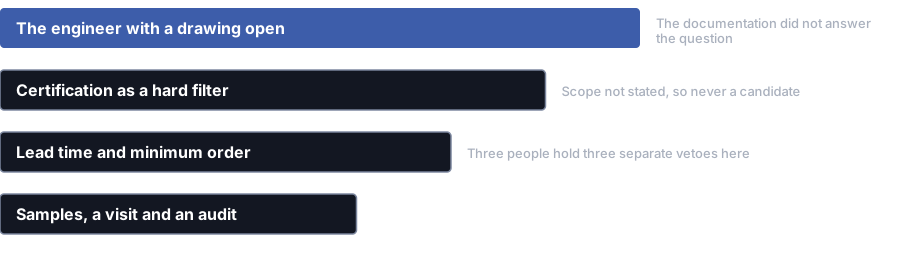
- 1The engineer with a drawing open — Low volume, very high intent. A phrase searched forty times a month can be worth more than one searched forty thousand times.The documents didn't answer the question
- 2Certification as a hard filter — A general quality standard gets you considered. Sector schemes decide eligibility in aerospace, automotive and medical work.Scope not stated, so never a candidate
- 3Lead time and minimum order — These settle more deals than price. A buyer with a stopped line will pay extra for six weeks instead of sixteen.Three people hold three separate vetoes here
- 4Samples, a visit and an audit — Physical proof closes it. The site's job is to get you far enough that someone will spend a day on you.
Common problems
Paying for industrial manufacturing marketing that doesn't work?
The person who ends up buying from you isn't looking for a manufacturer. They're looking for a grade of steel, a thread form, a flow rate, or a replacement for a part that's gone obsolete. They have a CAD window open and a deadline.
So industrial lead generation means a website that is a reference document that also sells. The companies winning here publish technical detail openly instead of holding it back for a work email address. The wider picture, including distributors and trade channels, is on the manufacturing sector page.
- The technical documents are behind a form, or not published at all.
- Datasheets, drawings, CAD models and material certificates are what the engineer came for. Put a registration wall in front of them and the engineer opens the next result. Publishing openly costs a lead capture you mostly weren't getting, and gets your part inside someone's assembly model.
- The catalogue is a PDF, so none of the range exists in search.
- A four-hundred-page PDF is a single URL. Every size, grade and configuration inside it is invisible to the searches it could answer. Give each product family its own page, with the specification table as text and each variant reachable, and a dormant catalogue becomes hundreds of pages that match real searches.
- The homepage was written for an audience that does not visit.
- Quality, innovation and decades of experience are trade-show talk. A design engineer wants your material range, tolerances held, machine envelope, finishes, and whether you can make eighty units as well as eighty thousand. A site that leads with warm words and buries capability answers a question nobody asked.
- Distributors and catalogue houses outrank you for your own parts.
- Big distribution platforms have a page for every product, structured data on all of it and more authority than any one manufacturer, so they often outrank you for your own part numbers. Give buyers a reason to come to the source: full engineering detail, revision history, compatibility notes and a direct route to a quote.
- Nobody can trace an enquiry, so marketing looks like it does nothing.
- Enquiries arrive as a call to a regional manager or a drawing emailed to an old address. Without call tracking, a structured quote form and a CRM source field, every deal is credited to the salesperson, and marketing is cut at the first budget review, long before a qualification cycle could show results.
- The qualification cycle is longer than anybody's patience.
- Sampling, first-article inspection, supplier audits and approved-supplier listing can take a year or more before a first order, so monthly lead counts mislead. Agree which early signs count — quote requests, sample requests, drawings downloaded by target companies — and when the work can fairly be judged.
What people search
Searches like “316l stainless steel flange dimensions table”
Specification and part-level searches
Made by a design engineer with a drawing open. Low volume, very high intent, and rarely answered by any manufacturer page.
- 316l stainless steel flange dimensions table
- astm a105 forged fitting supplier
- cross reference for obsolete bearing part number
- din 933 hex bolt m12 stainless supplier
- nema 4x enclosure ip rating equivalent
Capability and process searches
A buyer looking for a supplier by what they can make, not what they stock. This is where capability pages earn their place.
- cnc machining supplier
- 5 axis machining shop with aerospace approval
- low volume injection moulding uk
- iso 9001 sheet metal fabricator ontario
- aluminium extrusion manufacturer custom die
Standards, testing and documentation
Often searched by quality teams, not engineers, and almost nobody in the sector targets them.
- en 10204 3.1 material test certificate explained
- reach and rohs declaration for electronic components
- first article inspection report requirements
- difference between iso 9001 and as9100
- ce marking vs ukca for machinery
Obsolescence and second sourcing
A buyer under pressure whose supplier has failed, dropped a line or become too expensive. Fast-moving and unusually easy to win.
- drop in replacement for discontinued actuator
- second source supplier for machined components
- reverse engineering obsolete spare parts service
- alternative supplier to imported castings
These are example searches from keyword research and public search data. Before we suggest anything, we check how often people search for them in your area.
Where to spend
Technical SEO first, then search content
In the order we'd put them. Start at the top.
A page per product family, not a PDF catalogue
Put specification tables on the page as text. Make each variant reachable, let attributes be filtered, and attach drawings and models to the page, not a document library. Hundreds of real searches become answerable, which most manufacturing sites have never done.
Technical documents as open pages, not gated downloads
Publish datasheets, application notes, material selection guides, compatibility charts and installation instructions openly, laid out so an engineer can scan them. You swap a lead capture that mostly never happens for a place inside someone's design.
Rank for capability, standard and part-level searches
Cover the searches engineers and quality managers make: process plus material plus certification plus size, not just the few category terms a volume tool suggests. Each looks tiny; together they are the demand a specialist manufacturer can win.
A site that works for an engineer at eleven at night
Site search that finds a part number. Side-by-side comparison of variants. Metric and imperial switching. A quote form that accepts a drawing file and asks what your estimator needs to know.
Specifications AI assistants can read without guessing
Engineers increasingly use AI assistants to pick components and cross-reference parts. Specification data written as consistent, clearly labelled text, with units, standards and revisions stated, decides whether you are summarised accurately or left out.
Your website
Make your site easy to buy from
- A page per product family with the full specification table as text, not an image or PDF
- CAD models and dimensional drawings to download in the formats buyers use, without a registration form
- A capability list stating machine envelope, tolerances held, materials processed and realistic batch sizes
- Quality certifications shown with certificate number, issuing body, scope and expiry date
- Material, test and compliance documents listed by what you can supply on request
- A quote form that accepts drawing files and asks about quantity, material, tolerance and required date
- Site search that finds a part number or a standard designation, not just a product name
- Lead times and minimum order quantities by product family, with any exceptions stated
Measuring results
How we measure success
These numbers show if your marketing brings in customers. Website visits alone don't.
- Quote requests received, split by product family and by whether the part was already specified
- Quote to order rate, and how long you take to return a quote
- Drawing, datasheet and CAD downloads, tracked by file and by the companies downloading them
- Sample and first-article requests, the early sign that a qualification is starting
- New places on customers' approved supplier lists
- Enquiries from named target accounts, reported apart from general inbound
- Pipeline value by qualification stage, not lead count
- Tracked phone enquiries, so the route most industrial buyers use isn't invisible
The rules
Rules that shape your marketing
Certification and standards claims must match the certificate exactly. An ISO 9001 or sector certificate covers named sites, processes and a stated scope, and calling the company certified when only one plant is in scope is what a supplier audit finds first. Publish the certificate number, issuing body, scope and expiry, and take pages down if a certificate lapses.
Performance, material and durability figures are advertising claims you must be able to back up in most markets. Every number should trace to a test method, a standard and the test conditions, and be stated that way, not rounded into a headline. If a figure comes from one of your suppliers, credit them.
Publishing detailed specifications can trigger export control and dual-use rules for some products and destinations, depending on where you make and where you sell. What you may publish, and to whom, is for your compliance team to decide. Our part is to flag content that looks like it needs that check before it goes live.
Work made to a customer's drawing is normally confidential: the tooling, the design and often the relationship belong to them. Get written permission before showing a part, naming a customer or describing a programme. An anonymised description of sector, volume and tolerance is usually what you can publish.
Sources
Go to the source
Each rule above, linked to the body that publishes it. Which ones apply depends on where you work. Rules change, so check the latest version.
- Requires advertisers to have a reasonable basis for objective claims before making them.
- FTC ad substantiation
- Source: US: Federal Trade Commission, Policy Statement Regarding Advertising Substantiation
- Defines what items and technology are subject to US export controls, and what counts as published.
- EAR Part 734
- Source: US: Bureau of Industry and Security, 15 CFR Part 734 (eCFR)
- Explains UK controls on exporting military and dual-use goods, software and technology.
- UK strategic exports
- Source: UK: Export Control Joint Unit, UK strategic export controls
Questions
New to industrial manufacturing marketing? Start here
Should our datasheets and CAD files sit behind a download form?
Almost never. An engineer downloading a model is testing whether your part fits their assembly, the most valuable thing that can happen on a manufacturing website. A registration wall sends them to a distributor instead.
Capture leads where it costs less: a sample request, a quote form, a technical question route, or a login showing pricing and live stock. Gate the commercial layer, never the engineering.
Everything we make is custom. What is there to put on a website?
Your capability, limits and evidence. A buyer with a custom part is checking whether it fits what you can do: your processes, sizes, materials, routine tolerances, sensible volumes and certifications.
Anonymised examples do the rest. Describe a component by sector, material, tolerance and yearly volume, with no customer named and no drawing shown. Most confidentiality agreements allow that, and it tells a sourcing engineer more than a factory photo.
Nobody searches for what we make. Is search worth anything to us?
Yes. The searches exist; they just aren't the ones a volume tool reports. Engineers search standards, dimensions, materials, part numbers and cross-references, each small enough that most keyword research throws it away.
The value is in the maths. If a part is designed into a product that ships for eight years, a few right visits a month add up to real revenue, and there is usually almost no competition for those exact terms.
Our business comes from reps and trade shows. Why add anything?
Because the rep and the show are now the second step. Engineers research, shortlist and form a view before anyone meets, and your website either backs up what the rep says or undermines it.
The aim is to make field sales more efficient: fewer conversations explaining basic capability, more on parts the buyer has already checked against your published tolerances.
How do we measure leads when qualifying a supplier takes two years?
Agree at the start which early signs are meaningful: drawing downloads by target companies, sample requests, quote requests, first-article submissions and new supplier approvals started.
Also agree in writing when the work can fairly be judged. Anyone promising revenue impact within a quarter in this sector is describing a different industry.
Show me what to fix
Start with the free checkup. It shows what to fix first on your website, with no sign-up. Want the full plan for your industrial manufacturing business? Book a call, and we'll look at your market, your competitors and the searches that bring in customers.
Prefer to talk it over? Book a free call
Your BOOSTD score improves within 90 days, or your next month is free. After 6 months, more traffic or leads, or we keep working free (up to 6 free months in any 12 months). Read our guarantee
References
Sources for industrial manufacturer lead generation
The official documents and research this page is based on. Platform rules change, so check the source before you act on a detail.
Related
More on industrial manufacturing marketing
- manufacturing website designsRFQ forms with CAD upload, capability pages and spec sheets.
- marketing for engineering consultancies
- building a B2B pipeline
- agricultural equipment dealersThe same capital-goods problem inside a dealer territory and a crop calendar.
- selling to governmentWhere the buyer publishes a specification instead of taking a call.
Guides for industrial manufacturing
Other manufacturing businesses
Industries close to industrial manufacturing
Last updated · Published by Zubair Afzal, responsible editor