
Membership & Trade Associations marketing
Membership association marketing that grows renewals, not just joins
Membership association marketing planned around the renewal date, so fewer members lapse silently and each is worth more, before any recruitment push.

Timing
Busy months and quiet months
The renewal calendar is the business and sets the shape of your marketing year. One common renewal date means one huge week and eleven quiet months; anniversary renewals mean a small renewal every day, easier to manage and far easier to neglect.
People join because of career events, not campaigns: they qualify, change job, need a designation for a role, or learn from a client or tender that membership is required. The association is either there at that moment or it isn't.
Development deadlines, annual conferences and awards create the few predictable peaks, when lapsed members most often return and prospective members look.
Trade association demand moves with regulation. A consultation, a new standard, a licensing change or a tax measure brings a rush of businesses needing representation, guidance and somewhere to ask questions.
Lapse happens all the time, silently, clustering around employer changes, failed payments and the first year after joining, without the noise a recruitment campaign makes.
Non-dues income from conferences, training, certification, sponsorship, advertising and accreditation runs on its own cycles and often grows fastest, so it is the part most likely marketed by someone who has never spoken to the membership team.
The half nobody markets
Why members join, and the quiet reasons they stop renewing
A renewal that doesn't happen looks exactly like nothing happening. That is why nearly all the attention goes to the smaller half of the problem.
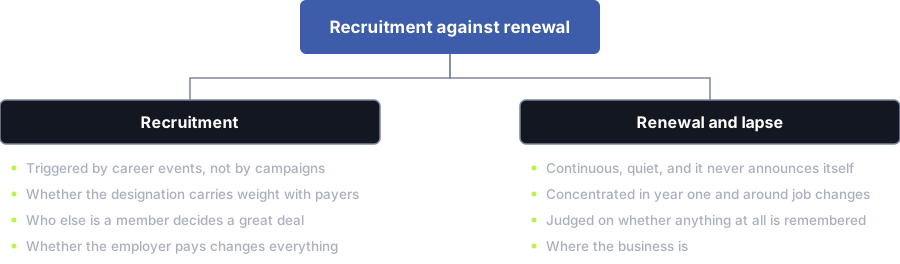
Recruitment
- Sparked by career events, not campaigns
- Whether the designation matters to payers
- Who else is a member counts for a lot
- Whether the employer pays changes it all
Renewal and lapse
- Constant, silent and easy to miss
- Mostly in year one and after job changes
- Judged on whether anything is remembered
- Where most of the income is
How they choose
How the shortlist gets made
Know how they choose and you know where to show up.
- The first question is whether the designation carries weight with the people who pay them (employers, clients, regulators or buyers), and whether it is required for anything they want to do.
- Who else is a member counts for a lot, especially for trade bodies. A business joins the association its customers and competitors belong to, and hesitates over one whose member list it doesn't recognise.
- Whether the employer pays changes the decision. For many prospective members the practical question is whether the association has made it easy to claim.
- People compare what is included, item by item: training, insurance, a legal or technical helpline, a journal, discounted certification, event access, and easier development requirements.
- For trade associations the test is influence: does membership get the business into conversations with regulators and large buyers, and does the logo help win work?
- Ease of joining matters more than it should. A body that can't say which grade someone qualifies for, or wants a form posted, loses people who had decided to join.
- Renewal comes down to a simpler question than joining: can the member remember anything the association did for them this year? If not, price is all that counts.
Common problems
Why membership association websites lose enquiries
Membership association marketing usually has its priorities upside down. Most of next year's income comes from existing members, yet most of the marketing goes to people who haven't joined, the renewal notice is a bare invoice, and silent lapses are recorded as a percentage once a year.
Start from the renewal date and work outwards. That's where the revenue is, and it's the part of the year almost nobody plans around.
- Everything worth having is behind the login.
- You ask prospective members to pay for value they can't see, and hide your best content from search. What membership is, what it costs, what each grade includes and a real sample of the material should be public. Keep the login for things that cost you to provide, like the helpline, the full library and discounted rates.
- Nobody can say why a member left.
- Cancellations are logged as decisions, but many are mechanical: an expired card, an employer that stopped paying, a job move and a renewal notice sent to an unread inbox. One required question at cancellation, automatic payment retries and self-service card updates win back more members than an equal-cost recruitment campaign.
- The renewal notice is an invoice with nothing attached to it.
- It arrives with a price and a deadline, after a year the member can't sum up. A renewal should say what the member used, what changed in their profession, what you did about it and what is next, in a series of messages starting weeks before the date. The finance system's invoice can't do that.
- The member directory is a search box that returns nothing.
- The public searches for a registered, accredited or chartered practitioner by specialism and town, and the association is the natural answer, but a JavaScript lookup over a database has no pages for any of it. Build proper pages by specialism, location and member, and it becomes your biggest source of member value and your strongest renewal argument.
- Recruitment and lapse are never in the same report.
- The board sees new members monthly and one churn percentage yearly, which hides whether the income-bearing grades are holding up and whether first-year members reach a second renewal. Reporting by grade and length of membership asks whether the base is growing.
- Membership, events, training and certification market separately.
- The same person gets four unconnected messages from four teams, which lowers response, wastes the best cross-selling chance and makes the organisation look less joined-up than it is. One contact plan, one calendar and a rule about who contacts whom each week fixes most of it.
What people search
Searches like “is [designation] membership worth it”
Deciding whether to join
A careful, sceptical search by someone weighing a yearly cost against a career benefit. Usually answered by a forum thread, not the association.
- is [designation] membership worth it
- how to become a chartered [profession]
- [association] membership cost per year
- do i need to be a member to practise as a [profession]
- [association] vs [association] which is better
The public looking for a member
Demand only the association can own, and usually fails to capture. Every one of these searches is a referral it could pass to a member.
- find a registered [trade] near me
- accredited [profession] [town]
- check if [profession] is qualified
- chartered [profession] directory [region]
- approved [trade] scheme member
Development, training and certification
Regular, deadline-driven demand from current members and from people about to need membership.
- cpd requirements [profession] hours
- [certification] course accredited provider
- how to log cpd for [body]
- [profession] conference [year] programme
Renewal, lapse and reinstatement
Searched by a member at the exact moment they are unsure about staying. They should find your page, not a complaint thread.
- cancel [association] membership
- reinstate lapsed membership [body]
- is professional membership tax deductible
- transfer membership to a new employer
These are example searches from keyword research and public search data. Before we suggest anything, we check how often people search for them in your area.
Where to spend
Spend on technical SEO first, then search content
In the order we'd put them. Start at the top.
Build the member directory as pages, not a lookup
Crawlable pages by specialism and location, a page for each member, consistent structured data, and links to the standards and guidance that explain accreditation. For most membership bodies this is the biggest unused asset they own.
Answer the questions that decide joining and renewing
What the designation means, what each grade requires, how development requirements work, what the profession is debating and what changed in regulation, published openly. It reaches prospective members and members deciding whether to renew.
Reports the board can read
Renewal rate by grade and length of membership, first-year survival, lapse reasons, income per member, and non-dues revenue linked to the member record. Most membership bodies can't produce this, so budget arguments are won by whoever sounds most confident.
Your website
What to fix on your website
- What membership is, what it costs and what each grade includes, all visible without logging in
- A grade or eligibility guide so prospective members can work out which category fits them
- The member directory as crawlable pages by specialism and location, with a page for each member
- Self-service renewal and payment, including updating a card without phoning the office
- Event booking and development logging members can do themselves
- A clear statement of what membership doesn't include, which prevents most first-year disappointment
- Guidance on employer funding, including something a member can forward to their manager
- The tax position of the subscription, where the body can state it accurately for that market
- A way back for lapsed members that needs no apology or phone call
- A public explanation of what accreditation certifies, written for members' own customers
Measuring results
The figures worth watching
These numbers show if your marketing brings in customers. Website visits alone don't.
- Renewal rate by grade and by joining year, not one organisation-wide percentage
- How many first-year members reach a second renewal, the earliest reliable sign of recruitment quality
- Lapses split between real decisions and failed payments or lost contact
- Lapsed members reinstated, and how long after lapsing they returned
- Income per member across subscriptions, events, training and certification combined
- New members by source, followed through to their first renewal, not just counted at joining
- Referrals passed to members through the directory, where you can record them
- Employer-funded and self-funded members tracked separately, because they lapse for different reasons
The rules
What regulators expect
Designations, accreditation marks and membership logos only keep their value if they are policed. Publish and enforce the rules on who may use a mark, in what form, and what happens when a member lapses or is disciplined, and never let your own marketing suggest a standing a grade doesn't carry. Misuse by a former member hurts every current one.
Trade associations fall under competition law in ways professional bodies often miss. Bringing competitors together creates risk around price signalling, information sharing, market sharing and collective boycotts, and a newsletter, benchmarking report or members' forum can all carry it. Have that material reviewed by someone who knows the rules; we flag content that looks like it needs that check.
A public member directory publishes personal data, not just a database view. It needs a lawful basis, a stated purpose, an accurate record of what each member agreed to, and a quick way to correct or remove entries. Sole traders are especially affected, because their business details are often personal ones.
If your body both represents and regulates, your marketing must keep the two apart, because copy blending advocacy for members with assurance to the public can mislead both. In several sectors that separation is a formal requirement.
Subscriptions paid by continuous payment are often consumer contracts when an individual joins for personal, not business, reasons. Automatic renewal, notice periods, price rises and cancellation are covered by consumer rules that have been tightening in several markets, so show the terms at the point of joining, not in a members' handbook.
Sources
The rulebooks, linked
Each rule above, linked to the body that publishes it. Which ones apply depends on where you work. Rules change, so check the latest version.
- How competition law applies to trade associations and professional and self-regulating bodies.
- OFT408
- Source: CMA guidance on trade associations and competition law (UK)
- Where trade association activity, such as information exchange among competitors, can raise antitrust concerns.
- FTC trade associations
- Source: FTC, Spotlight on Trade Associations (US)
- Processing personal data, such as publishing a member directory, needs a valid lawful basis.
- UK GDPR lawful basis
- Source: ICO guide to lawful basis (UK)
Questions
What people ask about membership association marketing
Should our member benefits sit behind the login?
Mostly no. Asking someone to pay for value they can't see is a hard sell, and it hides your best content from search.
Publish what membership is, what each grade includes, what it costs and a real sample of the material. Keep the login for things that cost you to provide: the helpline, the full library, member rates and paid tools.
Our membership renewal rate is slipping. Where do we start?
Split decisions from accidents. Separate a year of lapses into members who chose to leave and those whose payment failed, whose employer stopped paying, or who changed job and never saw the notice.
The second group is usually bigger than expected and much cheaper to win back: retry failed payments, allow self-service card updates, hold personal as well as work emails, and ask one question at cancellation. The first group is a value and communication problem, not a billing one.
Is the member directory worth investing in?
For most bodies it is the biggest opportunity on the site. The public searches for a registered or accredited practitioner by trade and town, and the association is the natural authority for that search.
It usually delivers nothing because it is a search box over a database with no pages behind it. Build crawlable pages by specialism and location and it sends real referrals to members, the most persuasive renewal argument you can have.
How do we get employers to pay for membership?
Make it easy to ask. Most members never raise it because they don't want to make the case, so make it for them: a short page on what the employer gets, what it costs, how it links to development requirements and how to claim, written to forward unedited.
Then guard the downside. An employer-paid member is at risk whenever budgets are cut or they change job, so keep their personal contact details and make the value visible to the member, not just finance.
We are a trade association. What should we be careful about publishing?
Anything that could look like competitors coordinating. Price commentary, benchmarking data, capacity or cost information and discussion of terms carry competition law risk when your audience is a room of rivals, and a newsletter is a publication like any other.
That is no reason to publish nothing; trade bodies produce some of the most useful sector content there is. Have a reviewer, take care with anything like forward pricing, and keep the members' forum moderated.
Get a clear first step
Start with the free checkup. It shows what to fix first on your website, with no sign-up. Want the full plan for your membership association business? Book a call, and we'll look at your market, your competitors and the searches that bring in customers.
Prefer to talk it over? Book a free call
Your BOOSTD score improves within 90 days, or your next month is free. After 6 months, more traffic or leads, or we keep working free (up to 6 free months in any 12 months). Read our guarantee
References
Sources for membership association marketing
The official documents and research this page is based on. Platform rules change, so check the source before you act on a detail.
Related
More on membership association marketing
- association website designsJoining, renewals, events and a member portal.
- how training buyers are reached
Guides for membership association
Other nonprofits businesses
Last updated · Published by Zubair Afzal, responsible editor