
Nonprofits & Associations
Marketing for charities, funders and membership bodies
One website has to work for somebody deciding whether to give and somebody arriving at the worst point of their year, and those two people need opposite things from it. These pages are written for organisations funded by supporters rather than by customers.
Prefer to talk it through? Book a strategy call
The category
Nonprofits & Associations: what the businesses have in common
Nonprofit marketing is usually discussed as though it were commercial marketing with a smaller budget and a nicer purpose. It is a different economic problem: the person paying is not the person served, and neither of them is buying anything.
That is why so many charity websites read strangely. They are built for the donor, judged by the board, and used most heavily by people looking for help, and reconciling those three is the actual work on nearly every project in this sector.
The payer is not the user
One website for the people who fund the work and the people who need it
In every commercial sector the buyer and the user are the same person. Here they are not, they want opposite things from the same pages, and the second group is usually the one served worst.
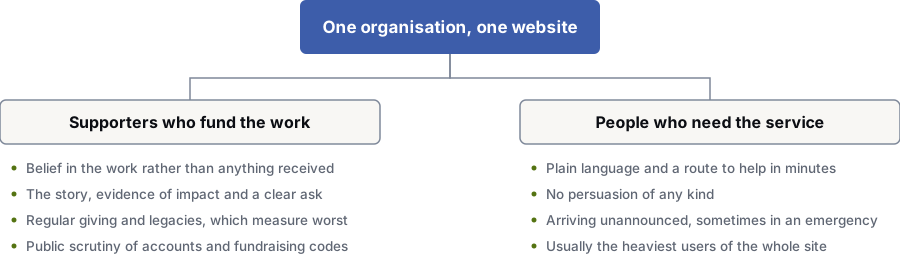
Supporters who fund the work
- Belief in the work rather than anything received
- The story, evidence of impact and a clear ask
- Regular giving and legacies, which measure worst
- Public scrutiny of accounts and fundraising codes
People who need the service
- Plain language and a route to help in minutes
- No persuasion of any kind
- Arriving unannounced, sometimes in an emergency
- Usually the heaviest users of the whole site
Where they split
Where one nonprofits strategy stops working
These differences are the reason the pages below are written separately rather than as one page with the business type swapped out.
- A service-delivery charity and a grant-making foundation barely overlap. One is trying to be found by people who need help while being funded by people who will never use it; the other is trying to be found by applicants and is accountable to a board rather than to a donor base.
- Membership bodies are subscription businesses with a mission attached. Renewal, member value, events and professional development set the economics, and a member deciding whether to pay again is judging what they used rather than what they were told.
- Campaigning organisations exist to change a decision, not to raise a gift. Their audience includes politicians, officials, journalists and the public, and success looks like a policy movement that no income report will ever attribute.
- Local and international causes compete for the same pound on completely different ground. A community organisation wins on proximity and visible results nearby; an international agency has to make distance feel immediate, and both are working around a national name that already owns the obvious search term.
Questions
Nonprofits marketing questions, answered
How do we serve donors and beneficiaries on one website?
By deciding which of them owns the homepage and giving the other an equally direct route, rather than pretending one journey can carry both.
In practice the split is structural: help content written plainly and reachable in a click from anywhere, supporter content that tells the story and makes the ask, and navigation that never forces somebody in difficulty to read an appeal before they find a phone number.
Is the Google Ad Grant worth managing properly?
Yes, and it does need managing, because the account rules will suspend it if it is left alone. It is a large amount of search inventory with real restrictions on how it may bid and what it may promote.
It suits informational demand — questions about a condition, a right, a process — far better than competitive fundraising terms. Keep it reported separately from paid spend, otherwise it makes the blended cost per donation look better than it is.
Trustees want to know the return on digital spend. What should we show them?
Cost per regular giver and the value of a supporter over time, rather than cost per donation in the month. The second number is easy to produce and misleads on nearly every decision it gets used for.
It is also worth showing what did not turn into money: advice pages used, services found, campaign responses answered. That is the mission being delivered, and a board that only ever sees income will keep asking why the help content exists.
We are an association rather than a charity. Does any of this apply?
The two-audience problem does, in a different form. A member joined for one reason and renews for another, and most associations never find out what the second reason was.
The rest is subscription mechanics: knowing which members used what, reaching the ones who have gone quiet before the renewal notice lands, and making the benefit visible during the year rather than in the fortnight it is being paid for.
Should we spend on marketing when donors expect the money to go to the cause?
It is a fair question and it deserves a straight answer rather than a defensive one. Raising money costs money in every channel, including the ones that look free, and an organisation that spends nothing on it usually raises less.
What supporters object to is opacity rather than cost. Explaining plainly what it takes to raise a pound, and what that pound then does, holds up far better than avoiding the subject.
Related
Where to go next
More to explore
Last updated · Published by Zubair Afzal (responsible editor), on owner authorisation