
Increase brand awareness
How to increase brand awareness: build it and prove it worked
To increase brand awareness, first find out whether people don’t know your name, don’t think of you first or don’t choose you. Each needs different work.
Brand basics
ExampleColour
Type
Voice
One line that says what you do and who it is for, used the same way everywhere.
Businesses pick awareness as a goal more often than they need to, because nobody can prove an awareness campaign failed.
A campaign that brings in no enquiries has failed. A campaign meant to make people aware of you has always made somebody aware of you, which is why awareness goals survive budget reviews that clearer goals don’t.
Being known is worth a lot. But the goal hardest to disprove is the one that most needs a measurement plan, written before any money is spent.
Pin down the gap
What "nobody has heard of us" can mean
"Nobody has heard of us" can describe several different situations. Each needs different work and costs a different amount, and budgets often buy the wrong one.
- They don’t recognise the name at all.
- Shown your name next to four others, a buyer in your category can’t place it. This is the cheapest gap to close: being in front of the right audience does most of the job. It’s also worth the least on its own, because recognising a name is a long way from choosing it.
- They recognise the name but never think of it first.
- When prompted, they know you. When the need comes up, three other names come to mind first. This is the expensive gap, and it decides whether you make shortlists. Closing it takes consistency over time and being known for something specific, not general fame or more exposure alone.
- They think of you and still choose someone else.
- That’s not an awareness problem, and no awareness spending will fix it. It’s preference: what you stand for, what you cost, what rivals promise and how risky choosing you feels. Treat it as awareness and you pay to bring more people to the same decision not to buy.
- They’ve heard of you and aren’t sure what you do.
- Your name has got around, but not what it stands for, so buyers never link you to a specific need. More exposure makes this worse, because it spreads a name with no meaning. Decide what you want to be known for before you spend any more.
Four steps, in order
From recognising your name to choosing you
These are four steps, and fewer people reach each one than the step below. Most budgets aim at the bottom step and get judged on the top one. That’s why the reporting argument never quite ends.
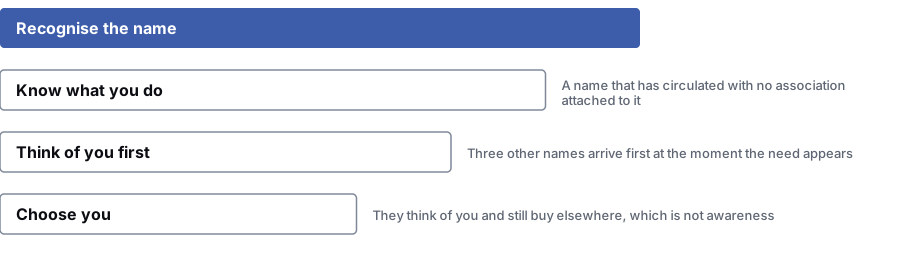
- 1Recognise the name — Shown your name next to four others, a buyer can place it. The cheapest step to change, and worth the least on its own.
- 2Know what you do — More exposure makes this worse, because it spreads a name with no meaning for anyone to remember it by.A name that got around without anything attached to it
- 3Think of you first — The expensive gap, and the one that decides shortlists. It takes consistency over time and a clear reputation, and volume alone won’t do it.Three other names come to mind first when the need appears
- 4Choose you — This is preference: what you stand for, what you cost and how risky you seem. Awareness spending aimed here just reaches the same no faster.They think of you and still buy elsewhere. That’s not awareness
Measurement
How to measure brand awareness, and what each measure misses
Each of these measures answers a different question and has a blind spot. None of them is a score.
| Dimension | What it shows | What it can’t see | How to read it fairly |
|---|---|---|---|
| Brand search volume | That more people are searching for you by name | Whether they liked what they found, or why they searched | As a quarterly trend, with campaign dates marked on it |
| Direct traffic | That people arrive knowing where to go, without searching | A big share of traffic that’s labelled direct but isn’t | Next to brand searches, never on its own |
| Share of search | Your brand searches compared with a set group of competitors | How people feel about you, and any brands you left out | As a direction of travel, with the competitor list shown openly |
| Survey or brand tracking | Whether people recognise you when prompted, and recall you when not, asked directly | What people do, as opposed to what they say they’d do | With the same sample, wording and timing every time |
| Impressions and reach | That the ads you paid for were shown | Whether anyone noticed, understood or remembered them | Only as a check that the campaign ran, never as proof of awareness |
Set this up first
Starting numbers to record before any awareness spend
Capture every item before you start. Starting numbers gathered afterwards don’t count, and without them, whether it worked becomes a matter of opinion.
- Twenty-four months of brand search volume for every spelling and misspelling of your name
- The same period for a named set of competitors, chosen and written down in advance
- Direct and unattributed traffic, with a note on how your analytics labels each
- A dated log of everything else running, so you can explain any spike
- The one thing you want your name linked with, in a single sentence
- A written statement of what would count as failure
- A short question asking where people heard of you, asked the same way every time, even if only to enquirers
- The date and method for each item above, so someone else can repeat it
What works
What gets people to think of you first
People remember you through repetition with a clear meaning. Repetition without meaning gives you a name people have seen and can’t place; meaning without repetition gives you a good idea nobody meets twice. Businesses usually give up on repetition too early, because it takes longer than one campaign.
The methods that work are simple. Show up where your buyers already go, with something worth their time. Get covered by journalists, trade publications and industry voices, because a third party saying your name carries more weight than you saying it. Publish something only you could publish, such as your own data or a clear view. And turn up in the same places, in the same voice, for long enough that people link you with it.
Standing out matters more than volume. In a category where every business says the same three things, nobody remembers anyone, however much they spend. Deciding what you’ll be known for, and what you won’t, makes every later pound of exposure work harder.
There’s also a threshold. Spending below a certain level in a market often gives no result you can detect, because the exposure never builds up enough for anyone to notice. If your budget can’t reach that level in one market, reach it in a narrower one.
How we report
What we will report on brand awareness work, and what we won’t claim
What we commit to
- Recording your starting numbers before any awareness spend, and showing you the full data
- Writing down in advance what would count as failure
- Naming the competitors in any share-of-search figure we give you
- Telling you when your budget is too small for any result to show up
- Keeping what people do separate from what people say, when we have both
What we will never do
- Present impressions or reach as proof that awareness went up
- Quote an awareness percentage without saying how it was worked out
- Promise that more people will recognise, remember or prefer you
- Take credit for a jump in brand searches without checking what else ran
- Recommend awareness spending when the gap is preference or conversion
Questions
Questions about increasing brand awareness
How do you measure brand awareness without a big survey budget?
Start with signals you already have: brand searches in Search Console, direct visits in analytics, and your brand searches compared with a named set of competitors over the same period. All of them move when awareness moves, and all are free.
None is perfect. Brand searches also rise when a campaign runs, when customers look for your login page and when something goes wrong. Read them as a trend over quarters, not month by month, and note what else changed at the time.
What is share of search and is it reliable?
Share of search is your brand search volume as a share of the total for you and a set group of competitors. Because it’s a ratio, it partly cancels out seasonal swings and category-wide changes that would otherwise make your own numbers hard to read.
It’s reliable for direction, not precise figures. Choosing the competitors is a judgement call, brand names that are also ordinary words skew it badly, and it says nothing about whether people like you. Useful, but not a scoreboard.
Is awareness ever the wrong goal?
Often. If people already know you and don’t choose you, that’s a preference problem, and more awareness just makes it more expensive. If you rarely win warm enquiries, awareness sends more people to the same leak.
A useful test: what would change if everyone in your market knew your name tomorrow? If the answer isn’t clearly "more revenue", the problem is somewhere else.
How long does awareness work take to show anything?
Longer than ads aimed at sales, and less predictably. Coverage and campaigns can cause a quick, short spike in brand searches and direct visits. Getting people to think of you without a prompt builds slowly, over quarters and years.
That’s why measurement has to be set up before you start. You can’t create a starting point afterwards, and without one you can’t tell a slow success from an expensive failure.
Do impressions and reach count as awareness?
No. An impression records that an ad was shown, not that anyone noticed it, understood it or linked it to your name. Treating impressions as awareness is the most common way a goal nobody can test gets an official-looking report.
Use impressions to check the campaign ran as bought. Judge awareness on what people do and on asking them directly.
Where to get help
Services that solve this
Digital PR
A digital PR agency that earns coverage in the publications your buyers read, with new data and timely expert comment. We never pay for placements.Content, Digital PR & Authority
A content marketing agency that writes from what only your business knows, so people mention and link to you. We earn coverage with good stories and never buy links.Marketing Analytics & Attribution
Marketing analytics and attribution you can trust, with a written account of where the data is blind and tests for what attribution can’t answer.Original Research & Data Studies
Original research and data studies designed method first, so journalists and AI tools can check and cite them. We publish what the data says, limits included.
Find out whether awareness is what’s holding you back
Bring your brand search history, three competitors and the last pitch you lost. We’ll tell you whether people don’t recognise you, don’t think of you or don’t prefer you, and set up starting numbers that would show if a campaign failed.
Prefer to talk it over? Book a free call
Your BOOSTD score improves within 90 days, or your next month is free. After 6 months, more traffic or leads, or we keep working free (up to 6 free months in any 12 months). Read our guarantee
References
Sources for increase brand awareness
The official documents and research this page is based on. Platform rules change, so check the source before you act on a detail.
Last updated · Published by Zubair Afzal, responsible editor