
Engineering & Architecture marketing
Engineering firm marketing that wins more bids, not just clicks
Engineering and architecture firm marketing that gets you onto more shortlists and frameworks, and wins the small jobs people search for.

Your website
Make your site easy to buy from
- Projects shown as evidence: sector, scale, procurement route, your role, the constraint and the outcome
- A filter that lets a shortlist-builder find three comparable projects without asking anyone
- Registrations, chartered status and the jurisdictions where you can sign or certify work
- Professional indemnity position and any prequalification schemes, frameworks or approved lists you’re on
- Named engineers and architects with their registrations, specialisms and the projects they personally led
- A separate, clearly written small-works section with fees, timescales and what building control will need
- Downloadable capability statements for each sector, current and in line with the bid library
- Image credits and permissions handled properly, since photographers hold copyright and clients hold confidentiality
Common problems
The engineering and architecture marketing traps to avoid
Most engineering and architecture work is awarded from a list drawn up before the job was ever advertised. Someone picks three or four practices they already trust, and procurement confirms it. Practices not on the list never knew there was one.
So marketing here has a narrower job, and a more useful one. Get onto the lists. Make your evidence easy to assess. Make each bid faster to write and closer to the criteria it’s scored against.
- Your portfolio is organised for you, and panels can’t use it.
- Projects appear as photos in date order. Nothing states your role, the scale, the procurement route, the constraint that made the job hard, or the fee band. Someone building a shortlist needs three comparable examples, confirmed in a couple of minutes. If they can’t, they pick the practice whose evidence was clear.
- You hear about the tender after the shortlist is drawn.
- Above a certain size, entry depends on supplier lists, framework places, prequalification schemes, insurance levels and policy documents. Meet these for the first time during a live procurement, and you lose on missing paperwork, whatever your capability. Registering and getting known to the people who build those lists is admin — and it decides eligibility.
- Every bid gets written from scratch by a fee earner.
- A director spends three evenings rewriting the same practice history, quality and safety statements, team biographies and project references. None of it exists in a current, reusable form. The submission costs your most expensive hours and still scores poorly, written at midnight against a deadline with no eye on the scoring rubric.
- The small-works demand is there, and nobody’s capturing it.
- Homeowners, small builders and self-builders search directly and urgently for a structural engineer, calculations for building control, or drawings for a planning application. They instruct within days. These jobs are steady, local and profitable at the right fee, and they fund the practice between larger commissions. Most practices bury them under a corporate portfolio aimed at developers.
- The relationships and references leave with the director.
- Clients appoint a named engineer or architect they’ve worked with before. The project record often lives in that director’s memory and personal contacts. When they leave, you lose the relationship, sometimes the ability to describe the project accurately, and occasionally the reference itself. Keep project data, image permissions and client history as assets the practice owns.
How they choose
Why they pick one business over another
Know how they choose and you know where to show up.
- Comparable experience decides the shortlist before anything else. A client wants projects of similar type, scale, sector and procurement route. Without three of them, you’re filtered out, however capable you are.
- Registration and the right to sign are pass-or-fail questions. Clients check first whether you have people licensed or chartered in the right jurisdiction, and whether they can seal or certify what’s needed. Get it wrong, and the conversation ends.
- Professional indemnity cover and its limit act as commercial gates. Many clients and frameworks set a minimum. Below it, you can’t take the project, whatever its merit. That makes your insurance position a fact worth publishing.
- The named individual matters as much as the practice. Who leads the commission, how much of their time is committed, and whether they stay involved after appointment come up in every scored interview.
- Relationships with the people who assemble teams decide many appointments. For an engineer, that’s often the architect, the main contractor or the developer. Being the practice they add to a bid team without thinking is worth more than any campaign.
- Small-works clients choose on different grounds: how quickly someone answers, whether the fee is clear, how soon a visit can happen, and whether the output satisfies building control. They are price-sensitive, and loyalty is low.
Two markets, one practice
Big commissions come through shortlists. Small jobs come from search.
Large commissions are won through relationships and published timetables, so search volume is a poor guide to them. The small-works half of the market searches constantly.
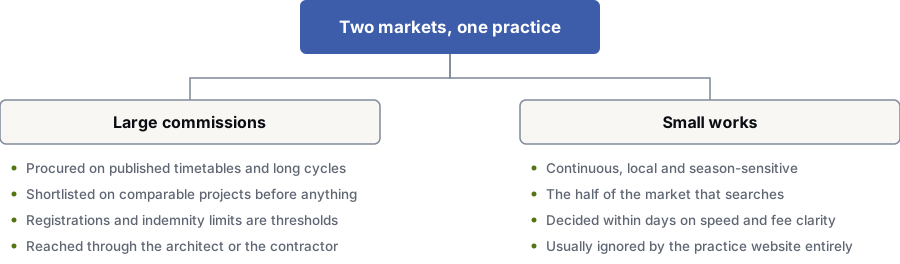
Large commissions
- Procured on published timetables, over long cycles
- Shortlisted on comparable projects first
- Registrations and indemnity limits are pass or fail
- Reached through the architect or the contractor
Small works
- Steady, local and seasonal
- The half of the market that searches
- Decided within days on speed and fee clarity
- Mostly ignored by practice websites
What people search
Searches like “structural engineer for extension”
Small works and domestic clients
The half of the market that searches. Urgent, local, decided within days, and mostly ignored by practice websites.
- structural engineer for extension
- structural calculations for building control
- engineer report for removing a load bearing wall
- architect for a loft conversion cost
- party wall surveyor near me
Specialist capability searches
Made by a contractor, developer or estates team looking for one specific skill, rarely for engineering in general.
- geotechnical investigation consultant
- mep engineer for a data centre project
- structural engineer for a listed building
- civil engineering consultant for highways adoption
- facade access and inspection engineer
Procurement and eligibility
Searched by a practice’s own bid team and by clients setting requirements. It shows what shortlists are filtered on.
- prequalification questionnaire for construction consultants
- how to get on a local authority framework
- professional indemnity limit for engineers
- consultant selection scoring criteria
- construction framework opportunities [region]
Checks after a recommendation
The search that follows an introduction from an architect or contractor. What it shows decides whether the referral survives.
- [practice name] projects
- check engineer registration [jurisdiction]
- [practice name] reviews
- is [practice name] chartered
- [practice name] team
These are example searches from keyword research and public search data. Before we suggest anything, we check how often people search for them in your area.
Where to spend
The website first, then copywriting
In the order we'd put them. Start at the top.
A portfolio built as evidence for shortlists
Projects you can filter by sector, scale, procurement route and your role. Each one says what was difficult and what was delivered, so someone building a shortlist can confirm a match in two minutes. It turns an archive nobody can navigate into the material that decides selection.
A bid library that answers the scoring criteria
Practice history, quality and safety statements, team biographies, method statements and project references, written once, kept current and set out to match how submissions are scored. It saves three evenings of director time per bid, and it lifts the score, because the answers were written to the rubric with time to think.
Win the small-works demand that searches
Homeowners and small builders look locally and urgently for a structural engineer, calculations for building control or drawings for planning, and instruct within days. A well-kept Google profile, reviews and pages written for that enquiry bring steady fee income between larger commissions — with no effect on your standing with bigger clients.
Measuring results
How we measure success
These numbers show if your marketing brings in customers. Website visits alone don't.
- Invitations to tender received, and where each one came from
- Prequalification and framework applications submitted, and the share that pass
- Bids shortlisted, and the win rate at interview
- Places held on panels, frameworks and approved supplier lists, tracked against renewal dates
- Fee value of appointments won, split by sector and procurement route
- Small-works enquiries turned into instructions, and the average fee per instruction
- Repeat commissions from named clients, architects and contractors, so the referral network is visible
- Time spent producing each bid, since it’s a cost measured in director hours
The rules
Before you publish an ad
Some professional titles are protected by law, others by the professional body. Architect is a protected title in the UK. Professional engineer is protected in Canadian provinces and US states. Chartered engineer may only be used by those registered with the Engineering Council. Who holds the registration, and where it’s valid, limits how you can describe work as certified or sealed. Cross-border claims are where practices most often go wrong — a licence in one province, state or country doesn’t let you sign work in another. Marketing that implies it does creates a regulatory problem, not just a wording issue.
Project images carry two separate permissions, and practices often obtain neither. The photographer usually holds copyright and licenses use for set purposes. The client controls disclosure of the project, the brief and sometimes the fact of the appointment. Security-sensitive, residential and commercially confidential projects are often off-limits entirely. Record permission with a scope and a date — never assume it from a friendly email.
In several markets, performance and sustainability claims in the built environment attract active scrutiny under advertising standards. Claims about embodied carbon, energy performance, net zero contribution or cost savings must be substantiated, tied to a defined methodology and approved by the client whose project produced the number.
Public procurement has rules on what can be said while a tender is live, how framework membership can be described, and whether a place on a list can be presented as an appointment. Announcing an award before the client does, or calling framework inclusion a contract, causes serious problems with the buying authority.
Prequalification assessors routinely check claims about professional indemnity, health and safety accreditation and quality certification. State a limit, scheme or certification you don’t currently hold, and you get removed from lists it took years to join. We write with all of this in mind and flag anything that needs confirming, but checking registration, insurance and permission stays with the practice.
Sources
Check the rules at the source
Each rule above, linked to the body that publishes it. Which ones apply depends on where you work. Rules change, so check the latest version.
- Only a registered person may practise or trade under a title containing “architect”, bar named exceptions.
- Architects Act 1997 s 20
- Source: UK legislation — Architects Act 1997, s 20
- Environmental claims must be truthful, accurate, clear and substantiated, among six principles.
- CMA Green Claims Code
- Source: UK Competition and Markets Authority — Green Claims Code
- Environmental marketing claims need a reasonable basis, often competent and reliable scientific evidence.
- FTC Green Guides
- Source: US Federal Trade Commission — Green Guides, 16 CFR Part 260
Questions
What to ask before you pay for engineering and architecture marketing
Can marketing bring in inbound work for a practice like ours?
For small works, yes, reliably. Homeowners and small commercial clients search, compare quickly and instruct within days. A well-built local presence captures that demand.
For large commissions, no — and any agency promising it is describing a different industry. Those are awarded from panels and shortlists put together by people who already know a handful of practices. Marketing can make you eligible, easy to shortlist and better at bidding. That’s a smaller claim, and a true one.
Most of our projects are confidential. What can we publish?
More than most practices assume, though less than they’d like, and your contracts set the limit. Where a client won’t be named, you can often still describe the project by sector, scale, structural or servicing challenge, and your role. That’s exactly what a shortlist-builder needs.
Where nothing at all can be said, use method, technical writing, published detailing and the registrations and specialisms of named people. Check the photographer’s licence separately from the client’s permission — they’re different agreements, and practices often forget the first.
How do we get onto frameworks and approved lists?
Run it as an ongoing programme, not something you wait to need. Track which frameworks and supplier lists serve the sectors you want, and know their refresh dates. Keep prequalification documents and insurance evidence current, and apply before you need the commissions.
The material overlaps almost entirely with the bid library, so building that library pays for itself twice. Most practices lose these on missed deadlines and incomplete paperwork, rarely on capability.
Should small residential work sit beside our commercial portfolio?
Same domain, separate section. A homeowner needing calculations for building control and a developer judging whether you can deliver a mixed-use scheme want different things. One front door makes you look too grand for the first or too small for the second.
A clearly signposted small-works section with fees, timescales and a fast response route works well, and leaves the main portfolio free to do its own job.
How is this different from marketing a management consultancy?
The entry bar is different. A consultancy competes mostly on positioning and published thinking, and in principle anyone who likes the argument can hire it. An engineering or architecture practice must be licensed to sign its drawings, insured to the client’s required limit and backed by comparable finished projects before anyone reads its ideas.
The evidence is physical, too, and needs permission. A consultancy’s proof is anonymised method. Yours is a building, a photo whose copyright someone else owns, and a client who has to agree it can be shown.
Show me what to fix
Start with the free checkup. It shows what to fix first on your website, with no sign-up. Want the full plan for your engineering and architecture business? Book a call, and we'll look at your market, your competitors and the searches that bring in customers.
Prefer to talk it over? Book a free call
Your BOOSTD score improves within 90 days, or your next month is free. After 6 months, more traffic or leads, or we keep working free (up to 6 free months in any 12 months). Read our guarantee
References
Sources for engineering firm marketing
The official documents and research this page is based on. Platform rules change, so check the source before you act on a detail.
Related
More on engineering and architecture marketing
- marketing for startups and scale-ups
- selling to the public sectorMost infrastructure engineering contracts are awarded here.
Guides for engineering and architecture
Other professional services businesses
Last updated · Published by Zubair Afzal, responsible editor