
Recruitment & Staffing marketing
Recruitment agency marketing that reaches both clients and candidates
Recruitment agency marketing that reaches clients and candidates, with separate messages and channels for each. Shift the effort as the job market turns.

Measuring results
The numbers we report
These numbers show if your marketing brings in customers. Website visits alone don't.
- Placements made, split into permanent, contract and temporary
- Gross profit per placement, and total gross profit by source
- Time to fill, from brief accepted to offer accepted
- Shortlist speed: hours from brief to first credible candidate submitted
- New client briefs won, and the share that become repeat clients
- Candidate registrations that are contactable and correctly tagged
- Applications per live job, used as a diagnostic, not a success measure
- Fill rate on roles accepted, and roles turned down because they weren’t winnable
- Source of hire for every placement, so owned channels are kept apart from paid access
Common problems
Common recruitment marketing mistakes
Recruitment is the only sector here with two customers who need completely different marketing. A hiring manager and a software engineer aren’t two segments of one audience; they’re two markets that meet inside your business.
Which one is hard to reach changes with the job market, sometimes within a quarter. A plan that can’t swing between them points the wrong way for about half its life.
- One website is trying to serve two very different audiences.
- A candidate wants to search jobs, see salaries and apply in under a minute. A hiring manager wants proof you can fill a hard role, an idea of your fees and a reason to call. Most agency sites manage neither, usually with a client homepage and a job search bolted on. Build two separate paths from the first click, each with its own navigation, proof and call to action.
- Job aggregators keep the candidate relationship you paid for.
- Jobs get syndicated, applications come through a third party, and you pay again and again to reach candidates you’ve already met. That is a fair trade when chosen, and a slow problem as your whole strategy. The fix is candidate demand you own: job pages that rank, a registration worth completing and a database tagged well enough to fill the next role.
- Reports count applications, and the business runs on placements.
- Applications are easy to increase and barely linked to revenue. A hundred unqualified applicants for a specialist role produce only screening hours. The numbers that matter are placements, time to fill, gross profit per placement and repeat clients.
- The market turned and the plan didn’t.
- When candidates are scarce, the work is attraction, employer stories, fast replies and visibility where passive candidates spend time. When vacancies are scarce, it is winning clients, proving your fill rate and holding margin against agencies cutting fees. Agencies on last year’s plan find out two quarters late, which here is most of a cycle.
- Everything is contingency and nothing is committed.
- Working roles on contingency against two other agencies means most of the effort is unpaid by design, and it rewards speed over judgement. Moving even part of the book to retained or exclusive terms changes the economics. That needs published proof of specialist depth, a clear account of what a retained search gives the client and a brand a hiring manager will commit to.
What people search
Searches like “recruitment agency for engineers”
Client side: looking for an agency
Small volume, high value, and made by someone with a role they can’t fill.
- recruitment agency for engineers
- best staffing agency for warehouse workers [city]
- specialist finance recruitment agency
- agency to hire software developers
- temp agency for hospitality staff near me
Client side: terms and how it works
Research before a first call. Whoever answers these clearly sets the tone for the negotiation.
- recruitment agency fees percentage
- contingency vs retained recruitment
- what is a rebate period in recruitment
- how much do staffing agencies charge per hour
- how to write a job brief for an agency
Candidate side: finding work
High volume and transactional. Aggregators compete hardest here, so job pages have to earn their own visibility.
- warehouse jobs [city]
- part time accounting jobs near me
- remote python developer jobs
- weekend nursing shifts [city]
- graduate marketing jobs [city]
Candidate side: advice and salary
Where you can reach a passive candidate long before they apply. Agencies rarely cover this well.
- average salary for a project manager [city]
- how to answer why are you leaving your job
- is it worth using a recruitment agency
- notice period rules when changing jobs
- cv template for engineering roles
These are example searches from keyword research and public search data. Before we suggest anything, we check how often people search for them in your area.
How they choose
How buyers choose between you and a rival
Know how they choose and you know where to show up.
- A hiring manager under pressure calls the agency that filled their last hard role, or whoever clearly works in that niche. Specialists beat generalists here more decisively than in any other professional service, because the buyer wants proof you already know the people they need.
- Clients test you with a role before they commit. The first brief is usually a trial, often shared with other agencies, and what happens next depends on the quality and speed of your first shortlist.
- Clients check terms closely: fee percentage, rebate or guarantee period, exclusivity and what happens if the candidate leaves. Publishing how your terms work saves that conversation on the first call.
- Candidates value fast replies above almost everything. A consultant who replies the same day, is straight about salary and gives feedback after an interview earns a candidate who comes back and refers others.
- Candidates judge the jobs before the agency. Adverts with no salary or location, or reposted for months, tell an experienced candidate the agency is fishing, and they stop applying to that source.
- Both sides check the individual consultant, not just the agency. A named recruiter who clearly knows a sector is why a passive candidate takes the call and a hiring manager passes on the brief.
Two audiences, one site
One page can’t serve a hiring manager and a candidate
These two come from different searches, in different numbers, and judge different things. Most agency sites are written for the client and leave the candidate side to aggregators.
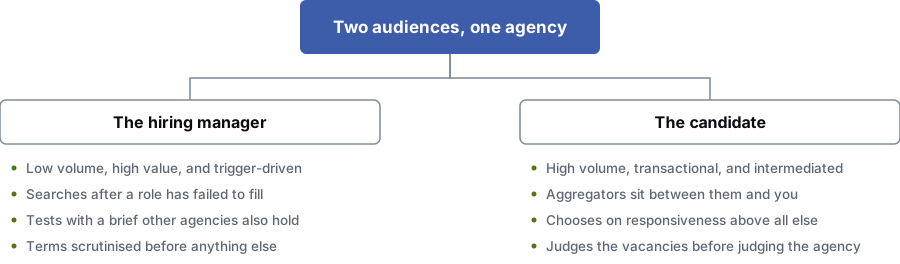
The hiring manager
- Low volume, high value, triggered by events
- Searches after a role has failed to fill
- Tests you with a brief other agencies share
- Checks terms before anything else
The candidate
- High volume, transactional
- Aggregators sit between them and you
- Chooses on fast replies above all else
- Judges the jobs before the agency
Where to spend
Spend on technical SEO first, then B2B search
In the order we'd put them. Start at the top.
Job pages that get indexed, and expire cleanly
An agency site adds and removes hundreds of pages a month, which is a technical problem first. Live roles must be crawled quickly and marked up correctly, expired jobs must not leave dead pages and thin duplicates must stay out of the index. That decides whether your own jobs compete with the aggregators syndicating them.
Client pages built around the niche you fill
Hiring managers search by discipline, sector and city, not for “recruitment services”. Pages naming the roles you fill, the salary picture in that market and the process a client should expect reach a few high-value buyers, and give consultants something credible to send after a cold approach.
A branch profile candidates and clients both check
Candidates search “recruitment agency near me” and check the map listing before they register, and clients look at the same reviews before they brief you. Each office needs a complete profile with the sectors it covers, real opening hours and replies to reviews, including the unhappy candidate who never heard back. It is the cheapest trust signal you have.
Your website
Is your website losing you work?
- Two clearly separate paths from the homepage: one for hiring, one for finding work
- Job search that is fast on a phone, filters by location and discipline, and needs no registration to browse
- Salary shown on jobs wherever the client allows, because candidates filter on it first
- An application that takes under two minutes, with file upload that works on a phone
- Consultant profiles by specialism, with direct contact details and proof of what they fill
- A client page that sets out fee structure, rebate terms and what a retained search involves
- Registration and data handling explained in plain English, including how long a CV is kept
- Sector and salary content that gives passive candidates a reason to visit before they job hunt
The rules
Stay inside the ad rules
Job advertising is regulated in every market this sector works in, and the risk sits in the job copy. Wording that suggests a preference on age, sex, nationality, disability, religion or another protected characteristic can be unlawful even when unintended, and harmless-feeling phrases are the ones most often challenged. Rules differ by country, and both agency and client can be responsible.
Candidate data is personal data in bulk, and some of it is treated as sensitive by law. The rules usually cover what candidates are told at registration, the legal basis for holding a CV, how long it is kept, who can see it, whether it can go to a client without permission and how deletion requests are handled. List building, alerts and re-engagement must be designed within them.
Advertising a job that doesn’t exist to collect CVs is an integrity problem and, in several markets, a regulated one. So is reposting a filled role or advertising one you haven’t been asked to fill. All of these lose the candidates you most want.
Several countries license or register employment agencies, and some now require pay ranges in job ads or limit questions about past salary. These rules change often. We build the site so adding a required field is easy, and flag anything to check with your own advisers.
Client confidentiality applies to briefs as much as placements. Naming a client, describing a hiring programme or publishing figures usually needs written permission, and confidential searches are confidential for reasons the client takes seriously. The agency and its legal advisers confirm what may be published.
Sources
Rules and where to read them
Each rule above, linked to the body that publishes it. Which ones apply depends on where you work. Rules change, so check the latest version.
- Adverts need the hirer’s authority, must name the agency and say if each role is temporary or permanent.
- Conduct Regs 2003 r 27
- Source: UK legislation — Conduct of Employment Agencies and Employment Businesses Regulations 2003, reg 27
- Job adverts may not show a preference for, or discourage, applicants because of a protected characteristic.
- EEOC job adverts
- Source: US Equal Employment Opportunity Commission — Prohibited practices: job advertisements
- People must be told who holds their data, why, on what lawful basis and for how long, when it is collected.
- UK GDPR Art 13
- Source: UK legislation — UK GDPR, Article 13
Questions
Recruitment marketing questions and answers
Should we market to clients or candidates first?
Whichever side is scarce right now, and expect that to change. When candidates are short, attraction and fast replies earn more than winning clients. When vacancies dry up, the reverse is true.
Keep both programmes running at different levels rather than switching one off. Rebuilding a candidate pipeline from zero when the market turns takes far longer than keeping a smaller one going.
Are our job pages worth optimising, or should we just use aggregators?
Use aggregators, but not as your only route. They put a third party between you and the candidate, so you keep paying to reach people you’ve already met.
Job pages that get crawled quickly, carry correct structured data and expire cleanly bring applications you own. They rarely replace paid distribution, but lower the cost of every role after the first.
How do we compete when three agencies get the same brief?
Be first with a credible shortlist. That is usually an operations question more than a marketing one: the fee tends to go to whoever submits the right people first.
Longer term, be in that position less often. Specialist depth, published proof in a niche and a clear case for retained search move a client from three-way contingency to a committed arrangement.
Our consultants won’t post on LinkedIn. Is that a problem?
It is a real cost, though not a fatal one. Candidates and hiring managers respond to a named person who knows a market in a way an agency page can’t match.
If consultants won’t write, they can talk while someone else writes it up for their approval. Inventing a voice for them doesn’t work; their own network notices straight away.
What should we report to the board?
Placements, gross profit and time to fill, split by where the candidate and the client came from. Those numbers justify or end a marketing budget.
Applications, traffic and follower counts belong in the working detail. All of them can rise without a single extra placement.
Get a clear first step
Start with the free checkup. It shows what to fix first on your website, with no sign-up. Want the full plan for your recruitment business? Book a call, and we'll look at your market, your competitors and the searches that bring in customers.
Prefer to talk it over? Book a free call
Your BOOSTD score improves within 90 days, or your next month is free. After 6 months, more traffic or leads, or we keep working free (up to 6 free months in any 12 months). Read our guarantee
References
Sources for recruitment agency marketing
The official documents and research this page is based on. Platform rules change, so check the source before you act on a detail.
Related
More on recruitment marketing
Guides for recruitment
Other professional services businesses
Last updated · Published by Zubair Afzal, responsible editor