
Management & Specialist Consulting marketing
Consulting firm marketing that makes your firm easy to shortlist
Consulting firm marketing that gets your firm on the shortlist before the tender starts, through reputation, published thinking and being easy to justify.

Where to spend
Content and PR first, then B2B search
In the order we'd put them. Start at the top.
Commentary in the places your buyers already read
Trade press, sector conferences and industry newsletters carry more weight with a senior buyer than a company blog, because someone else chose to publish them. Partner quotes, original analysis placed with outlets in your target sector and real data worth citing build the recognition that puts you on a shortlist months later.
Search for checking you out and for narrow problems
Nobody finds a consultancy by searching “consultancy”. But buyers do search your firm and partner by name after a recommendation, and specialists search a specific problem in a specific sector. Covering both at low volume protects the introductions the rest of the programme creates.
Named when a buyer asks AI for a shortlist
Senior buyers increasingly ask an AI assistant which firms specialise in a problem before they ask a peer. The firms named are the ones with clear, specific pages about what they solve, for whom, and with what evidence. Write those pages for one problem each, keep partner biographies factual, and make sure directories and press describe you the same way.
How they choose
How customers decide who to hire
Know how they choose and you know where to show up.
- The shortlist usually exists before any formal process starts. Someone asks a peer, a board member names a firm they used, or an executive remembers something you wrote. The tender that follows often confirms a preference.
- They’re buying a named person as much as a firm. Who leads the engagement, whether they have solved this exact problem before and whether they’ll stay involved after the pitch decide close selections.
- Proof of the same situation beats general excellence. A buyer wants a reference from an organisation of their size, sector and constraints, and will pass over a stronger firm that can’t provide one.
- The decision is about safety as much as ambition. The person choosing takes a personal risk if it fails, so an easy-to-justify choice, a documented process and a reference they can call beat the boldest proposal.
- Above a certain fee, procurement sets the rules: prequalification, framework membership, insurance levels, policy documents and a scored response. Capability is necessary but not enough, and firms are excluded on missing paperwork every week.
- Chemistry decides close contests, though nobody writes it into the criteria. Of two firms that clear the bar, the client picks the one that understood the problem fastest and that they want in the room for six months.
How the shortlist forms
The shortlist exists before any process begins
Few people find a consultancy through search alone, because a senior executive with a serious problem asks their network first. Everything after that is checking.
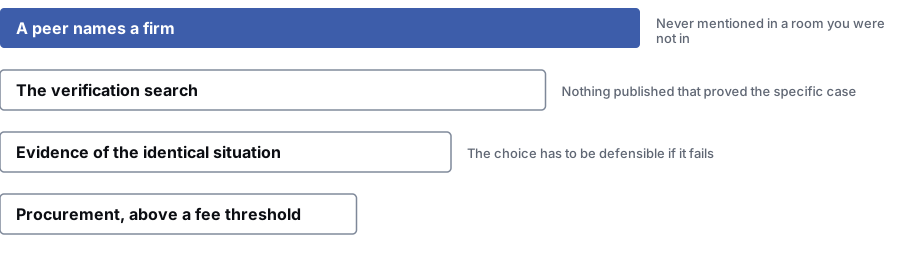
- 1A peer names a firm — The shortlist usually exists before any formal process. Someone asks a peer, or a board member names a firm they have used.Never mentioned in a room you weren’t in
- 2The checking search — The buyer looks up the firm, the named partner and what they have published. What they find decides if the introduction survives.Nothing published that matched their situation
- 3Proof of the same situation — A reference from an organisation of their size and sector, with their constraints. A matching case beats general excellence.The choice has to be defensible if it fails
- 4Procurement, above a certain fee — Prequalification, frameworks, insurance levels and a scored response, run by people who joined late.
Common problems
Consulting marketing problems to fix first
Consulting has the longest, least predictable buying process we cover. An engagement can take two quarters to appear, involve six people who have never bought one and get decided in a meeting you aren’t in.
Marketing can’t create much demand for consulting, but it can decide who gets considered. Being known, specific and easy to justify puts your firm on the list before it exists.
- The website makes claims every competitor also makes.
- Deep sector expertise, senior people on every engagement, practical results instead of a report nobody reads. A buyer comparing four firms sees the same three sentences four times, then picks the name they recognise. Say something a capable competitor would argue with: a defined client type, problems you turn down, a method detailed enough to criticise, or a view not everyone shares.
- You market the firm, and the client hires a person.
- Buyers want to know who will be in the room, and they look that person up before the meeting. An anonymous capability statement and a stock team page answer a question nobody asked. Named consultants with a clear point of view, published work and a checkable specialism do more for your shortlist chances.
- Thought leadership is published and then forgotten.
- A report takes four months, goes behind a form, is announced once and reaches people who already know you. Distribution is the problem, not the writing. Put it in front of a defined list of organisations repeatedly, through the partners who wrote it and the places those buyers read, and give consultants a reason to start a conversation from it.
- Procurement is treated as paperwork at the end.
- Above a certain fee, entry is controlled: a supplier list, a framework, a prequalification questionnaire, an insurance threshold, a policy pack. Firms meeting this for the first time in a live tender lose on completeness, not capability. Getting registered, prequalified and known to the people who build those lists decides whether you can compete at all.
- A nine-month sales cycle is being judged monthly.
- When an engagement takes two or three quarters to close, monthly reports on enquiries cause panic in month three and cancellation in month five, just before the first results. Agree up front which early signs count: coverage of the target list, conversations with named organisations, invitations to speak or bid, and proposals sent.
What people search
Searches like “how to choose a management consultant”
Choosing and evaluating a firm
Informational, made by someone who has decided to hire and now has to run a process.
- how to choose a management consultant
- questions to ask a consulting firm before hiring
- big four vs boutique consultancy
- what does a management consultant actually do
- how to write a consulting rfp
Specialist problem searches
Where a small consultancy can compete. The buyer searches for the problem, never the word consulting.
- supply chain consultant for food manufacturing
- erp implementation advisor for mid-sized manufacturers
- operating model design consultancy
- post merger integration specialist
- sustainability reporting consultant for retailers
Cost, structure and terms
Researched by the person who must get the fee approved, not the sponsor who wants the work done.
- management consultancy day rate
- fixed fee vs time and materials consulting
- how much does a consulting project cost
- consulting statement of work example
- how to measure consulting roi
Named firm and people searches
The checking search. Made after a recommendation, and it decides whether the introduction survives.
- [firm name] reviews
- [partner name] consultant
- [firm name] case studies
- is [firm name] any good
- [firm name] linkedin
These are example searches from keyword research and public search data. Before we suggest anything, we check how often people search for them in your area.
Your website
Is your website losing you work?
- A one-sentence statement of who the firm is for, that a client could repeat accurately
- Named partners with a clear point of view, published writing and a specialism buyers can check
- Pages about the problems you get called in for, alongside your list of capabilities
- How engagements work: what a first phase looks like, how long it runs and how fees are set
- Proof that respects confidentiality, such as anonymised situations, methods and sector context
- Published thinking readable without a form, with gating kept for material that earns it
- A procurement pack buyers can find: insurance, policies, registrations and company details
- A contact route that reaches a partner, not an unattended inbox
Measuring results
How you'll know it's working
These numbers show if your marketing brings in customers. Website visits alone don't.
- Qualified conversations opened with organisations on the target list
- Proposals sent, and the win rate on them
- Average engagement fee, and how it changes as positioning sharpens
- Pipeline value by trigger event as well as by channel
- Coverage of the target list: how many know the firm, and how recently they engaged
- Invitations to tender, to speak or to join a framework
- Repeat and expansion revenue from existing clients as a share of the total
- Time from first real contact to signed statement of work
- Referral and introduction sources recorded, so partner networks show up in the reports
The rules
Claims to avoid
Client confidentiality limits almost every persuasive asset a consultancy would want. Most engagement contracts restrict naming the client, describing the work or publishing results, and many restrict even mentioning the relationship. Get written permission first; often an anonymised account of the situation and method is the only option.
Conflicts of interest are a commercial and contract matter, not only an ethical one. Claiming depth in a sector where you advise competing organisations can cause problems with current clients, so check the sectors you promote against the engagements you’re running.
Claims about results must be ones the client can verify too. Engagement figures usually belong to the client, are often confidential and are often disputed later. Only publish a number the client has approved in writing.
Where a consultancy works close to regulated advice, such as investment, legal, tax, actuarial, safety or audit, the marketing must stay clearly on the right side of the line. Regulated language can imply a permission you don’t hold. The boundaries differ by country and regulator, and the firm and its advisers confirm them.
Public sector and framework work has its own rules: what you may claim about a place on a supplier list, how a tender response may be reused and what you may say while a procurement is live. We write with those limits in mind and flag anything that needs your judgement.
Sources
Where these rules come from
Each rule above, linked to the body that publishes it. Which ones apply depends on where you work. Rules change, so check the latest version.
- An offence to describe yourself as, or act as if, authorised for a regulated financial activity when you are not.
- FSMA 2000 s 24
- Source: UK legislation — Financial Services and Markets Act 2000, s 24
- An offence to pretend to be entitled to carry on a reserved legal activity, or use a title implying it.
- LSA 2007 s 17
- Source: UK legislation — Legal Services Act 2007, s 17
Questions
What people ask about consulting marketing
Nobody searches for what we do. Is search a waste of time for us?
No, though search won’t be your main source of work. It does two jobs. The first is checking: after a recommendation, people search the firm and the partner, and what they find decides whether the introduction survives.
The second is narrow problem searches in your specialism: low in volume and made by exactly the right person. Neither fills a pipeline alone; both support everything else.
How do we sound different when every firm claims the same expertise?
Say something a capable competitor would argue with: the client type you serve, the problems you turn down, your method in enough detail to be criticised, and a view about your sector not everyone shares.
It is uncomfortable because it excludes work. It is also the only reliable way to stop sounding like everyone else, and a clear position makes a referral easy to repeat.
Our partners won’t write. Can this work without them?
Partly, and it will underperform. Credibility in this sector sits with people, and buyers can tell a partner’s argument from a marketing article with a name on it.
The workable compromise: partners talk for an hour and someone else writes it up for their approval. That gets real substance without asking a busy person to draft.
Everything we do is confidential. What can we publish?
More than firms think. The situation, the method, the order of decisions and what went wrong can often be published once the client, figures and identifying details are removed.
An anonymised account of how a problem was diagnosed persuades a technical buyer more than a logo they can’t check. Where the contract rules out even that, sector analysis and your published method send the same signal.
How long before a marketing programme produces an engagement?
Longer than in any other sector we cover. Expect two to four quarters before revenue can fairly be linked to the programme, because the buying process takes most of that time.
You should see early signs much sooner: conversations with named organisations, invitations to speak or bid, and proposals sent. Agree those up front, or the programme gets cancelled just before the first deals land.
Should we respond to every RFP we receive?
No. An unexpected tender from an organisation you’ve never spoken to is often run to meet a rule, with a favourite already in place. Answering takes days of senior time for a low chance of winning.
That effort is better spent getting known to the people who build shortlists before a process starts, and getting onto the frameworks and supplier lists those shortlists come from.
Get your free checkup
Start with the free checkup. It shows what to fix first on your website, with no sign-up. Want the full plan for your consulting business? Book a call, and we'll look at your market, your competitors and the searches that bring in customers.
Prefer to talk it over? Book a free call
Your BOOSTD score improves within 90 days, or your next month is free. After 6 months, more traffic or leads, or we keep working free (up to 6 free months in any 12 months). Read our guarantee
References
Sources for consulting firm marketing
The official documents and research this page is based on. Platform rules change, so check the source before you act on a detail.
Related
More on consulting marketing
- technology and software firms
- building a pipeline from a standing start
- consultancy marketing in the UK
Guides for consulting
Other professional services businesses
Last updated · Published by Zubair Afzal, responsible editor