
AI search
Will AI replace SEO? What AI search changes, and what it needs
Published by Zubair Afzal, responsible editor
First published Updated 8 min readWe check this page every three months. Next check: .
Why AI can’t replace SEO: it depends on the search index
AI can’t replace SEO, because AI assistants read from the same search index that SEO gets you into. People give two confident answers to "will AI replace SEO" because the word covers two different things.
The first is the groundwork: pages that are easy to fetch, easy to read, correct and credible, so a machine can find and use them. The second is the result many clients paid for: someone clicking a blue link and landing on your site.
The groundwork can’t be replaced by the tools said to be replacing it. When an assistant answers a question about today, it looks it up in a search index, fetches the live page, or both, then writes an answer from what it found. SEO exists to put you in that pool of pages.
The click is a different story, and here the "SEO is dead" camp has a point. When a question is fully answered above the results, some people no longer need to click. That hits hardest on the kind of page many SEO programmes were built on.
So the useful question is which parts of your programme were paid for by a click that a machine can now give away free. You can answer that with an audit of your own data, without a forecast.
Which pages are at risk
Which parts of SEO AI puts at risk, and which it doesn’t
Sort your own SEO programme into these two groups before you decide anything about budget. The split is by type of page. It isn’t by industry.
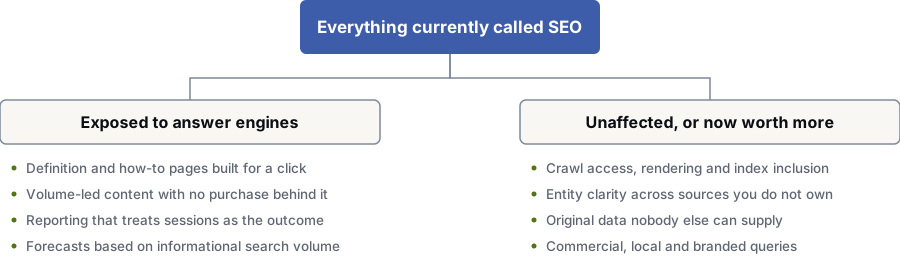
At risk from AI answers
- Definition and how-to pages written to win a click
- High-volume content with no purchase behind it
- Reports that count sessions as the result
- Forecasts built on informational search volume
Unaffected, or now worth more
- Crawl access, page rendering and indexing
- A consistent description of you on other sites
- Original data nobody else can supply
- Commercial, local and branded searches
What would have to be true for AI to replace SEO completely
Each condition below would have to hold, and none does yet.
| Dimension | What would have to be true | Where that stands now |
|---|---|---|
| Assistants stop needing a search index | Answers about news, prices, stock and local businesses would have to come from the model alone, with no look-up step. | They don’t. Assistants that answer about the present fetch or search the web, which is why they cite pages and why blocking their crawlers keeps you out. |
| Being findable stops mattering | A page that is unreachable, slow, or only built in the browser would have to be usable anyway. | The opposite is true. Being picked by an assistant is harder than ranking was, because there is no page two to land on. |
| People stop searching when they are ready to buy | People would have to stop typing supplier names, product models, prices, places and "near me" into a search box. | These searches are worth the most to a business, and a summary helps the searcher least. A summary can’t take a booking. |
| Buying moves inside the assistant | Buying, booking and enquiring would have to happen inside the assistant, off the business’s own website. | Still an open question, and some of it is being built. It would change where the sale happens, but a clearly described business would still matter. |
| Being seen stops affecting brand searches | Being named while people research would have to make no difference to who they contact later. | There is no evidence for that. People draw up a shortlist before the search that ends in a click. |
| Informational clicks were where the value was | Most of the commercial value of organic search would have to come from question-style searches. | Here the sceptics are right about the risk and wrong about the size. These clicks are at risk, but they were rarely where the revenue came from. |
What people mean
Four questions people mean when they ask if SEO is dead
Each has a different answer, and answering the wrong one is why the conversation goes round in circles.
- "Will Google send us less traffic than it does now?"
- Probably, on informational searches, and it may have started already. Check your own data: group your queries by type and your pages by template, then compare impressions with clicks. If they split on questions and hold on product and location searches, you have the common pattern.
- "Should we cut the budget?"
- Cut the part that buys informational visits; keep the part that keeps your site readable and your business described consistently. Businesses often do the reverse: they cancel the dull technical work and keep publishing top-of-funnel articles because a writer is already booked.
- "Will the job still exist in five years?"
- The job has changed its name three times and survived each time. What is going is the version built on ranking reports and monthly session graphs, which no longer describe the result a business gets.
- "Are we being sold a new thing to replace the old thing?"
- Often, yes. Ask what a proposed AI search line item does that your SEO line item doesn’t. If you hear things you already pay for (crawlability, structure, accurate copy, credible authors), you are being charged twice for one job. Some new work exists here, but less than the invoices suggest.
Our view
Our view on AI and SEO, and the claims we avoid
What we say
- Informational content written to win a click is a weaker investment than it was. We will advise you against commissioning more of it.
- Crawl access, a consistent business description and pages for buying searches matter more now than before.
- The risk varies a lot by type of page. You can measure yours from your own Search Console data.
- Some of what is sold as new AI work is SEO work with a different label on the invoice.
What we don’t claim
- That we know what search traffic will look like in three years. Nobody does, including the people publishing charts of it.
- That our own services are somehow unaffected by a change this big.
- That a place in an AI answer can be promised, arranged or bought.
- That doing nothing is safe because the basics never change. Something important is shifting.
More on AI search and SEO
The numbers behind this page, and what to do next.
Questions
Common questions about AI and the future of SEO
Is SEO dead?
No, though one thing people bought under the SEO label is fading: the informational page written to catch a definition search, which might turn one visitor in four hundred into a customer. It is a worse investment now than it was three years ago.
The core of SEO is intact. Your pages need to be easy to fetch and read, correct, the clearest source on their topic, and present for searches where people are ready to buy. Every AI assistant depends on this.
Should we cut our SEO budget?
Cut the part that pays for informational clicks, and move that money to pages closer to a sale. Keep the part that keeps your site readable by search systems and your business described consistently. Every search surface, old and new, needs that.
List your organic landing pages by the revenue they bring in, not by sessions, and see how much of your programme still looks worth paying for. Most programmes have a long tail of pages nobody ever justified in sales terms.
Will people stop visiting websites entirely?
There is no evidence for that. Assistants complete very few purchases; bookings, quotes, demos and checkouts still happen on a website the business controls.
What is changing is why people visit. Fewer visits come from someone who only wants a question answered, so a site that only answered questions is more exposed than one where people also buy, book or enquire.
If we appear in an answer without a click, is that worth anything?
Sometimes. If an answer names you accurately while a buyer is drawing up a shortlist, it affects which companies they look up later. That shows up as branded and direct traffic, which analytics tools don’t credit to the answer.
Being cited in an answer that was never going to produce a customer is worth close to nothing, though it still ends up in reports because it is easy to screenshot.
Do we need a separate AI search retainer?
Usually not. Most of what is sold as AI search is technical and content work that belongs in your SEO programme anyway. Splitting it into two invoices mainly helps the supplier.
A separate scope makes sense when your business is described wrongly on sites you don’t own and those descriptions need correcting. That is different from publishing pages, and often needs different skills.
How would we know if this prediction turns out to be wrong?
Watch the gap between impressions and clicks, not the total. If clicks fall while impressions hold on question-style searches, the shift is affecting you. If searches for your products and your brand start doing the same, this page is wrong and the risk is much wider than described here.
Anyone with Search Console and an afternoon can check it.
References
Sources for will AI replace SEO
The official documents and research this page is based on. Platform rules change, so check the source before you act on a detail.
Related
Keep reading on will AI replace SEO
- AEO, GEO and SEO defined
- technical SEO: getting found and read by search systemsThe part AI makes more important, if anything.
- publishing research nobody else hasHow to become the original source of a fact.
- how we approach AI search
- what an SEO agency does each month
- missing from AI answers, or described wrongly
Start here
Find out which of your pages are at risk
Give us read access to Search Console and we will show you which of your organic landing pages are at risk from AI answers and which aren’t.
Rather check it yourself? Try our free SEO tools