
AI search · 10 min read
ChatGPT SEO and Google SEO: what overlaps, and what does not
Google ranks pages and returns a list you choose from. An assistant composes one answer from sources it may never name. Most of the underlying work is identical. What changes is the unit that competes, the fact that there is no position to report, and whether a click happens at all.
Want to know where your own site stands? Run a free Growth Scan
The distinction
One difference, from which everything else follows
Google hands you a list and tells you where you came. An assistant hands the reader a single composed answer, built from sources it may never name, and there is no position to report back.
Everything people find confusing about this subject comes from that one sentence. A ranked list is observable: you can see it, log it and chart it. A composed answer is not a list at all, so the entire vocabulary of positions, movement and share of voice stops applying.
That does not make the work mysterious. It makes the reporting different. The work is largely what it always was; the honesty required about what you can and cannot know is where most of the difference lives.
The shared ground
Almost all of it is the same work
Assistants that answer questions about the current world do not invent their sources. They fetch them. That means a crawler has to reach your page, parse it and understand what it says, which is exactly the requirement Google has always had. A page blocked in robots.txt, buried behind a script that renders nothing to a fetcher, or served slowly enough to time out is not a candidate for either.
Clear structure matters for the same reason it always did, only more so. Headings that state what a section establishes, one idea per block, definitions near the top, figures attributed to a named source with a date. Systems that extract passages reward text that can be lifted without losing its meaning, and so do readers skimming on a phone.
Factual accuracy carries more weight than it used to, because errors travel further. A wrong figure on your page used to sit there until somebody noticed. Now it can be restated as a summarised claim, attached to your name, in a conversation you will never see and cannot correct. Keeping dates and numbers current stops being housekeeping and becomes reputational work.
Authority still decides who gets used. A model choosing between two pages that say the same thing has to prefer one, and the same signals that made a source credible to a search engine — coverage from places with their own reputation, consistent naming across the web, being the original for a claim rather than the fourth restatement of it — are the ones available to make that choice.
Google says so directly for its own AI features: there are no additional requirements to appear in AI Overviews or AI Mode, and no special optimisation is needed beyond the fundamentals. Pages that appear there are counted in the ordinary Search Console performance report rather than a separate one.
Being the primary source is the strongest position available in both worlds. Original research, first-hand data, a documented method: material nobody else can supply gets used, because there is no alternative to reach for.
Where the two diverge
Six of these rows are the entire practical difference. Everything else in the discipline is shared with ordinary organic search.
| Dimension | Google organic search | An assistant answering a prompt |
|---|---|---|
| What the reader receives | A ranked list of links and features. The reader does the choosing. | A written answer. The reader may accept it without choosing between anything. |
| The unit that competes | The page. A whole address earns a position for a query. | The passage. A few sentences get retrieved and used, and the rest of the page may play no part in that answer. |
| Position | A discrete, observable number for a query at a moment in time. | None exists. There is presence or absence, and it can differ between two runs of the same question. |
| What you can measure | Impressions, clicks, queries and average position, reported by the engine itself. | No first-party report of what an assistant said. Referral visits where a link is shown and followed, and nothing at all where it is not. (Google’s own AI features are the exception: they are counted in Search Console, though not reported separately.) |
| Consistency | Broadly stable between refreshes for the same wording. | Not deterministic. Phrasing, conversation history and model version all move the output. |
| The click | The objective. A result exists in order to be clicked. | Optional and frequently absent. The answer may have settled the question completely. |
| How an error spreads | It sits on your page until somebody fixes it. | It can be repeated as a summarised claim carrying your name, with no link attached to correct. |
| What is in your control | Your pages, structure, speed, authority and the links pointing at you. | Your pages, structure, speed, authority and the links pointing at you. Retrieval and synthesis belong to somebody else. |
| A defensible objective | Compete for the queries that produce customers. | Be the clearest, best-sourced, most current page on a specific claim, and make sure it can be fetched. |
Behaviour
The same intent, expressed two different ways
This is the most useful thing to look at, because it shows the shift without any theory attached. The person wants the same outcome in both columns. The way they express it changes what could possibly be retrieved.
Typed into a search box
Short, keyword-shaped, aimed at getting a list to work through. The searcher expects to do the comparing themselves.
- crm for small business
- best crm uk
- crm pricing comparison
- pipedrive vs hubspot
Asked of an assistant
Longer, conditional, and expecting the comparison work to be done for them. One prompt replaces what used to be four separate searches.
- which crm suits a twelve-person agency that already runs accounting software
- compare the two cheapest crms that handle email sequencing properly
- what usually goes wrong when a small team adopts a crm for the first time
Follow-ups that never reach a search box
These refine an answer already given. Nothing you publish competes for them directly — they are settled by what was retrieved on the first turn.
- is that still accurate this year
- what would you use instead
- summarise the drawbacks briefly
These are examples of how customers in this market search, drawn from keyword research and public search data. They are illustrative, not a volume claim: we size the demand in your area before recommending anything.
Where the competition sits
One conversation, and only the first turn is contested
A prompt replaces what used to be four searches, and the turns that follow it never reach a search box. Whatever was retrieved at the start is what the rest of the conversation gets built from.
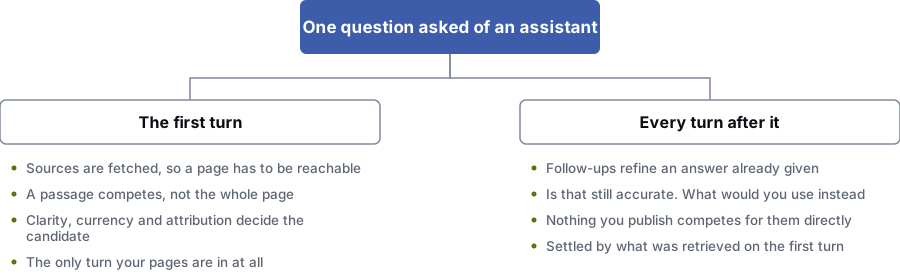
The first turn
- Sources are fetched, so a page has to be reachable
- A passage competes, not the whole page
- Clarity, currency and attribution decide the candidate
- The only turn your pages are in at all
Every turn after it
- Follow-ups refine an answer already given
- Is that still accurate. What would you use instead
- Nothing you publish competes for them directly
- Settled by what was retrieved on the first turn
Measurement
What we will and will not claim about assistant visibility
What we will do
- Run a written, fixed set of prompts on a stated schedule and show you the raw responses rather than a score derived from them.
- Record the date, the assistant and the exact wording every time, because all three change what comes back.
- Report the baseline first: whether the page is reachable, current, correct and clearly attributed to you.
- Tell you when an answer changed and we cannot attribute that change to anything we did.
What we will not do
- Promise a citation, a mention, or any share of the answers an assistant produces. Nobody can commit to that.
- Sell a rank tracker for assistant answers. There is no rank; a panel of sampled prompts is not a position report.
- Present a sampled prompt panel as though it measured your share of a market.
- Write pages designed to be quoted rather than to be correct, which is a short-lived trick and an obvious one.
The definitions, and the work itself
This page is about mechanics. These cover the terminology and the delivery.
Questions
Common questions about assistants and search
Is ChatGPT SEO a real discipline or a rebrand?
Mostly a rebrand, with a small part that is new. The crawlability, structure, accuracy and authority work is the same work you would do for Google, and anyone charging a premium for it under a different name is charging for the name.
The new part is small but real: writing so that a single claim can be lifted cleanly out of a page, keeping facts current because a stale figure gets repeated with your name on it, and accepting that measurement is sampling rather than reporting.
Can I track my ranking inside ChatGPT?
No, because there is no ranking. An assistant does not order sources into positions and publish the list; it composes one answer, and the same question asked twice can produce different sources.
What can be done is to run a fixed set of prompts on a schedule and record what came back, with the date and the wording. That is a sample, and it should be presented as one. A product that renders that sample as a position number is selling a chart, not a measurement.
Should I block AI crawlers?
It depends what you publish and why. If your content is the product and being summarised undermines the sale, blocking is a defensible commercial choice and you should make it deliberately.
If your content exists to bring in customers, blocking removes you from the pool of sources entirely. You cannot be excluded from consideration and hope to appear in the answer, and the vendors publish the user agents so the decision is yours to make either way.
The controls are finer than all or nothing. OpenAI documents separate crawlers: OAI-SearchBot for ChatGPT search and GPTBot for model training, and says each setting is independent, so a site can stay eligible for ChatGPT search answers while opting out of training. It also says sites that block OAI-SearchBot will not be shown in ChatGPT search answers, though they can still appear as navigational links. For Google, AI Overviews and AI Mode are governed by the ordinary Googlebot rules and snippet controls such as nosnippet and max-snippet.
Do I need different content for AI search?
Not different content. Slightly different discipline. Answer the actual question in the first paragraph, keep one claim per section, use headings that state the claim rather than tease it, and attribute figures to a named source with a date.
That is also better for readers, which is the useful test. If a change only makes sense as an attempt to influence a model, it is a tactic with a short shelf life and probably a poor one.
If nobody clicks through, what is the point?
Some of the point is lost, and that should be said plainly. Purely informational pages that existed to catch a definitional query will collect fewer visits over time, and no amount of optimisation reverses that.
What remains is worth having. Assistants are often used at the research stage, where being the source of a correct and well-attributed claim can shape the shortlist that arrives later. And the commercial searches at the end of the process, where someone is ready to book or buy, are still the ones most likely to end in a click.
How is this different from AEO and GEO?
AEO and GEO are the discipline names; this comparison is about the mechanics underneath them. AEO concerns being the extracted answer, GEO concerns being drawn on by a system that generates prose, and both describe the same underlying shift.
If the terminology is what you need sorted out, our definitions page separates the three and marks where they overlap rather than treating each as a distinct product.
If somebody has quoted you for AI search work
Send us the proposal. We will tell you which parts are ordinary organic search under a new label, which parts are different, and whether any of the measurement being promised is possible.
References
Sources
The primary documents and published research this page relies on. Platform rules change, so check the source before acting on a detail.
Last updated