
Accounting & Bookkeeping marketing
Accounting firm marketing that brings in clients who stay for years
Accounting firm marketing that wins clients who stay for years, with enquiries all year round, not just in deadline season.

Common problems
Why accounting ads and SEO fall flat
A client you win this year could still be paying you in eight years. That should shape the whole marketing plan. In most firms it changes nothing.
And almost nobody wakes up wanting a new accountant. People switch because something went wrong, something changed, or someone finally answered a question their current firm never did.
- The whole year happens in eight weeks.
- Enquiries cluster around filing deadlines and then stop. So firms market in a panic in their busiest weeks and go quiet the rest of the year: campaigns run when nobody can answer them, and silence falls when owners are calm enough to change. Targeting off-season events smooths demand.
- Price is the first question because nothing else was answered.
- When your website describes services like every other practice, a prospect can only compare on cost. Publish what a typical engagement includes, who it suits, what falls outside it and what changes the fee. Practices that do this get fewer, much better enquiries, because people after the cheapest option have already left.
- The firm wants advisory work and sells compliance.
- Year-end accounts, tax returns, payroll and bookkeeping get bought because they’re required. Advisory work gets bought because someone is worried, and carries a much better margin. Most practice websites describe only the required work. Give advisory its own page and a clear outcome, or it stays something partners mention now and then.
- Marketing is judged on the first invoice.
- A cost per new client that looks too high against one annual fee looks sensible against seven years of fees, plus payroll and the advisory work that follows. Practices that budget against the first invoice lose every ad auction to firms that did the maths, then decide the channel doesn’t work.
- Nothing on the site eases the fear of switching.
- A business owner thinking of changing isn’t worried about your qualifications. They worry about the handover, their records, something being missed between firms and an awkward talk with someone they’ve used for a decade. A page explaining what changing accountant involves, who contacts whom and how long it takes removes more friction than any service description.
- Bookkeeping is being sold against software and losing.
- At the transaction end, automation and offshore providers have pushed prices down and will keep doing so. The firms keeping their margin have moved up: management reporting, cash flow work, a sector focus, or bookkeeping bundled into an advisory relationship.
How they choose
How the shortlist gets made
Know how they choose and you know where to show up.
- Most searches start with a recommendation. A business owner asks another owner, their bank or their lawyer, then looks the firm up. What they find confirms the recommendation, or a thin, dated website undoes it.
- Qualifications work as a hard filter. Buyers check for a recognised designation and a registered practice before reading anything else, and many know “accountant” isn’t a protected word everywhere.
- Being nearby still matters, despite cloud software. Owner-managed businesses want to know they could sit in a room with the person handling their money.
- Specialism beats general skill. Restaurant groups, contractors, online sellers and dental practices all believe their tax position is unusual, and a firm that names their sector is assumed to have seen the problem before.
- Accounting platforms shape the shortlist. Owners already on a cloud package look for a practice that works in it, and advisor directories inside those platforms bring enquiries where the software question is settled.
- Slow replies are the most common reason people leave a firm, and speed is the easiest thing to prove in advance. A prospect who emails on Tuesday and hears nothing until Friday has learned all they need to know.
When a client is winnable
The busiest search month is the worst month to win anyone
Almost every practice puts its marketing into the deadline peak, when the fewest people are willing to switch. Switching happens in the quiet months after it.
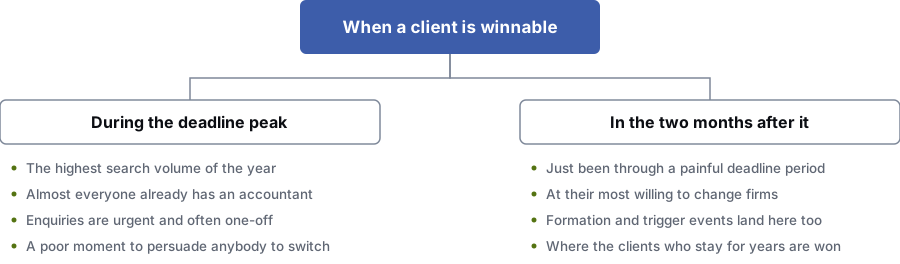
During the deadline peak
- The highest search volume of the year
- Almost everyone already has an accountant
- Enquiries are urgent and often one-off
- A poor moment to persuade anyone to switch
In the two months after it
- Just been through a painful deadline
- Most willing to change firms
- Company formations and other triggers land here
- Where clients who stay for years are won
Where to spend
Why local SEO comes before search content
In the order we'd put them. Start at the top.
Map visibility for the searches that end in a phone call
Many practice searches include a place name or “near me” and are decided in the map results. That means a well-kept Google Business Profile, categories that match the services you want, a steady flow of reviews and area pages that describe the real local area, not one page with the town name swapped.
Answers to the questions people ask before they call
Fees, switching, company formation, deadlines and bookkeeper versus accountant are searched constantly, and forums and software firms answer most of them. Clear answers from you reach buyers weeks before they enquire and give referrers a useful page to share.
Pricing, packages and what the first meeting involves
Most practice websites ask for a commitment before answering any of the visitor’s questions. We look at how packages are shown, whether a fee range appears, how much the form asks and what people are told happens next. This improves enquiry quality more reliably than extra traffic.
What people search
What people type, like “accountant for small business near me”
Looking for a practice now
The core commercial searches. Mostly won in the map results, and phrased as “small business”, not technical terms.
- accountant for small business near me
- accountant for limited company [city]
- bookkeeper near me
- chartered accountant [city]
- accountant for sole trader
- best accountant for contractors
Cost and fee research
Made before contact, and answered by whoever publishes something. Most practices publish nothing and leave it to forums.
- how much does a bookkeeper cost
- accountant fees for small business
- how much does an accountant charge for a tax return
- monthly accounting packages price
- is an accountant worth it for a sole trader
Trigger and problem searches
Someone in trouble or in transition. These convert quickly, and practice websites almost never target them.
- how to change accountants
- my accountant isn’t responding
- accountant for a company that missed a filing deadline
- do i need an accountant to register a company
- accountant to help with a tax investigation
Software and specialism
A buyer who has half decided. They want to know who works this way, in their sector.
- xero accountant near me
- quickbooks certified bookkeeper
- ecommerce accountant for online sellers
- accountant for dentists
- accountant for construction subcontractors
These are example searches from keyword research and public search data. Before we suggest anything, we check how often people search for them in your area.
Your website
What a good site does
- A clear statement of who you serve: business size, sectors and the software you use
- What switching involves, step by step, including professional clearance and how long the handover takes
- Packages that show what is included, what isn’t, and what raises the fee
- Named people with photos, designations and the sectors each one handles
- Advisory services presented as their own offer, not a line at the end of a compliance page
- A reply time for enquiries, in hours or days, that the practice will meet
- Proof of registration and professional body membership, worded exactly as the body allows
- A booking route with a clear description of what the first meeting covers, in place of a bare contact form
Measuring results
Track the leads that pay
These numbers show if your marketing brings in customers. Website visits alone don't.
- Qualified enquiries from businesses in the size and sector range you want
- Engagements won, split between compliance and advisory work
- Average annual fee per new client, compared with the previous group
- Estimated client lifetime value, with cost per new client judged against it
- Client retention and voluntary losses, reported next to new clients every quarter
- Advisory revenue as a share of total fees
- Share of new clients who arrive off-season, outside the deadline weeks
- Referral source recorded at enquiry, so the referrer network is visible
The rules
Stay inside the ad rules
Accountancy bodies set advertising and conduct rules for their members, often restricting testimonials, comparisons, statements about fees and any hint of a guaranteed result. The rules differ by country and body, so what one firm may publish is no guide for a firm elsewhere. The practice and its regulator confirm what applies.
Designations and titles are protected in most markets, so describing the practice wrongly is a regulatory issue, not a matter of style. A professional body member, a registered practice, a licensed practitioner and a bookkeeper are different things. Copy must reflect the credentials you hold today.
Client confidentiality is close to absolute in this sector and rules out most of the persuasive material an agency would normally use. Naming clients, describing an engagement, publishing figures or using a logo needs written permission first, and the detail that makes a case study interesting is often what the client won’t allow.
Anything that reads as tax advice carries duties beyond marketing, especially content about a specific situation, filing position or saving. The safe pattern is a general explanation with a clear invitation to get advice, reviewed before it goes live by someone in the practice qualified to sign it off.
If the firm handles client data across borders, or promotes services where it isn’t registered, data protection and cross-border rules apply on top of the professional ones. We raise anything that looks like a problem; the final judgement stays with the practice.
Sources
Primary sources for these rules
Each rule above, linked to the body that publishes it. Which ones apply depends on where you work. Rules change, so check the latest version.
- Tax practitioners may not make misleading claims; enrolled agents may not describe themselves as “certified”.
- Circular 230 §10.30
- Source: US Treasury — Circular 230, 31 CFR §10.30 (solicitation)
- Advertising tax agent services without being a registered tax agent is a civil penalty breach, with limited exceptions.
- TASA 2009 s 50-10
- Source: Australian Government — Tax Agent Services Act 2009, s 50-10
Questions
Before you hire an accounting marketing agency
Do people find an accountant through search, or is it all referral?
Both, and they work together. Most enquiries start with a recommendation, and nearly all include a search for the firm before contact. Looking invisible or dated then costs work the referral had already won.
There is also demand from people with no recommendation, around company formation, switching, fees and deadlines. It is smaller than a consumer category and converts well, because each searcher has a reason.
Should we publish our fees?
Publish enough for a buyer to see where they fit: full package prices, a starting figure or an explanation of what drives the fee. Any of the three beats saying nothing.
Silence makes price the first question on every call and attracts businesses too small to serve profitably. Practices that publish something usually get fewer enquiries and a much better fit.
How do we get more advisory work instead of compliance?
Start with the clients you already have. They’re the warmest market, and most don’t know the service exists. Advisory needs its own page, a clear outcome and a reason to start that isn’t the year end.
Then tie your marketing to the events that create the need: a sale, a funding round, a bad quarter or a rule change. Nobody searches for “advisory services”. They search for the problem.
Is it worth advertising during deadline season?
Yes for urgent, late and problem searches, because they convert fast. General acquisition campaigns usually aren’t worth it then: your team has no capacity, and the people who will switch aren’t ready yet.
The better time is the two months after the deadline, when business owners have just been through it and are finally willing to change firms.
Our bookkeeping fees keep getting undercut. What can marketing do?
On price, very little. Automation and offshore providers will keep pushing the transaction end down, and competing on cost there is a fight you will slowly lose.
Marketing can change what you sell: reporting and cash flow work in place of data entry, a named sector with specific needs, or bookkeeping inside an advisory relationship where price comparison stops applying.
How much should we be willing to spend to win a client?
Work it out from the whole relationship, not the first invoice. Take the average annual fee, multiply by how long clients usually stay, add the payroll and advisory work that follows, and decide what share you’ll pay to win one.
Most practices budget against one year and are surprised by the answer. Doing this maths first is what makes competitive channels workable.
Want more customers from Google?
Start with the free checkup. It shows what to fix first on your website, with no sign-up. Want the full plan for your accounting business? Book a call, and we'll look at your market, your competitors and the searches that bring in customers.
Prefer to talk it over? Book a free call
Your BOOSTD score improves within 90 days, or your next month is free. After 6 months, more traffic or leads, or we keep working free (up to 6 free months in any 12 months). Read our guarantee
References
Sources for accounting firm marketing
The official documents and research this page is based on. Platform rules change, so check the source before you act on a detail.
Related
More on accounting marketing
Guides for accounting
Other professional services businesses
Last updated · Published by Zubair Afzal, responsible editor