
Fulfilment & 3PL marketing
3PL marketing agency for brands outgrowing their warehouse
3PL marketing that wins ecommerce brands with a clear cost per order, real integration detail and an onboarding plan they can see before they sign.

Your website
Make your site easy to buy from
- A pricing page that explains the structure: receiving, storage, pick, pack, materials, postage, returns and any surcharges
- A page for each integration saying what the connector syncs, in which direction and how often
- Warehouse locations shown with the delivery coverage and transit times each one gives
- Onboarding set out as a dated plan: what you need from the brand, what happens each week, and who does it
- Service commitments stated clearly: order cut-off times, receiving turnaround, pick accuracy and how each is measured
- A description of your returns process, because returns are where most fulfilment relationships break down
- Stated minimums, and a clear description of the brands you are the wrong fit for
- Category limits listed: what you can't store or ship, and which categories need a licence you do or don't hold
Common problems
Fulfilment and 3PL marketing problems to fix first
Most fulfilment enquiries start the same way. A brand that packs its own orders has run out of space, people or weekends, and someone has said it can't go through another peak like this. Good 3PL marketing meets them there.
That buyer isn't shopping for logistics. They want to know if outsourcing will cost more than it saves, whether their store will still work afterwards, and whether they can survive moving stock in October.
- The pricing is a phone call and the buyer wanted a spreadsheet.
- An ecommerce operator models cost per order against their own orders: average units, weight, packaging, shipping zones and return rate. A provider who gives no inputs isn't judged expensive; they are left out of the model. Publish the price structure, its parts and what pushes each up or down, without publishing a rate card.
- Integration is claimed and never described.
- Saying you integrate with a platform tells the buyer nothing. They need to know if stock syncs both ways and how fast, whether tracking goes back to the order, how bundles, kits, subscriptions and pre-orders work, and what happens when they add a marketplace. A page per integration answering that is dull, and it decides deals.
- Onboarding is the real objection and nothing on the site addresses it.
- Moving stock into a stranger's warehouse means a spell when the brand can't ship, a rebuilt integration, new packaging and a stock count that turns up gaps. Another paragraph about accuracy rates doesn't help. A published, dated onboarding plan, a note on which months are bad for moving, and a named person running it win more deals.
- The pipeline is full of brands too small to serve profitably.
- Small brands search hardest, reply fastest and cost as much to sell to as large ones. Without a stated minimum volume, a clear picture of who you serve well and screening questions in the form, sales spends the week on accounts that will never cover their onboarding cost.
- Switching costs are treated as a moat and never mentioned.
- Switching costs cut both ways. They keep prospects with a provider they complain about, and make your own client losses silent: lines move away bit by bit, and the first sign is falling volume. A buyer trapped before asks about exit terms early, so publish notice periods, data handover and stock release. Almost nobody else does.
How they choose
Who decides, and what they look for
Know how they choose and you know where to show up.
- Cost per order is modelled against their own order profile: units per order, product size, packaging, shipping zones, return rate and stock turn. Surcharges that appear later are the fastest way to lose an account you just won.
- Integration with the platform and marketplaces they already use is a hard filter. If the connector can't handle their bundles, subscriptions or marketplace listings, nothing else matters.
- Coverage is judged against where their customers live, on delivery speed and shipping zone costs. That is why splitting stock across two sites is a common need, not an upsell.
- Carrier mix and negotiated rates matter as much as your fees. A brand buys the total cost of getting an order to a customer, so better postage rates can outweigh higher picking charges.
- They want to know who they will talk to when something goes wrong. A named account contact who knows their setup often separates providers who look identical on paper.
- Anyone who has moved before asks about exit terms early: notice periods, stock release, data returned and wind-down costs.
Two windows a year
When brands switch fulfilment provider, and what they check first
Peak trading freezes the market for months, leaving two realistic onboarding windows a year. Miss one and you lose a full trading cycle.
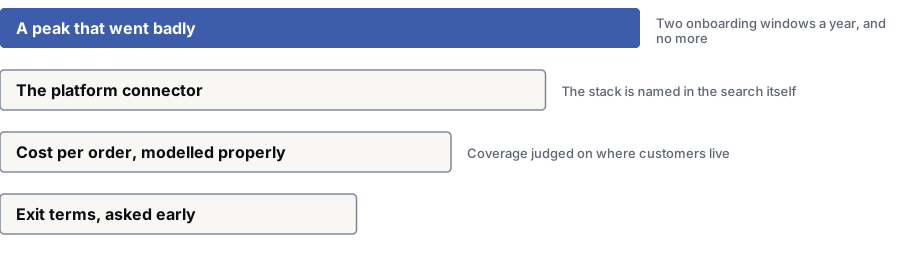
- 1A peak that went badly — Operational, not seasonal: a failed peak, a lease ending, a failure at the current provider, or growth that broke in-house packing.Two onboarding windows a year, and no more
- 2The platform connector — Checked first. If it can't handle their bundles, subscriptions or marketplace orders, nothing else on the page gets read.They name their platform in the search itself
- 3Cost per order, modelled properly — Against their real orders, not a headline rate: units per order, size, packaging, shipping zones and the carriers behind it.Coverage judged on where customers live
- 4Exit terms, asked early — Anyone who has moved before asks first: notice periods, how stock is released, what data comes back and what leaving costs.
What people search
What people type, like “3pl for shopify”
Platform-led searches
The strongest commercial group. Operators name their platform because compatibility is the first thing they check.
- 3pl for shopify
- fulfilment centre with woocommerce integration
- amazon fba prep service uk
- tiktok shop fulfilment partner
- 3pl that integrates with netsuite
Cost and comparison searches
Made while building the spreadsheet. Mostly answered by competitors and directories, so worth answering properly.
- 3pl pricing per order explained
- fba versus 3pl cost comparison
- pick and pack cost per order uk
- how much does ecommerce fulfilment cost
Geography and delivery speed
Sparked by a delivery promise the brand wants to make. This is where location pages earn their place.
- fulfilment centre near manchester
- 3pl with east and west coast warehouses
- canadian fulfilment for us brands
- eu fulfilment centre for uk sellers
Category and constraint searches
A brand with a product most providers can't handle. Few searches, very high conversion and almost no competition.
- supplement fulfilment 3pl with lot tracking
- temperature controlled ecommerce fulfilment
- fulfilment for subscription boxes
- hazmat compliant fulfilment centre
- fragile and oversized item fulfilment
These are example searches from keyword research and public search data. Before we suggest anything, we check how often people search for them in your area.
Where to spend
B2B search first, then search content
In the order we'd put them. Start at the top.
Pages for each platform, product category and region
Ecommerce operators search by the platform they use, the products they sell and where they need coverage, which covers almost every commercial search for a fulfilment provider. Proper pages for the combinations you serve well beat a single services page.
Cost content that screens buyers for you
Explain what fulfilment costs, how a rate card works, how it compares with in-house or a marketplace programme, and where hidden charges sit. Brands search all of this while building their comparison, and the provider who explains the maths tends to be trusted to quote.
A site that answers integration and onboarding questions in detail
Integration pages with real technical detail, a published onboarding timeline, coverage maps, service commitments and stated limits. The buyer's hard questions are predictable, and every one answered before the first call shortens the sales cycle.
Measuring results
Results you can check
These numbers show if your marketing brings in customers. Website visits alone don't.
- Enquiries from brands in your target order volume band, counted apart from total enquiries
- Orders shipped per client, and total orders shipped for clients won in the period
- Cost per qualified enquiry against average client lifetime value, not first-month revenue
- Onboarding time from signature to first order shipped
- Clients kept at twelve months, and revenue kept as existing clients grow
- Integration type recorded on won and lost deals, so gaps in platform coverage show up
- Proposal to signature rate, with a reason recorded for every loss
- Enquiries turned away at intake for missing your minimums or being in restricted categories
The rules
Rules that shape your marketing
Service level claims are advertising claims, tested against the contract. Same-day dispatch cut-offs, pick accuracy, receiving turnaround and delivery times must be measured, current and defined, and accuracy per line is a different number from accuracy per order. A figure published once and never checked becomes misleading as soon as operations change.
Restricted and regulated products bring licensing and storage duties that differ by jurisdiction. Alcohol, supplements, cosmetics, medical devices, batteries, aerosols, hazardous goods, food and age-restricted items each have their own rules, and advertising a capability you aren't licensed or approved for is a compliance problem first.
Cross-border claims need care. Duty, import VAT, customs clearance and country-of-origin rules change with trade policy, and phrases like "duty-free delivery" or "guaranteed customs clearance" can commit you to outcomes you don't control. Describe the service and paperwork you handle, not what happens at the border.
You process personal data for your clients: customer names, addresses, contact details and sometimes revealing order contents. Data processing terms, sub-processor disclosure, retention and storage location are duties under the privacy laws covering your clients and their customers, and differ by market. Marketing must describe data handling exactly as the agreement does.
Contract terms can set you apart, but must be accurate. Minimum terms, notice periods, post-termination storage charges and any lien over client stock are legally binding, so publish them only if the published version matches the contract.
Sources
Go to the source
Each rule above, linked to the body that publishes it. Which ones apply depends on where you work. Rules change, so check the latest version.
- Requires UK businesses storing imported goods for sellers established outside the UK to register with HMRC.
- Fulfilment House scheme
- Source: UK: HM Revenue & Customs, Fulfilment House Due Diligence Scheme
- Sets what a contract between a controller and a processor must cover, including sub-processors.
- UK GDPR Article 28
- Source: UK: UK GDPR Article 28 (legislation.gov.uk)
Questions
Common questions about fulfilment and 3PL marketing
Should a 3PL publish its pricing?
Publish the structure, even if you hold back the numbers. List the parts (receiving, storage, pick, pack, materials, postage, returns and surcharges) and what drives each. That lets a brand build its model with you in it, which decides the shortlist.
The fear of helping competitors is weaker than it sounds; they can get your rate card from any prospect. A buyer who can't model your costs just models someone else.
Our best prospects are already with another provider. How do we reach them?
Be visible before the trigger. A switch follows an operational event — a bad peak, a lease ending, a service failure, a growth step — and the brand then contacts the two or three providers it already has an impression of.
Keep a steady, low-cost presence: cost and comparison content, coverage of platform and category searches, and enough visibility with operations leads that they remember you when the packing bench stops coping.
Should we tell brands the truth about onboarding during peak season?
Completely, because the alternative is a migration that fails in public. Tell a brand that starting mid-October is a bad idea and offer a January or February slot.
It also wins deals. A nervous brand hears a provider turning down a risky timeline as one that understands the job, and usually comes back on the suggested date.
How do we stop attracting brands too small to serve profitably?
State a minimum and describe the brands you serve well, publicly, at the start of the enquiry path. Monthly order volume, order complexity and the categories you handle do most of the filtering.
Add screening questions to the form: order volume, platform, number of SKUs, category and current setup. You lose the right enquiries, and sales gets conversations that can turn into clients.
Is naming the platforms we integrate with worth the effort?
Yes. It is some of the best-returning content in this sector, because "platform name plus fulfilment" is how people search, and a page per integration ranks for combinations competitors only cover generally.
The page has to be specific: what syncs, in which direction, how often, how bundles and subscriptions work, and what isn't supported. A row of logos answers none of that.
Is our warehouse location a marketing asset?
Yes, when described as delivery coverage, not an address. A brand cares what share of its customers you can reach next day and what the shipping zones cost from there.
Framed that way, coverage maps, transit times, carrier options and the case for splitting stock across two sites are content a brand uses in its own planning.
Want more customers from Google?
Start with the free checkup. It shows what to fix first on your website, with no sign-up. Want the full plan for your fulfilment and 3PL business? Book a call, and we'll look at your market, your competitors and the searches that bring in customers.
Prefer to talk it over? Book a free call
Your BOOSTD score improves within 90 days, or your next month is free. After 6 months, more traffic or leads, or we keep working free (up to 6 free months in any 12 months). Read our guarantee
References
Sources for 3PL marketing agency
The official documents and research this page is based on. Platform rules change, so check the source before you act on a detail.
Related
More on fulfilment and 3PL marketing
- the retail and ecommerce brands you sell to
- letting the enquiry form qualify
- freight and carrier marketing
Guides for fulfilment and 3PL
Other logistics businesses
Last updated · Published by Zubair Afzal, responsible editor