
Transportation & Logistics
Marketing for freight, fleet and fulfilment operators
Capacity is the product and it expires nightly. Buyers in this sector run long formal tenders and then call at four hours’ notice when a load has to move, and they are comparing coverage and reliability far more closely than they are comparing a rate.
Prefer to talk it through? Book a strategy call
The category
Transportation & Logistics: what the businesses have in common
Logistics is the only sector we write for where the product disappears if nobody buys it today. The vehicle leaves at the scheduled time whether it is full or not, and the empty space is not inventory that can be sold next week.
That fact drives most of what follows. Marketing here earns its place by filling specific capacity in specific places, which is why these pages talk about lanes, tenders and cut-off times rather than about awareness.
Owning capacity or finding it
A carrier and a broker share a label and invert the business
Both sell space on a vehicle leaving at a fixed time. One has already paid for that vehicle and has to fill it. The other owns nothing and sells the ability to find capacity faster than the shipper can.
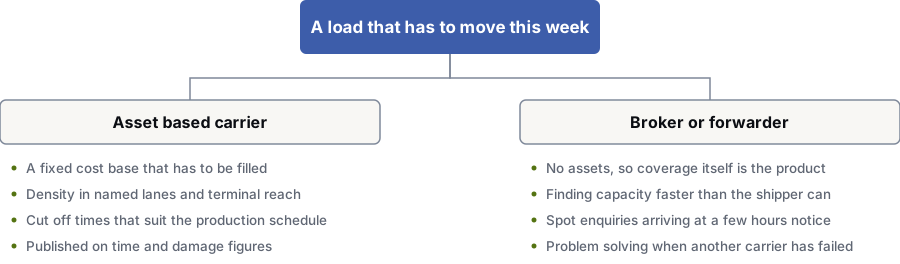
Asset based carrier
- A fixed cost base that has to be filled
- Density in named lanes and terminal reach
- Cut off times that suit the production schedule
- Published on time and damage figures
Broker or forwarder
- No assets, so coverage itself is the product
- Finding capacity faster than the shipper can
- Spot enquiries arriving at a few hours notice
- Problem solving when another carrier has failed
Where they split
Where one logistics strategy stops working
These differences are the reason the pages below are written separately rather than as one page with the business type swapped out.
- An asset-based carrier and a broker are opposite businesses wearing the same label. The carrier has a fixed cost base and must fill vehicles it already owns; the broker owns nothing and sells coverage, problem-solving and access to capacity it can find faster than the shipper can.
- Consumer moving and commercial freight share a vehicle and very little else. A household move is a once-a-decade emotional purchase settled on reviews and a quote within a day; a haulage contract is a procurement exercise with a submission deadline and a scoring matrix.
- Ecommerce fulfilment is bought the way software is bought. The customer is a merchant comparing integrations, pick accuracy, storage pricing and migration effort, and the evaluation looks far more like a technology purchase than a transport one.
- Specialist freight narrows the market to a short list. Temperature-controlled, hazardous, oversized and pharmaceutical work carries licensing, equipment and audit requirements most operators cannot meet, so the job shifts from reach to being findable by the few shippers who need exactly that.
Questions
Logistics marketing questions, answered
Freight is a commodity. Does marketing change anything?
It changes who gets asked to quote, which is the only decision marketing can influence in a rate-driven market. Buyers do not compare every operator; they compare the three or four they already believe can cover the route.
Getting into that consideration set is a coverage and credibility problem rather than a price one. Operators who publish where they run, what they handle and how they perform get invited to more of the quotes they would win.
How do we market when we are not allowed to publish rates?
Publish everything that surrounds the rate. Lanes covered, daily frequencies, terminal locations, equipment types, cut-off times, temperature ranges, licences held and how quickly a quote comes back are all more useful to a buyer than a number that would be wrong by the time they read it.
That material also filters the enquiries. A shipper who can see you do not serve their corridor stops calling, and the calls that remain are from people you can help.
Most of our revenue comes through tenders. What can marketing do about that?
Two things, both of which happen before the tender document exists. The first is being on the pre-qualification and approved carrier lists at all, which is an eligibility exercise involving accreditations, insurance levels and financial standing rather than persuasion.
The second is being a familiar name to the procurement and supply chain people writing the specification. A submission from an operator the buyer has read something useful from scores differently from an identical submission from a stranger.
Should we market backhaul capacity separately from contracted work?
Usually yes, because it is a different product sold to a different buyer under different conditions. Contracted volume is negotiated months ahead; a return-leg slot is sold this afternoon to whoever answers first.
The mechanics differ accordingly. Backhaul benefits from being findable by lane and by date, from an enquiry route that does not involve a form and a two-day wait, and from being visible on the exchanges and networks the freight moves through.
Everyone in our sector says the same things about reliability. What actually separates us?
Numbers and geography. Reliability described in adjectives is background noise; reliability expressed as an on-time percentage over a stated period, a claims rate, and a named lane you run four times a day is a competitive statement nobody can copy without the operation behind it.
The uncomfortable part is that it requires publishing figures that are not always flattering. Operators who do it anyway tend to find that buyers trust an honest ninety-four per cent far more than a vague promise of excellence.
More to explore
Last updated · Published by Zubair Afzal (responsible editor), on owner authorisation