
Information, Media & Digital
Marketing for publishers, broadcasters and digital media
Media businesses sell attention to advertisers and access to audiences, which means running two marketing operations at once. Distribution is rented from platforms that change without warning, and a direct relationship with the audience is the only asset nobody can withdraw.
Prefer to talk it through? Book a strategy call
The category
Information, Media & Digital: what the businesses have in common
Media is the sector where the commercial model is hardest to see from outside. The thing being made is consumed for free by most of the people who value it and paid for by somebody else entirely, which turns nearly every marketing question into a question about which side you are selling to.
It is also the sector most exposed to what is currently happening in search. When an answer arrives without a visit, a business built on visits has a structural problem rather than a campaign problem, and these pages start from that rather than working around it.
From reached to owned
Where a media business sits between reach and a direct relationship
Attention is rented at the top and owned at the bottom, and this sector divides on how much of it survives the drop. That is also what decides whether the money arrives from advertisers or from the audience.
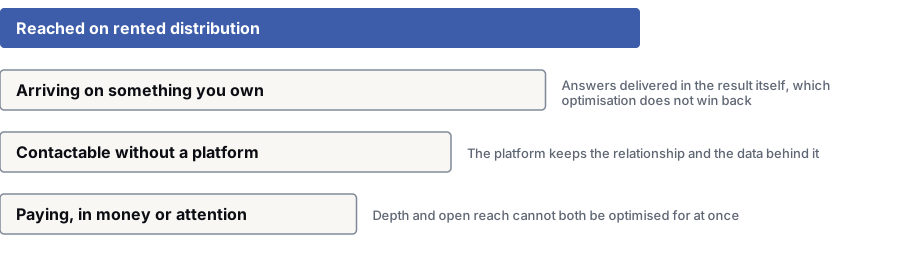
- 1Reached on rented distribution — Search, social, app stores and recommendation feeds supply most of the audience and set the terms.
- 2Arriving on something you own — The visit is where advertising, subscription and affiliate revenue all become possible at all.Answers delivered in the result itself, which optimisation does not win back
- 3Contactable without a platform — Email, apps, podcast subscribers and memberships are the audience the business owns.The platform keeps the relationship and the data behind it
- 4Paying, in money or attention — One side pays with a subscription and the other with attention sold on, and the two pull against each other.Depth and open reach cannot both be optimised for at once
Where they split
Where one media strategy stops working
These differences are the reason the pages below are written separately rather than as one page with the business type swapped out.
- Subscription and advertising models optimise against each other. One rewards depth, loyalty and a paywall that frustrates casual readers; the other rewards reach and open access, and a publisher chasing both usually finds each choice quietly undermining the other.
- Trade and consumer publishing sell entirely different scarcity. A niche B2B title with twelve thousand qualified readers can charge more per impression than a consumer site with two million, because the advertiser is buying access to a job title rather than to a crowd.
- Audio, video and text have different discovery mechanics. Podcasts are found inside closed apps with almost no search surface, video discovery lives inside one recommendation system, and text is fully exposed to the search shifts affecting the sector, so a single content plan misreads at least two of the three.
- Owned and creator-led media differ on where the trust sits. When an audience follows a named person, the asset can walk out; when it follows a title, the business keeps it but has to work harder to feel human, and the succession risk in each case is completely different.
Questions
Media marketing questions, answered
AI answers are taking our traffic. Is search still worth investing in?
Yes, but not in the same material. The pages losing most are the ones that existed to deliver a fact somebody can now read in the result itself, and rewriting them will not return that traffic because the visit is no longer necessary.
What holds up is work that cannot be summarised without loss: original reporting, primary data, a specific voice, and coverage nobody else has. That is also the material most likely to be cited when an answer is generated, which is a different objective from ranking and should be measured differently.
Should we be growing subscriptions or advertising revenue?
They pull in opposite directions, so the straight answer is to choose a primary and treat the other as secondary. Subscription rewards depth, loyalty and a paywall that frustrates casual readers; advertising rewards reach and open access.
Publishers who try to maximise both usually find each weakening the other: the paywall suppresses the impressions, and the advertising load suppresses the conversions. Picking one and being deliberate about the trade-off outperforms drifting between them.
How do we sell to advertisers when our traffic numbers are falling?
By selling something other than volume. An advertiser buying a niche trade title is not buying a crowd, they are buying access to people with a specific job and a budget, and that access has not become less valuable because a search engine sends fewer casual readers.
That requires knowing your audience in detail and being able to evidence it: roles, sectors, seniority, purchasing responsibility, and how engaged they are. Publishers who can describe that command prices that pageview counts never would.
Is an email list really worth more than search traffic?
Per person, usually yes, and the gap has widened. A subscriber can be reached tomorrow without permission from an intermediary, converts to paid at far higher rates, and does not disappear when a ranking or a feed changes.
It is not a replacement for reach, though. Search and social still do the discovery; the point of the list is that discovery becomes an asset you keep rather than a visit you rented once.
Will commercial marketing compromise our editorial independence?
It does when the boundary is left undefined, and it does not when the boundary is written down. The failures are predictable: sponsors influencing coverage, affiliate links inserted into reporting, and sponsored material that looks like editorial without disclosure.
The workable arrangement separates the two explicitly — who commissions what, what gets labelled, what advertisers may and may not see in advance — and treats that separation as part of what is being sold. Trust is the inventory in this business, and it is destroyed by exactly the shortcuts that raise revenue this quarter.
Where to start
Where media marketing starts
This sector is covered on this page rather than split into separate industry pages. These are the services that apply, and the neighbouring sectors that sell to the same buyers.
Services that do the work
Sectors that share these buyers
More to explore
Last updated · Published by Zubair Afzal (responsible editor), on owner authorisation